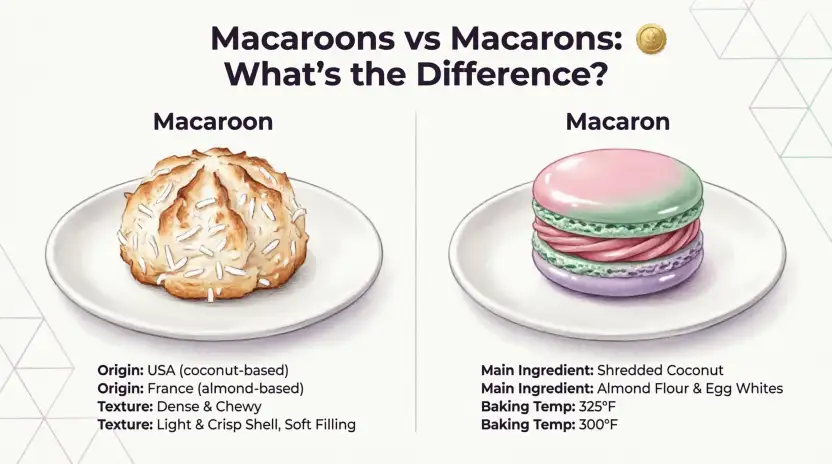
If you are wondering if the correct word is macaroons or macarons, both are correct, but they usually refer to different desserts. Macarons are delicate French-style sandwich cookies made with almond flour, egg whites, and sugar, while macaroons are usually dense cookies made with shredded coconut or almonds.
The confusion is easy to understand. The two words look almost the same, sound similar, and both describe sweet baked treats. They also share a long history connected to almond-based confections.
Today, however, the terms often describe two very different cookies. A colorful sandwich cookie with a smooth shell and creamy filling is usually a macaron. A rough, chewy coconut cookie is usually a macaroon.
This guide explains the difference between macaroons and macarons, their meanings, origins, pronunciation, regional usage, and common mistakes. You will also see practical examples to help you choose the right word in everyday, academic, business, and food-related writing.
Macaroons or Macarons: Quick Answer
The short answer is simple:
- Macaron = a smooth, round sandwich cookie with two shells and a filling.
- Macaroon = usually a chewy cookie made with coconut or almonds.
- Macaron is strongly associated with French-style pastry.
- Macaroon is common for coconut-based cookies.
- Both words are real English words.
- The two terms are historically related, which helps explain their similar spelling.
For example:
I bought six colorful macarons from the French bakery.
My grandmother makes coconut macaroons every Christmas.
The easiest memory trick is:
Macaron = sandwich cookie.
Macaroon = coconut cookie.
This is a useful rule, but it is not absolute. Some dictionaries use macaroon as a broader term and may include the French-style cookie as one meaning.
What Does Macaroons or Macarons Mean?
What Is a Macaron?
A macaron is a small, round pastry made from ingredients such as egg whites, sugar, and finely ground almonds.
It normally has:
- Two smooth, rounded shells
- An almond-based exterior
- A soft or crisp outer texture
- A filling in the center
- Different colors and flavors
Common macaron flavors include:
- Chocolate
- Vanilla
- Raspberry
- Pistachio
- Lemon
- Coffee
- Salted caramel
A macaron is often associated with French pastry shops and elegant desserts.
What Is a Macaroon?
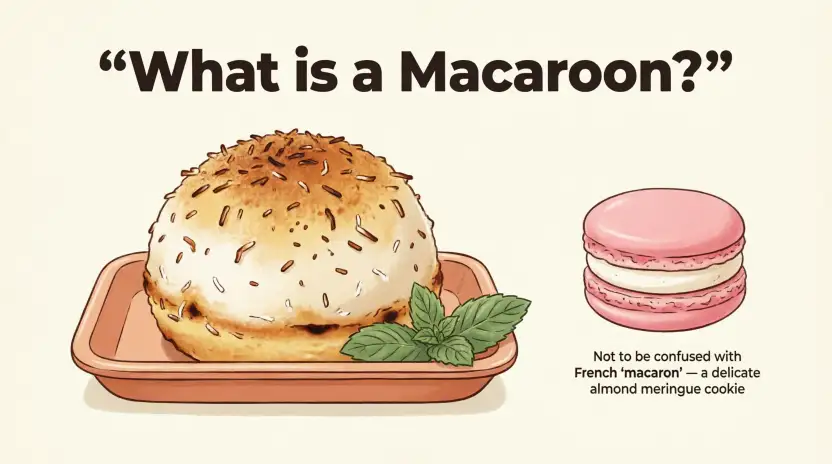
A macaroon is usually a small cookie with a rougher texture.
Modern macaroons are often made with:
- Shredded coconut
- Egg whites
- Sugar
- Almonds in some recipes
Coconut macaroons are especially common in English-language baking.
They are often chewy inside and lightly browned on the outside.
Why Are They So Easy to Confuse?
The words have a shared history. Both are connected to older almond-based sweets.
Over time, different recipes and baking traditions developed. The words also took on different meanings in modern English.
That is why macaron vs macaroon is not simply a spelling question. It is mainly a question of which type of dessert you mean.
The Origin of Macaroons and Macarons
The history of these words is more complicated than the modern difference suggests.
Both macaron and macaroon are related to older words connected with almond-based pastries. The French macaron became associated with the refined, sandwich-style pastry that many people recognize today.
The modern macaron has a distinctive structure. It uses two delicate shells with a filling between them.
The word macaroon, meanwhile, developed in English as a term for almond-based cookies and later became strongly associated with coconut macaroons in many English-speaking settings.
This historical connection explains why the words look so similar.
It is also important not to assume that every historical version looked exactly like the modern French macaron or today’s coconut macaroon. Recipes and names changed over time.
So, when you see the two words today, think of them as related names that developed into different modern food terms.
British English vs American English
The difference between macaron and macaroon is not simply a British-versus-American spelling rule.
Both terms can appear in English-speaking countries. The main difference is usually the dessert being described.
| Term | British English | American English | Example |
| Macaron | Used for the French-style sandwich pastry | Commonly used for the French-style sandwich cookie | “She ordered pistachio macarons.” |
| Macaroon | Used for certain almond or coconut cookies | Very commonly associated with coconut cookies | “He baked coconut macaroons.” |
| Macaroons | May sometimes be used more broadly | Usually suggests coconut or almond cookies | “The bakery sells chocolate macaroons.” |
In modern food writing, macaron is the clearest choice when you mean the colorful French-style sandwich pastry.
Use macaroon when you mean a traditional chewy cookie, especially one made with coconut.
There can still be overlap. Some dictionaries recognize macaroon as a broader term that can include a macaron.
Which Version Should You Use?
United States
For American readers, use macaron for the French-style sandwich cookie.
Use macaroon for the familiar coconut cookie.
Example:
The bakery sells French macarons and coconut macaroons.
United Kingdom
British readers will understand both terms. Use macaron when referring specifically to the French-style pastry.
For a coconut or almond cookie, macaroon is generally clearer.
Canada
Canadian English uses both terms. In food writing, the same practical distinction works well:
- French sandwich pastry = macaron
- Coconut or traditional cookie = macaroon
Australia
Australian readers are familiar with both words. Choose the word that matches the actual dessert.
If the dessert has two smooth shells and a filling, macaron is usually the clearer choice.
International Writing
For an international audience, clarity matters more than regional preference.
If needed, describe the dessert the first time:
French macarons, the colorful almond sandwich cookies, were served after dinner.
Or:
Coconut macaroons were placed on the dessert table.
Academic Writing
Use the most specific term available.
If you are discussing French pastry, use macaron.
If you are discussing coconut-based cookies, use macaroon.
Avoid changing between the two terms unless the meaning also changes.
Business Writing
Restaurants, bakeries, menus, product descriptions, and food businesses should use the term that accurately describes the product.
A bakery selling almond sandwich cookies should generally list them as macarons, while a coconut cookie should be listed as a macaroon.
Clear naming helps customers understand what they are buying.
Common Mistakes
Mistake 1: Calling Every Round Cookie a Macaron
Incorrect:
I made coconut macarons for the party.
Better:
I made coconut macaroons for the party.
Explanation:
If the cookies are traditional coconut cookies, macaroons is usually the more precise term.
Memory tip:
Think macaron = filled sandwich.
Mistake 2: Calling French Sandwich Cookies Macaroons
Less precise:
The bakery sells beautiful French macaroons.
Clearer:
The bakery sells beautiful French macarons.
Explanation:
The word macaron clearly identifies the smooth, filled French-style pastry.
Memory tip:
Two smooth shells + filling = macaron.
Mistake 3: Treating Macaron as a Spelling Error
Incorrect idea:
“Macaron” is just a misspelling of “macaroon.”
Correct understanding:
Macaron and macaroon are both established words.
Explanation:
They are related words, but modern English commonly uses them for different types of desserts.
Mistake 4: Assuming One Word Is Always Correct
The context matters.
A coconut cookie is not normally described as a macaron simply because both desserts contain sugar and egg whites.
Likewise, calling a French sandwich pastry a macaroon can create confusion.
Everyday Examples
1. Emails
Hi Sarah,
I ordered macarons for the office celebration. They will arrive this afternoon.
Here, macarons refers to the filled French-style pastries.
2. Business Writing
Our bakery now offers pistachio, vanilla, and raspberry macarons.
This wording is clear for a bakery menu or product description.
3. News Headlines
Local Bakery Opens New Macaron Counter
The term quickly tells readers what type of pastry the business sells.
4. Blogs
If you love coconut desserts, these homemade macaroons are easy to make.
Here, macaroons works because the article is about coconut cookies.
5. Social Media
Fresh strawberry macarons are ready for the weekend! 🍓
The word fits a post showing colorful filled sandwich cookies.
6. Academic Writing
French macarons are known for their smooth shells and filling.
The specific term is useful in food history, culinary studies, or cultural writing.
7. Daily Conversation
Would you like a macaron with your coffee?
Or:
My aunt brought coconut macaroons to the party.
Both are correct because they describe different foods.
Google Trends & Modern Usage
People often search “macaroons or macarons” because the words are visually and phonetically similar.
The confusion is especially common when people encounter the words on bakery menus, recipe websites, social media, and food blogs.
Modern English food writing generally uses macaron for the French-style sandwich pastry and macaroon for the chewy coconut or almond cookie.
However, dictionary definitions show some overlap. This means it is not always accurate to say that the two words are completely unrelated or that one is universally wrong.
Search interest can also be influenced by the rise of colorful French macarons in bakery culture, food photography, cooking videos, and social media.
Rather than relying on spelling alone, identify the dessert first. Its ingredients, shape, texture, and filling usually tell you which term is clearer.
Quick Comparison Table
| Version | Meaning | Correct? | Region | Example |
| Macaron | French-style sandwich pastry | Yes | International | “She bought chocolate macarons.” |
| Macaroon | Usually a coconut or almond cookie | Yes | English-speaking regions | “I baked coconut macaroons.” |
| Macarons | Plural of macaron | Yes | International | “The macarons have raspberry filling.” |
| Macaroons | Plural of macaroon | Yes | International | “The macaroons are chewy.” |
Macaron vs Macaroon at a Glance
| Feature | Macaron | Macaroon |
| Typical shape | Two round shells | Rough mound or small cookie |
| Common ingredient | Almond flour | Coconut or almonds |
| Filling | Usually yes | Usually no |
| Texture | Smooth shell with soft or chewy center | Often chewy and dense |
| Common association | French pastry | Coconut cookie |
| Plural | Macarons | Macaroons |
| Main confusion | Similar spelling | Similar spelling |
Key Takeaways
- Macaron and macaroon are both correct words.
- A macaron is usually a French-style sandwich cookie.
- A macaroon is usually a chewy coconut or almond cookie.
- The two words are historically related.
- Use macaron when you mean the smooth, filled pastry.
- Use macaroon for coconut-based cookies.
- Regional usage can overlap, so context matters.
- When writing for a broad audience, describing the dessert can remove any doubt.
FAQs
1. What is the difference between macaroons and macarons?
Macarons are usually smooth, colorful sandwich cookies made with almond flour, egg whites, and sugar, with a filling between two shells. Macaroons are usually rougher, chewy cookies made with coconut or almonds. The two words are related, but modern English commonly uses them for different desserts.
2. Is it macaroon or macaron?
Both are correct, but they usually describe different desserts. Macaron is the preferred term for the French-style sandwich pastry. Macaroon commonly refers to a chewy coconut or almond cookie. If you are unsure, look at the dessert itself rather than choosing based only on spelling.
3. Are macarons made from coconut?
Traditional French-style macarons are generally made with ground almonds, egg whites, and sugar rather than shredded coconut. Coconut is strongly associated with macaroons. Some modern recipes may vary, but the classic macaron is an almond-based sandwich pastry.
4. Are macaroons and macarons the same thing?
They are not usually the same thing today. They share a related history and similar names, but their modern forms are different. Macarons usually have two smooth shells and a filling, while macaroons are often chewy coconut or almond cookies.
5. Why are macarons so expensive?
Macarons can require careful preparation. The shells need the right mixture, shape, baking conditions, and texture. They are also often filled and sold as delicate specialty pastries. Prices vary widely depending on the bakery, ingredients, location, and production method.
6. How do you pronounce macaron?
The pronunciation of macaron differs slightly between English accents. In English, it generally sounds like “mack-uh-RON,” with the final syllable receiving the main stress. The French pronunciation is different from the common English pronunciation.
7. How do you pronounce macaroon?
Macaroon is generally pronounced “mack-uh-ROON,” with the final syllable stressed. The ending sounds like “roon.” This helps distinguish it from macaron, although pronunciation can vary somewhat between accents.
8. Is macaron a French word?
Yes. Macaron is a French word used for the pastry. The English term was borrowed from French, while related forms of the word have a longer history connected with almond-based sweets.
9. Which is correct for coconut cookies, macaron or macaroon?
Macaroon is normally the clearer choice for coconut cookies. For example, “chocolate coconut macaroons” and “homemade coconut macaroons” are natural phrases. Calling them macarons may make readers think of the French sandwich pastry.
10. What is the plural of macaron?
The plural is macarons. For example: “The bakery sells six different macarons.” The plural of macaroon is macaroons. Choosing the correct plural depends on which dessert you mean.
Conclusion
The difference between macaroons or macarons becomes much easier once you focus on the dessert instead of the spelling. Both words are correct, and both have a related history, but they usually refer to different modern treats.
A macaron is the smooth, delicate sandwich pastry made with almond-based shells and a filling. A macaroon is usually a chewy cookie made with coconut or almonds.
For most modern food writing, the practical rule is simple: use macaron for the French-style filled pastry and macaroon for the traditional coconut cookie. This distinction works well in recipes, menus, blogs, social media posts, and everyday conversation.
There is some dictionary overlap, so it is better to avoid saying that one spelling is always wrong. Context is the key.
Remember: a macaron is usually a filled sandwich cookie, while a macaroon is usually a chewy coconut cookie.
Use that simple distinction, and you will rarely confuse the two again.
Read more about!
- Apologising or Apologizing: Which Spelling Is Correct?
- Performa or Proforma: Which Spelling Is Correct?
- Inspite or Despite: The Correct Spelling Explained

I’m Olivia Parker, a grammar and English writing enthusiast passionate about making English simple and easy to understand. Through Wordsblog, I share clear explanations, useful grammar tips, and practical writing guidance to help readers write with confidence. My goal is to make learning English easier, one word at a time.