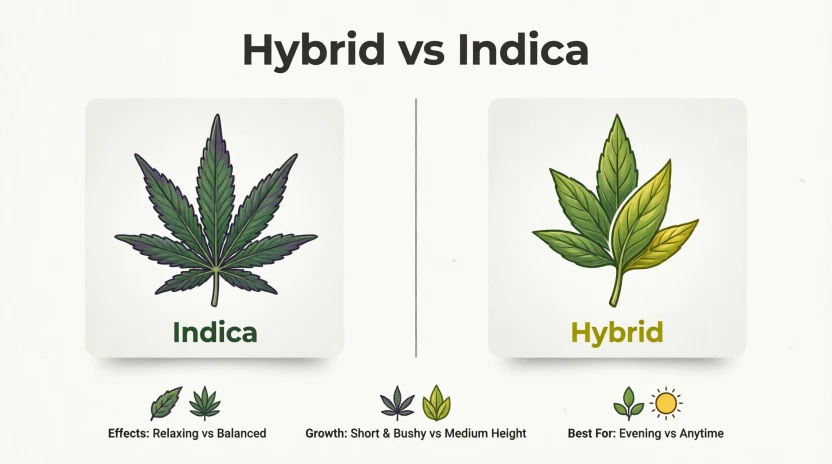
Hybrid vs. indica is a common comparison among people trying to understand cannabis types and how they differ. Indica is a traditional cannabis category, while hybrid usually refers to cannabis bred from indica and sativa lineages. However, these labels do not reliably predict exactly how a cannabis product will affect every person.
People often associate indica with relaxation and sleepiness, while hybrids are thought to offer a mix of effects. These descriptions are common in cannabis marketing, but the real picture is more complex. A product’s THC and CBD levels, chemical profile, individual response, and other factors can all matter.
Understanding hybrid vs. indica can help readers make sense of product labels, online discussions, and cannabis terminology. It can also help separate popular beliefs from what research actually supports.
In this guide, you will learn what indica and hybrid mean, how they differ, where the terms came from, and how to interpret them in everyday writing. You will also find clear comparison tables, examples, common mistakes, and answers to frequently asked questions.
Hybrid vs. Indica: The Quick Answer
Hybrid and indica are cannabis classification labels, but they are not exact opposites. Indica generally refers to a traditional cannabis category, while hybrid describes cannabis developed by crossing plants associated with different lineages. Indica is often marketed as relaxing, and hybrids as offering mixed effects. However, labels alone cannot reliably predict a product’s effects.
Hybrid vs. Indica: Quick Answer
The main difference is how the terms describe cannabis.
- Indica: A traditional cannabis category commonly associated with shorter, bushier plants and broader leaves.
- Hybrid: A category commonly used for cannabis bred from different cannabis lineages.
- Indica-dominant hybrid: A hybrid marketed or described as having more indica-associated characteristics.
- Balanced hybrid: A product described as having a more balanced indica-sativa background.
For example:
- A product described as indica may be marketed toward people seeking a relaxing experience.
- A hybrid may be described as having a mixture of characteristics associated with indica and sativa.
- An indica-dominant hybrid combines the hybrid label with an indication of its reported lineage or characteristics.
These descriptions are not guarantees. Two products carrying the same label may differ in their chemical composition and effects.
What Does Hybrid or Indica Mean?
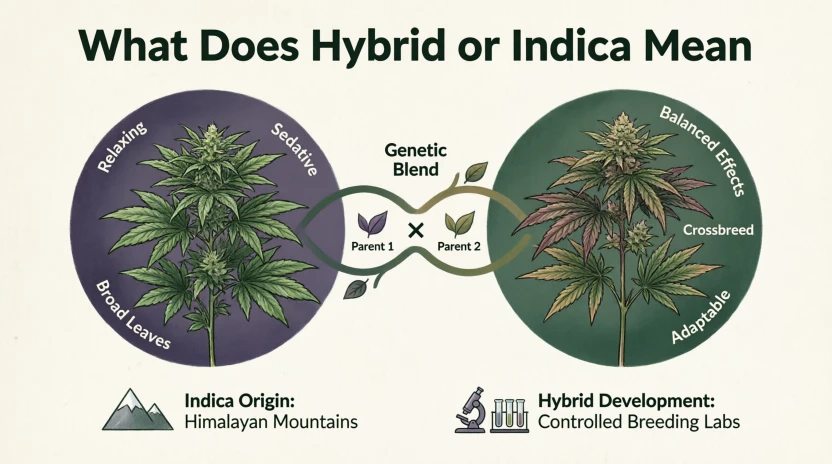
To understand hybrid vs. indica, it helps to look at each term separately.
What Is Indica?
Indica is a traditional category used to describe certain types of cannabis. Historically, plants described as indica have often been associated with shorter growth, broader leaves, and a bushier shape.
In the modern cannabis market, indica is also used as a product label. Retailers often associate indica products with relaxation, calmness, or sleepiness.
However, these associations should not be treated as medical facts. A product labelled indica will not necessarily make every person feel relaxed or sleepy.
The label also does not tell you everything about its THC content, CBD content, or other chemical compounds.
What Is a Hybrid?
A hybrid is commonly described as cannabis bred by crossing plants associated with different cannabis lineages, often indica and sativa.
Breeders may select plants for particular growth traits, aromas, chemical profiles, or other characteristics. As a result, hybrid products can vary widely.
You may see descriptions such as:
- Indica-dominant hybrid: A hybrid described as leaning toward indica-associated traits.
- Sativa-dominant hybrid: A hybrid described as leaning toward sativa-associated traits.
- Balanced hybrid: A hybrid described as having a more balanced background.
These terms describe broad categories, not precise measurements of chemical content or guaranteed experiences.
What Is the Main Difference?
The key difference is that indica is a traditional category, while hybrid generally describes the result of crossing different cannabis lineages.
A hybrid can have indica ancestry. Therefore, calling a product a hybrid does not mean it has no indica characteristics.
It is also important to distinguish plant ancestry from a product’s chemical profile. Labels may offer some background information, but they cannot replace reliable information about the product itself.
The Origin of Hybrid and Indica
The terms hybrid and indica come from the history of cannabis classification and cultivation.
Where Did the Term Indica Come From?
The word indica is Latin in form and relates to India. In botanical naming, Cannabis indica became associated with cannabis plants described in historical botanical literature.
Over time, indica became a familiar term in cannabis cultivation and commerce. Modern sellers often use it to group products according to reported plant ancestry, physical traits, or expected effects.
However, the historical botanical meaning and the modern retail meaning are not always identical. Cannabis classification remains complex, and the labels used by sellers do not always reflect clear genetic divisions.
Where Did the Term Hybrid Come From?
The word hybrid broadly describes something produced by combining different types or lineages. In plant breeding, it commonly refers to the offspring of a cross between genetically distinct plants.
Cannabis breeders have crossed plants over many generations to develop new combinations of characteristics. This has helped create the wide range of products sold under hybrid labels today.
A hybrid may have a complicated ancestry rather than a simple, evenly divided indica-sativa background.
Why Do These Terms Cause Confusion?
The terms are often used in two different ways.
First, they describe plant history or characteristics. Second, they are used in marketing to suggest how a product might feel.
Those meanings can overlap, but they are not the same. Research published in Nature Plants found that cannabis samples labelled indica and sativa were not clearly separated across their overall genetic makeup, although some differences in terpene-related traits were associated with the labels.
This is one reason it is better to treat indica and hybrid as broad labels rather than exact scientific predictions.
British English vs. American English
The terms hybrid and indica are used in both British and American English. There is no standard British-versus-American spelling difference between them.
| British English | American English | Example |
| Hybrid | Hybrid | The article explains the meaning of hybrid cannabis. |
| Indica | Indica | The product description uses the indica label. |
| Indica-dominant hybrid | Indica-dominant hybrid | The label describes an indica-dominant hybrid. |
| Cannabis | Cannabis | The report discusses cannabis classification. |
Are the Meanings Different in the UK and US?
The basic meanings are similar. Most differences arise from laws, medical regulations, and local terminology rather than spelling.
Cannabis laws also vary by jurisdiction. A term used in a product listing in one country may appear in a different legal or commercial context elsewhere.
What About Academic and Professional Writing?
In academic writing, define the terms and explain their limits. Do not assume that the labels represent scientifically distinct groups unless your source supports that claim.
In business writing, use the product’s stated classification accurately. Avoid presenting marketing descriptions as proven medical effects.
For general readers, plain explanations are usually best. Make it clear when you are describing common beliefs rather than established findings.
Which Version Should You Use?
The right wording depends on your audience and purpose. Hybrid and indica are both valid terms, but neither should be used as a substitute for a full description of a cannabis product.
United States
Both terms are widely used in cannabis-related retail and educational content. If you are writing for a US audience, explain if you mean plant ancestry, a product label, or an expected effect.
United Kingdom
The terms are also understood in the UK. However, cannabis laws and the rules for cannabis-based medicinal products differ from those in many US jurisdictions. Use current official guidance when discussing legal or medical matters.
Canada
Both labels appear in cannabis-related discussions. For consumer education, distinguish a product’s marketing category from its actual chemical profile.
Australia
Both terms may appear in general cannabis discussions. When writing about medicinal cannabis, use the terminology provided by reliable clinical or regulatory sources and avoid implying that the label alone establishes suitability.
International Writing
Define indica and hybrid the first time you use them. Readers may have different levels of familiarity with cannabis terminology.
Avoid slang when a neutral term will make your meaning clearer.
Academic Writing
Use the terminology of your source and explain how the study defines each category. Where possible, include relevant information about cannabinoids, terpenes, and the study’s methods.
Do not treat the words indica and hybrid as interchangeable.
Business Writing
Describe products accurately and avoid unsupported claims such as “guaranteed to help you sleep” or “will improve focus.”
A responsible product description distinguishes reported characteristics from verified composition and established medical evidence.
Common Mistakes
Confusion about hybrid vs. indica often comes from treating broad labels as precise scientific or medical categories.
| Incorrect example | Better example | Explanation |
| All indica products cause sleepiness. | Indica products are often marketed as relaxing, but effects vary. | A label cannot guarantee an individual response. |
| Every hybrid has equal indica and sativa ancestry. | Hybrid ancestry can vary. | A hybrid does not have to be a 50/50 cross. |
| Hybrid and indica mean the same thing. | Indica is a category; hybrid describes a cross between lineages. | The terms describe different things. |
| Indica always has more THC. | THC levels depend on the specific product. | The category alone does not establish potency. |
| A hybrid always produces balanced effects. | A hybrid’s effects depend on several factors. | The word does not guarantee a particular experience. |
| These labels are exact scientific classifications. | These labels are broad and can be imprecise. | Modern cannabis genetics and chemistry are complex. |
Memory Tip
Think of it this way: indica is a category, while hybrid describes mixed ancestry.
Remember that neither term, on its own, tells you exactly how a cannabis product will affect someone.
Everyday Examples
These examples show how to use the terms clearly in different forms of writing. They explain terminology rather than recommend a cannabis product.
1. Emails
Example:
“Could you clarify if the report uses indica and hybrid as botanical categories or retail labels?”
This wording asks for a clear definition instead of assuming the terms have one fixed meaning.
2. Business Writing
Example:
“The product catalogue separates indica-labelled products from hybrids and provides available chemical-profile information.”
This sentence distinguishes the category label from additional product information.
3. News Headlines
Example:
“Hybrid vs. Indica: Why Cannabis Labels Do Not Tell the Whole Story”
The headline names the comparison and signals that the article will examine the limits of common assumptions.
4. Blogs
Example:
“Indica and hybrid are common cannabis labels, but neither one guarantees a particular effect.”
This is a useful opening sentence for an educational article because it answers the central question directly.
5. Social Media
Example:
“Hybrid vs. indica explained: learn what the labels mean, how they differ, and why product chemistry matters.”
This version is short, informative, and suitable for a general educational post.
6. Academic Writing
Example:
“The study compared cannabis products classified by retail labels and assessed differences in their reported chemical profiles.”
This sentence avoids assuming that retail categories automatically represent distinct genetic groups.
7. Daily Conversation
Example:
“What does hybrid mean on this label?”
“It usually means the cannabis was bred from different lineages, but the label alone does not tell you its full chemical profile.”
This exchange uses plain English while leaving room for differences between products.
Google Trends and Modern Usage
Hybrid vs. indica is a comparison people encounter when researching cannabis terminology, reading product descriptions, or trying to understand the difference between common labels.
However, search interest is not the same as scientific evidence. Without checking a defined Google Trends region and time period, it would be misleading to claim that one term is searched more often than the other.
Why Do People Search for Hybrid vs. Indica?
Common reasons include:
- Understanding the meaning of each label.
- Learning how hybrid differs from indica.
- Checking if the labels predict particular effects.
- Understanding indica-dominant and balanced hybrid descriptions.
- Finding out what product labels can and cannot tell them.
Which Term Is More Common?
Both terms are established in cannabis-related language. Their visibility may differ across regions, retailers, and search periods.
A meaningful Google Trends comparison should specify the location, date range, and search category. It should also account for the fact that Trends reports relative search interest rather than a direct count of all searches.
No exact search-volume figures are claimed here.
What Does Modern Research Say?
Research suggests that the traditional indica-sativa distinction does not neatly capture all the genetic and chemical variation in cannabis. A study in Nature Plants found that samples carrying those labels were not clearly distinct across their overall genetic makeup.
Product chemistry may offer more useful detail than a broad category alone. THC, CBD, and terpenes are among the factors researchers examine, although the relationship between a product’s chemistry and its effects is complex.
For general readers, the practical lesson is simple: understand what the label means, but do not assume it tells the whole story.
Quick Comparison Table
| Version | Meaning | Correct? | Typical context | Example |
| Indica | Traditional cannabis category and common retail label | Yes | Plant descriptions and product labels | “The listing uses an indica label.” |
| Hybrid | Cannabis commonly described as bred from different lineages | Yes | Breeding and product descriptions | “The catalogue lists a hybrid.” |
| Indica-dominant hybrid | Hybrid described as leaning toward indica-associated traits | Yes | Product classification | “It is described as an indica-dominant hybrid.” |
| Balanced hybrid | Hybrid described as having a balanced background | Yes, as a descriptive label | Retail and general discussions | “The listing calls it a balanced hybrid.” |
| Indica means guaranteed sleep | Unsupported generalisation | No | Misleading effect claims | “Indica always causes sleepiness.” |
| Hybrid means 50/50 | Incorrect assumption | No | Misinterpretation of ancestry | “Every hybrid has equal ancestry.” |
Key Takeaways
- Indica is a traditional cannabis category and a widely used retail label.
- Hybrid usually describes cannabis bred from different lineages.
- An indica-dominant hybrid is still a hybrid.
- A hybrid does not necessarily have equal indica and sativa ancestry.
- The labels do not reliably predict every person’s response.
- THC, CBD, terpenes, and other factors may help describe a product more precisely.
- Regional spelling differences are not the main issue; meaning and context matter more.
- Use reliable scientific and regulatory sources for medical or legal claims.
FAQs: Hybrid vs. Indica
1. What is the main difference between hybrid and indica?
Indica is a traditional cannabis category, while hybrid usually describes cannabis bred from different lineages. Hybrid products can include indica ancestry, so the terms are not complete opposites. Both labels are broad descriptions and do not provide a full account of a product’s genetics, chemical composition, or likely effects.
2. Is hybrid stronger than indica?
Not necessarily. Strength depends on factors such as THC concentration and the amount consumed, rather than the hybrid or indica label alone. Products in either category can vary considerably. A category name should not be used as a reliable measure of potency or as a substitute for verified product information.
3. Does indica always make you sleepy?
No. Indica products are often marketed as relaxing or sedating, but this is not a guaranteed effect. Individual responses can differ, and product composition matters. It is more accurate to describe sleepiness as a commonly associated effect than to claim that every indica-labelled product causes it.
4. Does hybrid mean 50% indica and 50% sativa?
No. Hybrid does not automatically mean an equal genetic split. Cannabis may have complex ancestry from many generations of breeding. Terms such as indica-dominant and balanced hybrid are broad descriptions, and their exact meaning can depend on the breeder or seller using them.
5. Can a hybrid also be indica-dominant?
Yes. An indica-dominant hybrid is a hybrid described as having more indica-associated ancestry or characteristics. The term does not mean the product is pure indica. It is a useful example of how the two labels can overlap rather than describe entirely separate categories.
6. Which is better, hybrid or indica?
Neither category is universally better. The labels do not reliably predict the effects or suitability of a particular product. Anyone considering cannabis for a medical reason should speak with a qualified healthcare professional and consider reliable information about the product, its risks, and relevant medical guidance.
7. Do hybrid and indica have different THC levels?
There is no fixed THC level for either category. THC content depends on the specific product and its cultivation and processing. Some indica-labelled products may contain high THC, while others may not. The same variation applies to hybrids, so a reliable product label or laboratory report is more informative than the category name.
8. Are hybrid and indica scientifically different?
The distinction is not as clear-cut as many retail descriptions suggest. Research has found that cannabis samples labelled indica and sativa are not neatly separated across their overall genetic makeup. The terms remain common in commerce, but they should not be treated as precise scientific classifications without supporting evidence.
9. Are hybrid and indica spelled differently in British and American English?
No. The standard spellings are the same in British and American English: hybrid and indica. Differences in how the terms are used generally reflect local laws, product markets, or writing context rather than spelling rules.
10. What should you check beyond the hybrid or indica label?
Look for reliable information about the product’s THC and CBD content, other available chemical-profile details, and relevant safety warnings. These details provide more information than a broad category alone. For medical use, consult a qualified healthcare professional rather than relying on retail labels or general claims about expected effects.
Conclusion
Understanding hybrid vs. indica starts with one key distinction: indica is a traditional cannabis category, while hybrid generally describes cannabis bred from different lineages. The terms are widely used, but their meanings can become confusing when sellers use them to suggest specific effects.
Indica is often associated with relaxation, while hybrids are commonly described as offering mixed characteristics. These are popular descriptions, not guarantees. Cannabis products vary in their chemical composition, and individual responses can differ. Research also shows that traditional cannabis labels do not always correspond to clear genetic divisions.
For readers, writers, and students, the best approach is to define the terms accurately and avoid treating them as exact measures of potency, safety, or medical benefit. When discussing a particular product, use reliable information about its composition and consult qualified professionals when medical questions arise.
If you are writing about cannabis for a general audience, keep the explanation simple, factual, and balanced. This helps readers understand the terminology without confusing marketing claims with scientific evidence.
Remember: indica describes a traditional category, hybrid describes mixed lineage, and neither label tells the whole story. Explore more clear, practical word explanations on Wordsblog to build your understanding one topic at a time.
Read more about!
- Vizio vs. TCL: Which TV Brand Is Better?
- Goedert or Kincaid: Who Should You Start in 2026?
- Sudafed or DayQuil: Which Is Better for a Cold?

I’m Olivia Parker, a grammar and English writing enthusiast passionate about making English simple and easy to understand. Through Wordsblog, I share clear explanations, useful grammar tips, and practical writing guidance to help readers write with confidence. My goal is to make learning English easier, one word at a time.








5 thoughts on “Hybrid vs. Indica: What’s the Difference?”