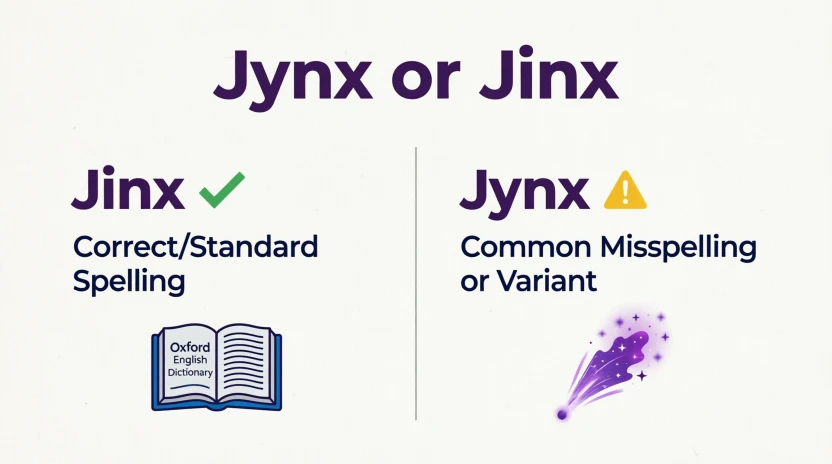
Jinx is the correct spelling when you mean bad luck, a curse, or something believed to bring misfortune. Jynx is not a standard spelling of this word, but it is the official name of a Pokémon character. The right choice depends on what you want to say.
Many people search for “jynx or jinx” because the two spellings sound the same. The letter y in Jynx can make it look like a creative or alternative spelling of jinx. However, these words do not have the same use in standard English.
Knowing the difference helps you avoid spelling mistakes in schoolwork, emails, blog posts, and everyday messages. It also helps if you are writing about Pokémon, where Jynx has a specific meaning as a character name.
In this guide, you will learn what jinx means, why Jynx is used as a proper name, how the words differ, and which spelling to choose in different situations. You will also find clear examples, common mistakes, and answers to frequently asked questions.
Jynx or Jinx: The Quick Answer
Jinx is the correct English word for bad luck, a curse, or a person or thing believed to cause misfortune. Jynx is a proper name best known as the name of a Pokémon character. Use jinx in ordinary writing and Jynx when referring to that character.
Examples:
- Correct: “I hope I don’t jinx the game by saying we will win.”
- Correct: “That broken mirror is said to bring bad luck, but I don’t believe in jinxes.”
- Correct: “Jynx is a Pokémon character.”
Jynx or Jinx: Quick Answer
The difference is simple: jinx is a standard English word, while Jynx is a proper name used in the Pokémon franchise.
Use jinx when talking about bad luck, tempting fate, or supposedly bringing misfortune. Use Jynx when referring to the Pokémon character or another specific name that is officially spelled that way.
Although the two spellings sound alike, they are not interchangeable. Choosing the correct spelling depends on the meaning of your sentence.
What Does Jinx Mean?
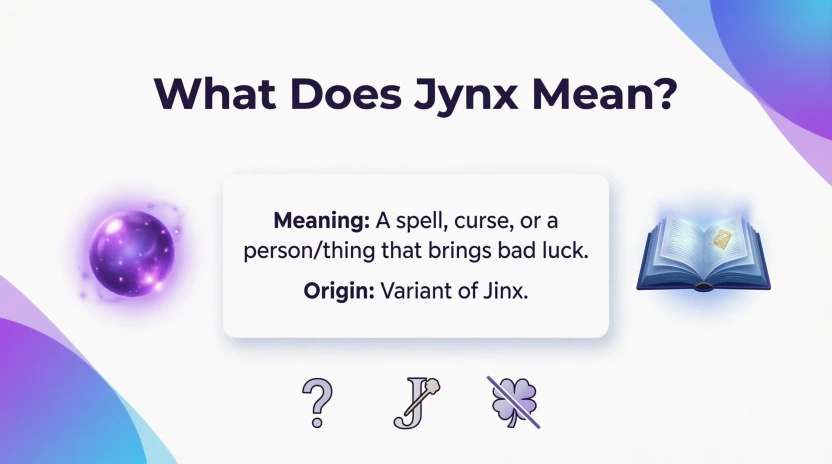
Jinx is a noun and a verb in English. It is used when someone believes that a person, action, or statement may bring bad luck or cause something to go wrong.
Jinx as a Noun
As a noun, jinx refers to a person or thing believed to bring bad luck. It can also describe a run of bad luck.
Examples:
- “Our team has a jinx when it plays in the final.”
- “I think I have a jinx on me because everything keeps going wrong.”
- “Don’t say we have won yet. You might bring us a jinx.”
In casual speech, people often use jinx in a playful way. They do not always believe that saying something can truly cause bad luck.
Jinx as a Verb
As a verb, jinx means to bring or seem to bring bad luck to someone or something.
Examples:
- “I don’t want to jinx our chances.”
- “You jinxed the match by celebrating too early.”
- “Let’s not jinx it by talking about the result.”
The verb often appears in conversations about sports, exams, travel plans, and other events where people hope for a good outcome.
Jinx as a Casual Expression
People sometimes say “Jinx!” when two people say the same word or phrase at the same time. In some versions of the game, one person must say the other person’s name or wait for permission to speak again.
Example:
“Great minds think alike!”
“Jinx!”
This is an informal expression, so its exact rules can vary between friends and families.
What Does Jynx Mean?
Jynx is best known as the name of a Pokémon character. In this context, it is a proper noun and is written with a capital letter.
Jynx is an Ice- and Psychic-type Pokémon in the main Pokémon games. Its name is a distinctive spelling that should be preserved when discussing the character.
Examples:
- “Jynx appears in the Pokémon games.”
- “My favorite Pokémon characters include Jynx.”
- “The guide explains Jynx’s abilities.”
The spelling Jynx is appropriate in these examples because each sentence refers to the named character.
Is Jynx an Alternative Spelling of Jinx?
No. Jynx is not a standard alternative spelling of the ordinary English word jinx.
You might see jynx used as a username, brand name, fictional name, or creative spelling online. Such uses do not make it the standard spelling for the word meaning bad luck.
If you are writing a normal sentence about tempting fate, use jinx. If you are writing about the Pokémon character, use Jynx.
The Origin of Jinx and Jynx
Understanding the history of these spellings helps explain why they look similar but serve different purposes.
Where Does the Word Jinx Come From?
The English word jinx became established in the early twentieth century. Its exact origin is uncertain, and dictionaries discuss possible links to earlier words associated with magic or superstition.
Today, the word is widely used in informal English. It can describe an imagined curse, a streak of bad luck, or the act of supposedly bringing bad luck by saying something.
For example:
“I was going to say that nothing could go wrong, but I don’t want to jinx it.”
Here, jinx refers to the belief that speaking too confidently about a good outcome might somehow spoil it.
Why Is Jynx Spelled With a Y?
Jynx is a distinct proper name used for the Pokémon character. Its spelling should be treated as part of the character’s official name rather than as a spelling rule for ordinary English words.
The use of y does not mean that English speakers can generally replace the i in jinx with a y. Standard English spelling does not support that substitution in this word.
The key lesson is that names can have unique spellings. A proper name may look like an ordinary word without following the spelling conventions used for that word.
British English vs American English
There is no standard British-versus-American spelling difference between jinx and Jynx. Both varieties of English use jinx for the ordinary word and Jynx for the Pokémon character.
| Context | British English | American English | Example |
| Bad luck | Jinx | Jinx | “Don’t jinx it.” |
| Bringing bad luck | Jinx | Jinx | “I hope I don’t jinx the result.” |
| Pokémon character | Jynx | Jynx | “Jynx is a Pokémon.” |
| Plural noun | Jinxes | Jinxes | “They blamed their jinxes.” |
| Past-tense verb | Jinxed | Jinxed | “She jinxed our chances.” |
| Present participle | Jinxing | Jinxing | “Stop jinxing the game.” |
Are There Regional Differences?
The spelling remains the same in the United States, United Kingdom, Canada, and Australia. Differences may occur in pronunciation or in the situations where people use the expression, but there is no established regional spelling rule that changes jinx to jynx.
For professional writing, consistency still matters. Follow the spelling used by standard dictionaries and preserve official names as they are written.
Which Version Should You Use?
The correct spelling depends on your audience and the subject of your writing, not on the country where you live.
United States
Use jinx when discussing bad luck or tempting fate. Use Jynx when writing about the Pokémon character.
Example: “I don’t want to jinx our team’s chances.”
United Kingdom
The same rule applies in British English. Neither jynx nor Jynx should replace jinx in an ordinary sentence about bad luck.
Example: “Don’t jinx your chances before the interview.”
Canada
Canadian English also uses jinx as the standard word. The spelling Jynx is appropriate when referring to the Pokémon character.
Example: “I hope I haven’t jinxed the weather for our trip.”
Australia
Australian English follows the same distinction. Use jinx for the ordinary word and Jynx for the proper name.
Example: “Let’s not jinx our chances of winning.”
International Writing
For a global audience, use jinx in ordinary English and explain the meaning if your readers may not know the expression.
When writing about games, animation, or Pokémon, retain the official spelling Jynx.
Academic Writing
In academic work, choose jinx when it is the correct word for the intended meaning. If you are discussing superstitions, explain that a jinx is a belief or expression associated with bad luck rather than treating it as a proven cause.
Capitalize Jynx when discussing the named Pokémon character.
Business Writing
In formal business communication, jinx is usually informal. You can use it in a casual message, but more direct language may be clearer in a professional report.
Instead of writing “I don’t want to jinx the project,” you could write “The project is progressing well, although the final outcome is not yet certain.”
Use Jynx only when the name itself is relevant.
Common Mistakes With Jynx and Jinx
Writers often confuse these spellings because they sound alike. The easiest way to avoid errors is to check the meaning before choosing the spelling.
| Incorrect or confusing example | Correct example | Explanation |
| “I hope I don’t jynx the match.” | “I hope I don’t jinx the match.” | Use jinx for the ordinary English word. |
| “The Pokémon is called Jinx.” | “The Pokémon is called Jynx.” | Use the official character name. |
| “She thinks she has a jynx.” | “She thinks she has a jinx.” | The noun meaning bad luck is jinx. |
| “I jynxed my chances.” | “I jinxed my chances.” | The past tense is formed from jinx. |
| “He keeps jynxing our plans.” | “He keeps jinxing our plans.” | The standard present participle is jinxing. |
Common Spelling Mistakes to Avoid
Mistake 1: Using Jynx because it looks unusual.
Creative spellings can work in names and usernames, but they should not replace standard spelling in formal writing.
Mistake 2: Capitalizing jinx unnecessarily.
Write jinx in lowercase unless it begins a sentence or appears in a title where capitalization is required.
Mistake 3: Changing the spelling when adding an ending.
The standard forms are jinxes, jinxed, and jinxing. The letter i remains in these forms.
Memory Tip
Remember this simple rule:
- Jinx = bad luck.
- Jynx = the Pokémon name.
If your sentence is about a game result, an exam, or an unlucky event, you almost certainly need jinx. If it is about the Pokémon character, choose Jynx.
Everyday Examples of Jynx and Jinx
The following examples show how to use each spelling naturally in different settings.
1. Emails
Informal email:
“I hope the meeting goes well. I don’t want to jinx it by celebrating early.”
This use is suitable for a friendly message to a colleague.
2. Business Writing
Informal team message:
“We have made good progress, but let’s not jinx the launch before testing is complete.”
For a formal report, consider replacing the expression with a more direct statement about uncertainty.
3. News Headlines
A headline about a sports team might read:
“Can the Team Finally Break Its Jinx?”
Here, jinx refers to a perceived pattern of bad luck.
A headline about a game character might read:
“Jynx Returns in the Latest Pokémon Discussion.”
Here, Jynx is a proper name.
4. Blogs
Correct: “Why People Say ‘Don’t Jinx It’ Before a Big Event.”
Correct: “A Beginner’s Guide to Jynx in Pokémon.”
The first title discusses a common expression. The second focuses on a named character.
5. Social Media
- “Please don’t jinx our winning streak!”
- “I finally learned more about Jynx in Pokémon.”
- “I said the weather would stay sunny, and now it is raining. Did I jinx it?”
These examples show the casual tone often associated with jinx.
6. Academic Writing
Correct: “The expression ‘don’t jinx it’ reflects a common form of superstition.”
Correct: “The paper examines Jynx as a character in the Pokémon franchise.”
Academic writers should define informal terms when necessary and use proper names accurately.
7. Daily Conversation
Person A: “Everything is going perfectly today.”
Person B: “Don’t jinx it!”
Another example:
“I was afraid to say we would win because I didn’t want to jinx the game.”
Both examples use jinx correctly.
8. Gaming Conversations
Correct: “Jynx is one of the Pokémon characters I want to learn more about.”
Correct: “I hope I don’t jinx my next battle.”
These sentences make the difference especially clear: one refers to a character, while the other describes a superstition.
Google Trends and Modern Usage
People search for “jynx or jinx” because the words sound alike and the spelling with y appears in popular culture. The Pokémon character also makes Jynx familiar to many readers who might otherwise know only the word jinx.
There is no need to assume that one spelling is becoming a general replacement for the other. They serve different purposes.
Why Do People Search for Jynx or Jinx?
Common reasons include:
- They are unsure which spelling means bad luck.
- They have seen the Pokémon character’s name.
- They want to check a social media post or message.
- They are learning English and want to understand the difference.
- They need to spell the word correctly in a blog, school assignment, or email.
Which Spelling Is More Common?
In ordinary English, jinx is the standard spelling for the word related to bad luck. Jynx appears in specific names and other creative uses.
Exact search-volume comparisons require current keyword or search-trend data. Without that data, it would be misleading to provide precise figures or claim a particular growth rate.
For writers, the practical point is more important than search volume: match the spelling to the intended meaning.
Quick Comparison Table: Jynx vs Jinx
| Version | Meaning | Correct? | Region | Example |
| Jinx | Bad luck or a supposed curse | Yes | All major English varieties | “Don’t jinx it.” |
| Jynx | Name of a Pokémon character | Yes, as a proper name | International | “Jynx is a Pokémon.” |
| Jynx | Ordinary word meaning bad luck | No, in standard English | All major English varieties | Use “jinx” instead. |
| Jinx | Pokémon character’s official name | No, if referring to Jynx | International | Write “Jynx.” |
Key Takeaways
- Jinx is the standard English word for bad luck or a supposed curse.
- Jynx is best known as the name of a Pokémon character.
- The two spellings sound alike but are not interchangeable.
- British, American, Canadian, and Australian English use jinx in the ordinary sense.
- Standard forms include jinxes, jinxed, and jinxing.
- Use jinx in casual expressions such as “Don’t jinx it.”
- Preserve the spelling Jynx when referring to the Pokémon character.
- Always choose the spelling that matches the meaning of your sentence.
FAQs About Jynx or Jinx
1. Is jynx or jinx the correct spelling?
Jinx is correct when you mean bad luck, a curse, or the act of supposedly bringing misfortune. Jynx is a proper name, most notably used for a Pokémon character. If you are writing an ordinary English sentence such as “Don’t jinx it,” use jinx.
2. Is jynx a real word?
Jynx is used as a proper name, especially for the Pokémon character. It can also appear in usernames, fictional names, and creative branding. However, it is not the standard spelling of the English word meaning bad luck. For that meaning, use jinx.
3. What does jinx mean?
A jinx is a person, thing, or situation believed to bring bad luck. As a verb, to jinx means to supposedly cause bad luck or spoil a good outcome. For example, “I don’t want to jinx our chances” means the speaker does not want to tempt fate.
4. What does Jynx mean in Pokémon?
Jynx is the name of an Ice- and Psychic-type Pokémon. The spelling is a proper name, so it should be written as Jynx when referring to the character. Its spelling does not change the standard spelling of the ordinary English word jinx.
5. Are jinx and jynx pronounced the same?
Yes, they are generally pronounced the same in English, which is why people often confuse them. The main difference is spelling and meaning. Jinx is the standard word for bad luck, while Jynx is a proper name used for the Pokémon character.
6. Is jynx an acceptable spelling of jinx in American English?
No. American English uses jinx for the ordinary word meaning bad luck or a supposed curse. Jynx is appropriate when it is an official name or another deliberate proper noun, but it should not replace jinx in standard writing.
7. How do you use jinx in a sentence?
You can use jinx as a noun or a verb. As a noun, you might say, “Our team seems to have a jinx.” As a verb, you could say, “I hope I don’t jinx the result.” Both examples use the standard spelling correctly.
8. What is the plural of jinx?
The plural of the noun jinx is jinxes. For example, “The team believes it has overcome several jinxes.” When using the word as a verb, the standard forms include jinxed for the past tense and jinxing for the present participle.
9. Is jinx used in British English?
Yes. Jinx is used in British English with the same basic meaning as in American English. A British speaker might say, “Don’t jinx it,” when hoping that a good situation continues. There is no standard British spelling change from jinx to jynx.
10. Should I use jinx or Jynx in a blog post?
Choose the spelling based on your topic. Use jinx when discussing bad luck, superstition, or the phrase “don’t jinx it.” Use Jynx when writing about the Pokémon character. Correct spelling makes your meaning clearer and helps readers understand the topic immediately.
Conclusion: Jynx or Jinx?
The choice between jynx and jinx depends on what you mean. In standard English, jinx is the correct word for bad luck, a supposed curse, or the act of tempting fate. It works in everyday conversation, social media posts, emails, and many informal forms of writing.
Jynx, on the other hand, is a proper name best known for the Pokémon character. Although both spellings sound the same, they serve different purposes. Using one in place of the other can confuse readers, especially when you are writing about gaming, superstition, or popular culture.
For clear and accurate writing, remember to use jinx when you mean bad luck and Jynx when you mean the Pokémon character. This rule applies across British, American, Canadian, and Australian English.
The easiest rule to remember is this: bad luck is a jinx, but the Pokémon is Jynx. If this guide helped you, explore more word comparisons on Wordsblog to improve your spelling and everyday English.
Read more about!
- Delt or Dealt: Which Spelling Is Correct?
- Hybrid vs. Indica: What’s the Difference?
- Believes or Beliefs: Which Word Is Correct?

I’m Olivia Parker, a grammar and English writing enthusiast passionate about making English simple and easy to understand. Through Wordsblog, I share clear explanations, useful grammar tips, and practical writing guidance to help readers write with confidence. My goal is to make learning English easier, one word at a time.







2 thoughts on “Jynx or Jinx: Which Spelling Is Correct?”