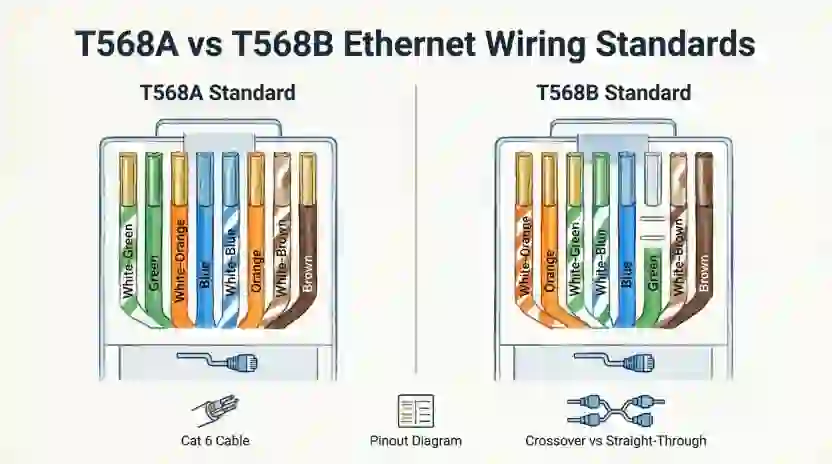
T568A and T568B are two wiring standards used to connect the eight wires inside an Ethernet cable to an RJ45-style connector. Both are valid, and neither is inherently faster than the other. The best choice depends on your existing network, installation requirements, and the wiring standard used at the other end of the cable.
People search for T568A or B because the two wiring patterns look almost identical, but their wire colors differ in key positions. Choosing the wrong pattern for an existing installation can cause connection problems, especially when the cable ends are terminated inconsistently.
The good news is that the difference is simple once you understand the color codes. Both standards use the same four twisted pairs. The main change is the position of the green and orange pairs.
In this guide, you will learn the T568A and T568B pinouts, how to choose the correct standard, and how to avoid common wiring mistakes. You will also see practical examples for home networks, offices, patch panels, and Ethernet cables.
T568A or B? Quick Answer
T568A and T568B are both accepted Ethernet wiring standards. They differ mainly in the placement of the green and orange wire pairs. Use the same standard at both ends of a normal Ethernet cable. T568B is common in many commercial installations, while T568A may be required by an existing installation or project specification. Follow the applicable requirements and keep your wiring consistent.
T568A or B: Quick Answer and Key Differences
The main difference between T568A and T568B is the order of the green and orange wire pairs.
Both standards use eight conductors arranged into four twisted pairs. The blue and brown pairs stay in the same positions in both patterns.
Here are the key points:
- T568A: The green pair occupies pins 1 and 2.
- T568B: The orange pair occupies pins 1 and 2.
- Performance: Neither standard is inherently faster when the cable is installed and tested correctly.
- Compatibility: Use the same wiring pattern at both ends of a normal straight-through cable.
- Crossover cables: Using T568A at one end and T568B at the other creates a traditional crossover arrangement.
For example, a cable wired T568B at both ends is a straight-through cable. A cable wired T568A at both ends is also straight-through.
The important rule is consistency. Do not mix the two patterns at opposite ends unless you deliberately need a crossover cable or have a specific wiring design.
What Do T568A and T568B Mean?
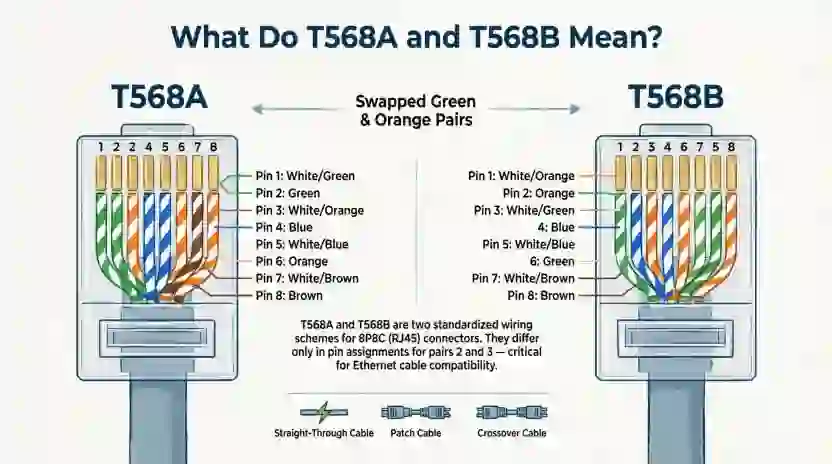
T568A and T568B are color-coded wiring assignments used to terminate twisted-pair network cables.
They tell an installer which colored wire belongs to each contact in an eight-position, eight-contact connector, commonly called an RJ45 connector.
These assignments are used with Ethernet cabling in homes, offices, schools, and commercial buildings. You may encounter them when installing wall outlets, keystone jacks, patch panels, and network cables.
What Is T568A?
T568A places the green pair on pins 1 and 2 and the orange pair on pins 3 and 6.
Its pin order is:
- White/green
- Green
- White/orange
- Blue
- White/blue
- Orange
- White/brown
- Brown
This pattern is useful when it matches the existing cabling, project specification, or applicable installation requirements.
What Is T568B?
T568B reverses the positions of the green and orange pairs compared with T568A.
Its pin order is:
- White/orange
- Orange
- White/green
- Blue
- White/blue
- Green
- White/brown
- Brown
T568B is widely used in many commercial Ethernet installations, particularly in North America.
T568A vs. T568B Pinout Table
| Pin | T568A wire color | T568B wire color |
| 1 | White/green | White/orange |
| 2 | Green | Orange |
| 3 | White/orange | White/green |
| 4 | Blue | Blue |
| 5 | White/blue | White/blue |
| 6 | Orange | Green |
| 7 | White/brown | White/brown |
| 8 | Brown | Brown |
Important: This table assumes you are identifying pins in the correct connector orientation. Always check the pin numbering and color labels supplied by your connector manufacturer before terminating a cable.
The Origin of T568A and T568B
T568A and T568B come from the structured cabling standards maintained by the Telecommunications Industry Association (TIA).
These standards help installers connect twisted-pair cables in a consistent way. Standardized wiring makes it easier to install, test, repair, and maintain network connections across different locations.
The two patterns reflect different wiring conventions. T568B aligns with an older AT&T 258A color-coding arrangement, while T568A provides compatibility with certain earlier wiring arrangements. Fluke Networks explains the differences between these two codes and their place in structured cabling standards.
Over time, both patterns became established in network installations. As a result, you may find either standard in existing buildings.
The existence of two standards does not mean one is automatically better. The correct choice depends on the installation requirements and the need to match the existing network.
For a new project, check the project specification and applicable cabling standard before choosing a pattern.
British English vs American English
T568A and T568B are technical wiring codes, not alternative English spellings. Their names and pin assignments do not change between British and American English.
However, spelling preferences may affect the words used in installation instructions. British English often uses colour, while American English usually uses color.
| British English | American English | Example |
| Colour code | Color code | Check the wire colour code before termination. |
| Fibre optic cable | Fiber optic cable | The office uses fibre optic cabling. |
| Labelled | Labeled | Make sure the cable is labelled correctly. |
| Standardised | Standardized | The network uses a standardized wiring plan. |
Do T568A and T568B Change by Country?
The wiring assignments themselves remain the same. What may differ is the standard required by a particular project, customer, or existing installation.
In the United States, T568B is common in many commercial environments. In the United Kingdom, Canada, Australia, and other regions, the appropriate choice should be based on the relevant project requirements and local practices rather than an assumption about language or geography.
Always check the actual wiring specification instead of relying on spelling conventions or country names.
Which Version Should You Use?
The best choice depends on where the cable will be installed and what is already in place.
United States
T568B is a common choice in commercial installations. However, T568A is also a valid wiring pattern.
If you are extending an existing network, inspect the current outlets, patch panels, and installation documentation before choosing a standard.
United Kingdom
Follow the cabling specification used by the building owner or installer. If you are adding a new outlet to an existing network, match the established wiring pattern.
Do not assume that every UK installation uses the same standard.
Canada
Check the project’s cabling requirements and existing network configuration. Either pattern can be suitable when it meets the applicable requirements and is used consistently.
Australia
Use the specified wiring pattern for the installation. When modifying an existing system, check the wiring labels and manufacturer instructions rather than changing the pattern without a reason.
International Writing and Documentation
When writing a network guide for an international audience, explain both standards and include the complete pinout table.
Avoid statements such as “T568B is always correct.” A clear guide should explain when each pattern is suitable and why consistency matters.
Academic Writing
For technical reports, assignments, and research papers, identify the wiring standard by its exact name. Use a reliable technical reference and describe the pin order accurately.
Business Writing
For office installations, follow the client’s specification or the organization’s cabling policy. Document the chosen pattern so future technicians can maintain the system without guesswork.
Practical recommendation: If you are replacing a cable, match its original wiring. If you are building a new network, follow the specified standard and use it consistently across the installation.
Common Mistakes When Choosing T568A or B
Small wiring mistakes can lead to failed connections, poor performance, or time-consuming troubleshooting.
| Incorrect practice | Correct practice | Explanation |
| Using T568A at one end and T568B at the other by accident | Use the same pattern at both ends for a normal cable | Different patterns create a crossover arrangement. |
| Swapping only individual wires without following a standard | Follow all eight pin assignments | Correct pair placement matters. |
| Assuming T568B is always faster | Choose based on the installation requirements | Neither standard is inherently faster. |
| Ignoring the existing patch panel | Check the existing wiring first | New connections must fit the network design. |
| Guessing the pin order | Verify the connector’s pin numbering | Connector orientation can cause confusion. |
| Skipping cable testing | Test the finished cable | Testing can reveal wiring faults and damaged conductors. |
Memory Tip
Remember this simple rule:
- T568A: Green comes first on pins 1 and 2.
- T568B: Orange comes first on pins 1 and 2.
The blue and brown pairs stay in the same positions. Only the green and orange pairs switch places.
If the cable does not work, do not assume the wiring standard is the only possible cause. A damaged conductor, poor termination, faulty connector, or incorrect cable type may also be responsible.
Everyday Examples of T568A and T568B
These examples show how the two standards are used in real network installations.
1. Home Ethernet Network
A homeowner wants to connect a router to a wall outlet in another room.
The installer checks the existing wiring and uses the same standard at both ends of the permanent cable run. This helps maintain a consistent connection.
2. Business Office
A company adds several network outlets for new desks.
The technician checks the patch panel and installation documentation before terminating the new cables. Matching the established pattern makes future maintenance easier.
3. Network Installation Email
A project manager sends this email:
“Please confirm if the new outlets should use T568A or T568B. We want all terminations to match the approved cabling specification.”
This message clearly identifies the decision that needs to be confirmed.
4. Technical Documentation
A network guide might state:
“Terminate both ends of the straight-through Ethernet cable using T568B.”
This is clearer than simply saying “Use the standard wiring,” because it identifies the exact pattern.
5. News or Technology Headline
A technology publication might use a headline such as:
“T568A vs. T568B: Understanding Ethernet Wiring Standards”
This title tells readers that the article compares two technical wiring options.
6. Blog Article
A helpful blog post should explain the pin order, show the differences in a table, and tell readers how to select the correct standard.
It should also warn readers not to mix the two patterns accidentally.
7. Academic Assignment
A student writing about structured cabling can explain that both standards use eight conductors and differ in the placement of the green and orange pairs.
The student should support technical claims with reliable references.
8. Daily Conversation
A technician might ask, “Is this cable wired T568A or T568B?”
The question helps identify the termination pattern before connecting the cable to the rest of the network.
Google Trends and Modern Usage
People search for “T568A or B,” “T568A vs T568B,” and “RJ45 wiring order” because they need a clear answer before making or repairing an Ethernet cable.
These searches often come from homeowners, students, IT technicians, electricians, and people installing network equipment.
The confusion is easy to understand. Both standards use the same eight wire colors, and six of the eight pin positions remain the same. Only the green and orange pairs switch positions.
T568B is common in many commercial installations, so it often appears in practical wiring guides. However, that does not make T568A incorrect or universally unsuitable.
Exact regional search popularity should be checked in Google Trends using the relevant search terms, location, and date range. Without a verified comparison, it would be misleading to claim that one term receives a specific percentage more searches than the other.
The most useful approach is to focus on the reader’s practical question: Which wiring pattern should I use for my cable?
The answer is to follow the applicable specification and keep both ends consistent for a standard straight-through cable.
T568A vs. T568B: Quick Comparison Table
| Feature | T568A | T568B |
| Main purpose | Ethernet cable termination | Ethernet cable termination |
| Pins 1 and 2 | White/green, green | White/orange, orange |
| Pins 3 and 6 | White/orange, orange | White/green, green |
| Blue pair | Pins 4 and 5 | Pins 4 and 5 |
| Brown pair | Pins 7 and 8 | Pins 7 and 8 |
| Ethernet performance | Equivalent when correctly installed | Equivalent when correctly installed |
| Straight-through cable | Use T568A at both ends | Use T568B at both ends |
| Typical use | Existing installations and specified projects | Common in many commercial installations |
| Best choice | When required by the installation | When required by the installation |
Key Takeaways
- T568A and T568B are both valid Ethernet wiring patterns.
- Their main difference is the position of the green and orange wire pairs.
- T568A places the green pair on pins 1 and 2.
- T568B places the orange pair on pins 1 and 2.
- Neither standard is inherently faster when installed correctly.
- Use the same pattern at both ends of a normal straight-through cable.
- An intentional T568A-to-T568B arrangement creates a traditional crossover cable.
- Always check the project specification and test the completed cable.
FAQs About T568A or B
1. Is T568A or T568B better?
Neither standard is universally better. Both can provide the same Ethernet performance when the cable is correctly terminated and meets the required specifications. T568B is common in many commercial installations, while T568A may be required by an existing system or project. Choose the pattern that matches the installation requirements.
2. Which is faster, T568A or T568B?
Neither wiring pattern is inherently faster. Network speed depends on factors such as cable category, installation quality, equipment capabilities, and the link configuration. A correctly installed T568A cable can perform as well as a correctly installed T568B cable under equivalent conditions.
3. Can I use T568A on one end and T568B on the other?
Yes, but this creates a traditional crossover arrangement rather than a normal straight-through cable. It may be appropriate for certain legacy networking situations or specific designs. For an ordinary Ethernet connection, use the same standard at both ends unless the equipment or installation specifically requires otherwise.
4. Does T568B support Gigabit Ethernet?
Yes. T568B can support Gigabit Ethernet when used with suitable cable, compatible equipment, and a correctly installed link. T568A can also support Gigabit Ethernet under equivalent conditions. The wiring pattern alone does not determine the maximum network speed.
5. Is T568A still used?
Yes. T568A remains a valid wiring standard. It may be used in installations where the project specification or existing cabling calls for it. Its suitability should be assessed against the applicable requirements rather than assuming that every new installation must use T568B.
6. What is the T568B color order?
The T568B order from pin 1 to pin 8 is white/orange, orange, white/green, blue, white/blue, green, white/brown, and brown. Check the connector’s pin numbering before terminating the cable, because viewing the connector from the wrong side can lead to mistakes.
7. Can I mix T568A and T568B in the same building?
A building may contain different wiring arrangements, but each cable run should follow its documented design. Mixing patterns at opposite ends of a normal cable creates a crossover arrangement. When extending a network, match the existing wiring and confirm that every connection meets the project’s requirements.
8. Do T568A and T568B affect Power over Ethernet?
Neither pattern is inherently better for Power over Ethernet (PoE). PoE performance depends on compatible equipment, cable quality, correct termination, and compliance with the relevant requirements. Both standards use the same eight conductors. Follow the installation specification and verify the completed cable.
9. How do I know if my Ethernet cable uses T568A or T568B?
Inspect the wire colors at the connector or termination block and compare them with a reliable pinout table. T568A has white/green and green on pins 1 and 2. T568B has white/orange and orange on those pins. A cable tester can help identify wiring faults and confirm the pin connections.
Conclusion
Choosing between T568A or B is straightforward once you understand how their wire pairs differ. Both standards are used for Ethernet cable termination, and neither is inherently faster when installed correctly. The key difference is that T568A places the green pair on pins 1 and 2, while T568B places the orange pair there.
For a normal straight-through Ethernet cable, use the same wiring standard at both ends. If you are repairing an existing network, match its established wiring pattern. If you are installing new cabling, follow the project specification and applicable standards.
T568B is common in many commercial installations, but T568A is also a valid option. Do not change an established wiring pattern simply because another one seems more popular. Correct termination, consistent wiring, suitable cable, and proper testing matter far more than choosing one pattern over the other.
The simple rule to remember is this: choose the required standard, follow its color code, and keep your cable connections consistent. If this guide helped you understand the difference, share it with someone working on an Ethernet installation.
Read more about!
- Delt or Dealt: Which Spelling Is Correct?
- Hybrid vs. Indica: What’s the Difference?
- Believes or Beliefs: Which Word Is Correct?

I’m Olivia Parker, a grammar and English writing enthusiast passionate about making English simple and easy to understand. Through Wordsblog, I share clear explanations, useful grammar tips, and practical writing guidance to help readers write with confidence. My goal is to make learning English easier, one word at a time.