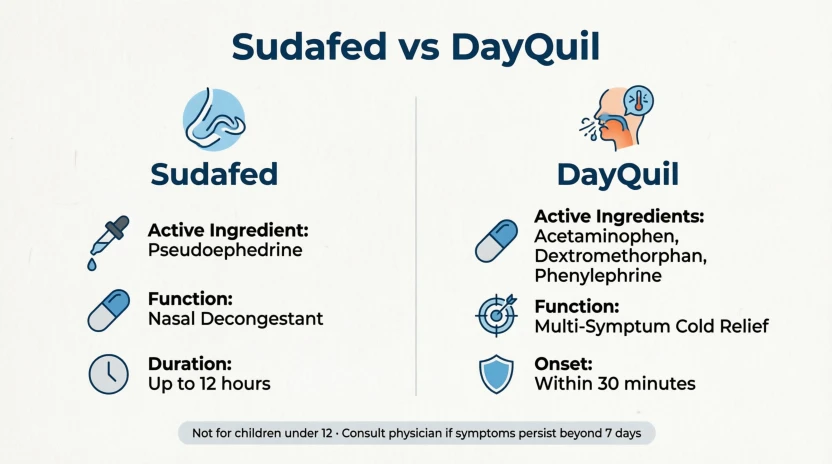
Sudafed or DayQuil may both help relieve cold symptoms, but they are not the same medicine. Sudafed is best known for relieving a blocked nose, while DayQuil Cold & Flu is designed to relieve several symptoms at once, such as a cough, fever, headache, and nasal congestion, depending on the product.
The right choice depends on what is bothering you most. If your main problem is a stuffy nose, a suitable Sudafed product may help. If you have several cold symptoms at the same time, a DayQuil formula may seem more convenient. However, the ingredients matter more than the brand name.
Another common source of confusion is that both brands have different products. Some contain more than one active ingredient, and their formulas can vary by country. This matters because taking two medicines with overlapping ingredients can increase the risk of side effects or an accidental overdose.
In this guide, you will learn the key differences between Sudafed and DayQuil, what each medicine treats, how their ingredients compare, and what to check before using either one.
Sudafed or DayQuil: Quick Answer
Sudafed is mainly used to relieve nasal congestion, while DayQuil Cold & Flu is designed to relieve several cold and flu symptoms. The best option depends on your symptoms and the active ingredients in the specific product.
- Choose a suitable Sudafed product: If a blocked nose or sinus pressure is your main concern.
- Consider DayQuil Cold & Flu: If you also need relief from a cough, fever, headache, or minor body aches.
- Check the label first: Not every Sudafed or DayQuil product contains the same ingredients.
Neither medicine cures a cold or flu. Both provide temporary symptom relief, and neither is right for everyone.
Sudafed vs. DayQuil: Quick Comparison
| Feature | Sudafed | DayQuil Cold & Flu |
| Main purpose | Nasal congestion relief | Relief of several cold symptoms |
| Blocked nose | Depends on the active ingredient | Some formulas include an oral decongestant |
| Cough relief | Only if the specific formula includes a cough medicine | Many Cold & Flu formulas include a cough suppressant |
| Fever relief | Only if the formula includes a fever reducer | Many Cold & Flu formulas contain acetaminophen |
| Headache relief | Depends on the formula | Many formulas contain acetaminophen |
| Number of ingredients | One or more, depending on the product | Often several active ingredients |
| Main caution | Decongestants may affect blood pressure and heart rate | Ingredients may overlap with other cold or pain medicines |
This table describes common US products, not every product sold under either brand. Always check the exact package before taking a medicine.
What Does Sudafed or DayQuil Mean?

What Is Sudafed?
Sudafed is a brand name used for products that treat nasal and sinus congestion. Some US Sudafed products contain pseudoephedrine, a decongestant that reduces swelling in the nasal passages.
When the tissues inside your nose swell, air and mucus have less room to move. A suitable decongestant can reduce that swelling and make breathing through your nose easier.
Sudafed products may help with:
- A blocked or stuffy nose.
- Sinus pressure caused by congestion.
- Nasal congestion related to a cold or allergies.
However, the Sudafed name alone does not tell you every ingredient in the package. Combination products may contain additional medicines for other symptoms.
Pseudoephedrine can raise blood pressure and heart rate. People with high blood pressure, heart disease, certain other medical conditions, or specific medicine interactions should speak with a pharmacist or clinician before using it.
What Is DayQuil?
DayQuil is a brand of daytime cold and flu medicines. Many US DayQuil Cold & Flu products combine several active ingredients to address more than one symptom.
A common US DayQuil Cold & Flu formula contains:
- Acetaminophen: Helps reduce fever and relieve minor aches and pains.
- Dextromethorphan: Helps suppress a cough.
- Phenylephrine: Included as an oral nasal decongestant in some formulas.
Other DayQuil products may have different ingredients. For example, a severe-symptom formula may also contain guaifenesin, which helps loosen mucus in the airways.
DayQuil is often marketed as a non-drowsy daytime option. However, that does not mean it is suitable for every person or every activity.
One important detail is that the US Food and Drug Administration has proposed removing oral phenylephrine from certain over-the-counter products because available evidence did not support its effectiveness as a nasal decongestant. The proposed action concerns effectiveness, not a finding that the ingredient is unsafe. Check current guidance and the label for your product.
Sources: DailyMed’s Sudafed label, DailyMed’s DayQuil label, and FDA information on oral phenylephrine.
The Origin of Sudafed and DayQuil
Sudafed and DayQuil are brand names, not names for a single active drug. Their different purposes reflect the kinds of symptoms their products are designed to relieve.
Sudafed is associated primarily with decongestant products. DayQuil is associated with daytime cold and flu symptom relief, often through a combination of active ingredients.
This distinction matters because brand names do not always describe the full contents of a medicine. A product may be reformulated, sold in different strengths, or marketed under a slightly different name in another country.
For safe use, focus on three details:
- The active ingredients.
- The symptoms listed on the package.
- The warnings and directions for that specific product.
These details are more useful than choosing a medicine based on its brand name alone.
British English vs. American English: Product Differences
Unlike spelling comparisons, Sudafed vs. DayQuil is mainly a medicine comparison, not a language difference. However, regional product differences are important because the same brand may not have the same formula in every country.
| Feature | United Kingdom | United States |
| Sudafed | A range of products is sold under the brand | Products include pseudoephedrine decongestants and other formulations |
| DayQuil | US DayQuil products may not be routinely available through standard UK retail channels | Several daytime cold and flu formulations are available |
| Active ingredients | Depend on the product | Depend on the product |
| Buying restrictions | Some decongestants have pharmacy restrictions | Pseudoephedrine sales are subject to federal and state requirements |
| Best approach | Read the UK package and patient leaflet | Read the US Drug Facts label |
Do not assume that a product with a familiar brand name has the same ingredients abroad. If you are travelling, ask a local pharmacist to help you compare the active ingredients.
Which Version Should You Use?
The safest choice depends on your symptoms, health history, other medicines, and location. The following advice is general information, not a personal diagnosis or prescription.
United States
If nasal congestion is your main symptom, a suitable single-ingredient decongestant may be worth discussing with a pharmacist. If you also have a cough, fever, and aches, a multi-symptom DayQuil product may cover more of your symptoms.
Remember that not every DayQuil formula contains the same ingredients, and oral phenylephrine has effectiveness concerns.
United Kingdom
Check which products are actually available locally. Sudafed products vary, and UK products may have different ingredients from similarly named US products.
Do not assume that DayQuil sold or discussed online has the same formula as a UK cold medicine. A pharmacist can help you compare the ingredients and find an appropriate alternative.
Canada
Read the Canadian product label rather than relying on US product descriptions. Brand availability, approved formulations, and directions may differ.
Ask a pharmacist if a single-symptom medicine or a combination product is more appropriate.
Australia
Check the Australian packaging and official medicine information. Do not import US dosing instructions or assume that a product has the same ingredients as one sold locally.
A pharmacist can help you choose an option based on your symptoms and other medicines.
International Writing and General Advice
For an international audience, describe medicines by their active ingredients and purpose. Explain that Sudafed and DayQuil formulas can differ by country.
This approach avoids giving readers advice that may not match the medicine available in their region.
Academic Writing
Use official product labels, government medicine regulators, and reputable clinical guidance as references. Distinguish between a brand name and an active ingredient.
Avoid claims that one brand is universally better. The answer depends on the formulation and the symptoms being treated.
Business and Health Writing
Use clear language and avoid suggesting that a medicine cures a cold. Explain what symptoms it may temporarily relieve and highlight relevant safety warnings.
For health articles, link to reliable sources and make it easy for readers to check the exact product label.
Common Mistakes When Choosing Sudafed or DayQuil
| Common mistake | Better approach | Why it matters |
| Assuming all Sudafed products contain the same drug | Check the active ingredients | Formulas vary |
| Assuming DayQuil treats every cold symptom | Read the list of uses | Some symptoms may not be covered |
| Taking both without checking the labels | Ask a pharmacist to review both products | Ingredients or effects may overlap |
| Taking extra medicine for a persistent fever | Follow the label and seek advice when needed | Some ingredients can cause serious harm in excess |
| Assuming non-drowsy means risk-free | Read warnings and consider how you feel | Side effects and individual reactions still matter |
| Ignoring blood pressure concerns | Ask a clinician or pharmacist about decongestants | Some can raise blood pressure and heart rate |
Memory Tip
Think of Sudafed as congestion-focused and DayQuil as multi-symptom relief. This is a useful general guide, but the active ingredients on the package are the final check.
Everyday Examples: When Might Each Medicine Be Considered?
These examples explain how symptom patterns affect the choice. They are not instructions to take a particular medicine.
Example 1: A Blocked Nose
You have a stuffy nose, but no fever or cough.
A suitable decongestant may address the main symptom. Ask a pharmacist if pseudoephedrine is appropriate for you, especially if you have high blood pressure or heart problems.
Example 2: A Cough and Fever
You have a cough, a headache, and a raised temperature.
A DayQuil formula that contains a cough suppressant and acetaminophen may cover more of these symptoms. Check if the product contains other ingredients you do not need, and avoid combining it with another medicine containing acetaminophen.
Example 3: Congestion and Body Aches
Your nose is blocked, and your muscles ache.
A multi-symptom product may seem convenient, but convenience is not the only factor. Compare its ingredients with your symptoms and check if you can safely use each ingredient.
Example 4: A Cold While Taking Other Medicines
You already take prescription medicines or another cold remedy.
Do not add Sudafed or DayQuil until you have checked for interactions and overlapping ingredients. A pharmacist can review the exact products and help you avoid taking the same ingredient twice.
Example 5: Symptoms That Are Getting Worse
Your symptoms are severe, last longer than expected, or improve and then become worse.
Do not keep adding cold medicines to manage the problem. Seek medical advice, particularly if you have difficulty breathing, chest pain, dehydration, or a persistent high fever.
Google Trends and Modern Usage
People search for “Sudafed or DayQuil” because both brands are linked to cold relief, but they serve different purposes. The search often reflects a practical question: Should I choose a medicine for a blocked nose or one that covers several symptoms?
Other common searches include:
- Sudafed vs. DayQuil for congestion.
- Can you take Sudafed and DayQuil together?
- Which is better for a cough and a stuffy nose?
- What is the difference between pseudoephedrine and phenylephrine?
- Does DayQuil help with sinus pressure?
These queries show why a useful comparison should explain the ingredients, not just the brands.
No specific Google Trends figures are presented here. Without checking a defined country, date range, and search term comparison, it would be misleading to claim that one brand is more popular than the other.
For readers, the most useful takeaway is simple: choose based on the symptoms you need to treat, the ingredients in the exact product, and your personal safety considerations.
Sudafed vs. DayQuil: Quick Comparison Table
| Version | Main purpose | Correct choice? | Typical context | Example |
| Sudafed with pseudoephedrine | Relieves nasal congestion | May be suitable | A blocked nose or sinus congestion | “My main symptom is a stuffy nose.” |
| DayQuil Cold & Flu | Relieves several cold symptoms | May be suitable | Cough, fever, aches, and other listed symptoms | “I have a cough and a headache.” |
| Sudafed combination product | Depends on its ingredients | Check the label | Congestion plus other symptoms | “This product contains more than one active ingredient.” |
| DayQuil Severe | Broader symptom relief in some formulas | Check the label | Multiple symptoms, potentially including mucus | “I need to check if this formula covers my symptoms.” |
There is no universal winner. The best option is the one that safely addresses your symptoms without exposing you to unnecessary ingredients.
Key Takeaways
- Sudafed is mainly associated with nasal decongestion.
- DayQuil Cold & Flu often treats several symptoms at once.
- Formulations vary by product and country.
- Pseudoephedrine can raise blood pressure and heart rate.
- Some DayQuil formulas contain acetaminophen, so avoid accidental duplication with other medicines.
- Oral phenylephrine has documented effectiveness concerns in the United States.
- Do not combine Sudafed and DayQuil without checking their ingredients and getting appropriate advice.
- Ask a pharmacist if you have a medical condition, take other medicines, or are unsure which product is suitable.
FAQs About Sudafed or DayQuil
1. Is Sudafed or DayQuil better for a stuffy nose?
Sudafed containing pseudoephedrine may be a useful option for nasal congestion if it is suitable for you. DayQuil products may also list congestion relief, but some US formulas contain oral phenylephrine, whose effectiveness as a nasal decongestant is under review by the FDA. Check the ingredients and ask a pharmacist if you are unsure.
2. Is Sudafed stronger than DayQuil?
Neither brand is always stronger. Sudafed products may focus on congestion, while DayQuil products often combine several ingredients for different symptoms. The effect depends on the active ingredients, dose, and formulation. Comparing the brand names alone does not provide a reliable measure of strength or effectiveness.
3. Can you take Sudafed and DayQuil together?
Do not combine them without checking the exact labels and consulting a pharmacist or clinician. Some products may have overlapping effects or ingredients, and pseudoephedrine may interact with certain medicines. DayQuil may also contain acetaminophen or other ingredients that require special care. A professional can check the specific products for you.
4. Does Sudafed help with a cough?
A single-ingredient Sudafed product containing pseudoephedrine is intended to relieve nasal congestion, not directly suppress a cough. If your cough is caused by mucus draining from your nose, treating the congestion may help some people. A persistent or severe cough may need a different approach.
5. Does DayQuil help with sinus pressure?
Some DayQuil formulas are labelled for nasal congestion and related cold symptoms, but the effect depends on the ingredients. Do not assume that every formula provides effective sinus relief. If sinus pain is severe, persistent, or accompanied by worsening symptoms, ask a healthcare professional for advice.
6. Does DayQuil contain acetaminophen?
Many US DayQuil Cold & Flu formulas contain acetaminophen, also called paracetamol in the UK and some other countries. It helps reduce fever and relieve minor aches and pains. Check your exact label and do not combine it with another product containing the same ingredient unless a healthcare professional advises you how to do so safely.
7. Can Sudafed raise blood pressure?
Yes. Sudafed products containing pseudoephedrine can raise blood pressure and heart rate. People with high blood pressure, heart disease, or certain other conditions should consult a pharmacist or clinician before using them. Seek professional advice if you take blood pressure medicines or other drugs that may interact with decongestants.
8. Is DayQuil safe to take every day?
DayQuil is intended for short-term symptom relief according to the product directions, not routine daily use without a clear reason. Taking it too often or combining it with other medicines may increase the risk of side effects. Follow the package instructions and seek medical advice if your symptoms persist or worsen.
9. Is Sudafed or DayQuil better for the flu?
Neither medicine treats the flu virus itself. They may provide temporary relief for certain symptoms, depending on their ingredients. Flu can sometimes cause serious complications, especially in people at higher risk. Seek medical advice promptly if you have severe symptoms or may benefit from early antiviral treatment.
10. Which is safer, Sudafed or DayQuil?
Neither is automatically safer for everyone. Sudafed containing pseudoephedrine may be unsuitable for people with certain heart or blood pressure conditions. DayQuil may contain several ingredients, which can increase the risk of accidental duplication with other medicines. The safest choice depends on your health, other medicines, and the exact product label.
Conclusion: Sudafed or DayQuil?
When comparing Sudafed or DayQuil, the main difference is the range of symptoms each product is designed to treat. Sudafed is mainly associated with nasal congestion relief, while DayQuil Cold & Flu often combines ingredients to address a cough, fever, headache, and other cold symptoms.
If your main concern is a blocked nose, a suitable decongestant may be enough. If you have several symptoms, a multi-symptom product may be more convenient, but it can also expose you to ingredients you do not need.
Always check the active ingredients before choosing either medicine. This is especially important if you take other medicines, have high blood pressure or heart disease, are pregnant, or are buying a product outside the United States.
Do not assume that two products are safe to combine just because they have different brand names. If you are unsure, ask a pharmacist to review the exact products and your symptoms.
The best cold medicine is not the one with the most ingredients. It is the one that safely treats the symptoms you actually have. Share this guide with anyone who needs help understanding the difference.
Read more about!
- Coworker or Colleague: What’s the Difference?
- NutriBullet or Ninja: Which Blender Is Better
- Soot or Sut: Which Spelling Is Correct?

I’m Olivia Parker, a grammar and English writing enthusiast passionate about making English simple and easy to understand. Through Wordsblog, I share clear explanations, useful grammar tips, and practical writing guidance to help readers write with confidence. My goal is to make learning English easier, one word at a time.