A caregiver is a person who looks after someone who needs help, while a caretaker is someone who takes care of a person, property, building, or place. Both words can describe a person who provides care, but their meanings and common uses differ by context and region.
The confusion often comes from the fact that both words can describe someone who helps another person with daily needs. For example, a person who helps an parent may be called a caregiver in the United States, while caretaker may be used in some settings to describe a person responsible for someone’s well-being or a property.
Choosing the right word matters in healthcare, job descriptions, family conversations, and professional writing. It can also depend on if you are writing for an American, British, or international audience.
In this guide, you will learn what caregiver and caretaker mean, how their use differs across regions, and which term works best in everyday and professional situations. You will also find practical examples, common mistakes, and answers to frequently asked questions.
Caregiver or Caretaker: The Short Answer
A caregiver usually provides personal support to someone who needs help because of age, illness, disability, or another need. A caretaker often looks after a building, property, or place, although it can also mean someone who cares for a person. In American English, caregiver is common in healthcare contexts. In British English, carer is also widely used for a person who looks after someone.
Caregiver or Caretaker: Quick Answer
Use caregiver when you mean someone who helps another person with daily activities, personal needs, or health-related care. Use caretaker when you mean someone responsible for maintaining a property, building, or place.
Examples:
- Caregiver: Maria is the primary caregiver for her father.
- Caretaker: The school caretaker checks the building each morning.
- Both may fit: A person who supports someone who needs daily assistance may be described as a caregiver or caretaker, depending on the region and context.
The best choice depends on what the person looks after and what duties they perform.
What Does Caregiver or Caretaker Mean?
What Does Caregiver Mean?
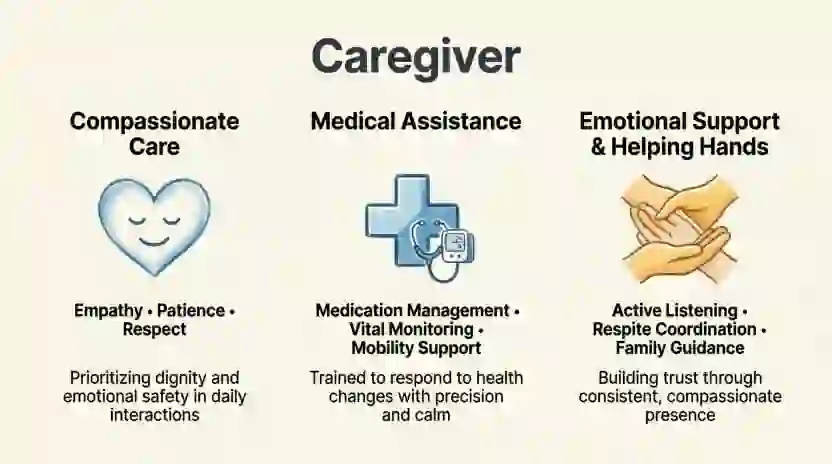
A caregiver is someone who provides help and support to another person who needs care. This support may be physical, emotional, or practical.
Caregivers often help older adults, people with disabilities, people recovering from illness, or children who need special support.
Common caregiver duties include:
- Helping with bathing, dressing, or eating.
- Preparing meals and managing household tasks.
- Helping someone attend medical appointments.
- Offering emotional support and companionship.
- Assisting with medication routines as directed by a healthcare professional.
A caregiver may be a family member, a friend, or a paid professional. The word does not automatically mean the person has medical training or a professional license.
Example: “James became his mother’s caregiver after she had surgery.”
This sentence shows that James helps his mother with her needs during recovery.
What Does Caretaker Mean?
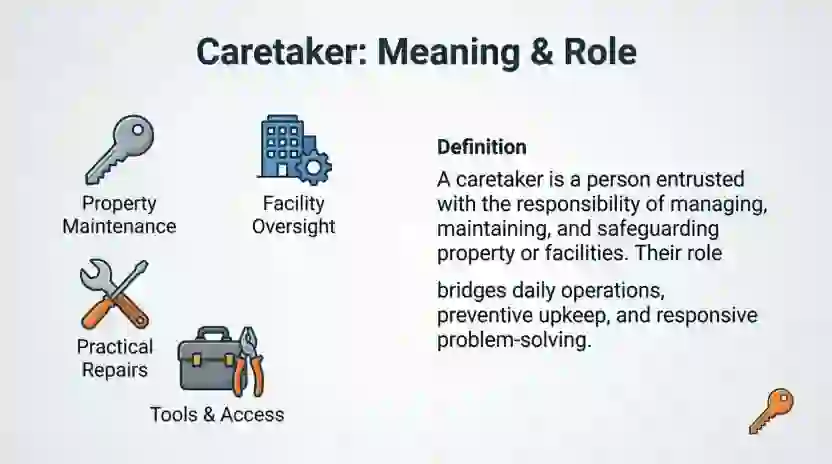
A caretaker is someone who takes responsibility for looking after a person, building, property, or other place. The exact meaning depends on the context.
In many everyday and employment settings, caretaker refers to someone who maintains a property or ensures that a building remains safe and in good condition.
Common caretaker duties include:
- Checking and securing a building.
- Reporting maintenance problems.
- Keeping a property clean and orderly.
- Monitoring equipment or facilities.
- Looking after a site when the owner is away.
Caretaker can also describe someone who looks after a person, especially in certain regional or personal contexts. Therefore, it is not always wrong to use caretaker for a person who provides personal care.
Example: “The caretaker repaired the gate and checked the school grounds.”
Here, caretaker refers to someone responsible for maintaining a place, not providing personal care.
Is There an Overlap Between the Two Words?
Yes. Both words relate to looking after someone or something.
The difference is usually one of emphasis:
- Caregiver emphasizes the care and support given to a person.
- Caretaker often emphasizes responsibility for a person, property, or place.
- Carer is another common term for someone who looks after a person, particularly in British English.
When writing a job advertisement or professional document, choose the term that best describes the actual duties.
The Origin of Caregiver and Caretaker
Where Does the Word Caregiver Come From?
Caregiver combines care and giver. The word describes someone who gives care to another person.
The word fits naturally into healthcare and social care language because it focuses on the help provided to a person. It is widely used in American English, including discussions about family caregiving, elder care, and support for people with disabilities.
The related word caregiving describes the act or process of providing that care.
Where Does the Word Caretaker Come From?
Caretaker combines care and taker. It describes someone who takes responsibility for looking after a person or thing.
The word has long been associated with duties such as maintaining buildings, watching over property, and managing places on behalf of others. It can also refer to someone temporarily responsible for a role or organization.
For example, an interim caretaker government is a temporary government that manages public affairs until a longer-term arrangement is established.
Why Are the Words Used Differently?
The words developed around a shared idea: looking after someone or something. Their modern uses differ because English often uses specific terms for different kinds of responsibility.
Caregiver highlights the act of giving support. Caretaker often highlights the responsibility of watching over or maintaining something.
These are usage patterns, not absolute rules. Context and local English conventions still matter.
British English vs. American English
The distinction between caregiver and caretaker is not simply a difference in spelling. Both words are used in English-speaking countries, but some terms are more natural in particular contexts.
| Context | British English | American English | Example |
| Someone who supports an older relative | Carer or caregiver | Caregiver | She is her father’s caregiver. |
| Professional personal support | Carer or care worker, depending on the role | Caregiver or care worker, depending on the role | He works as a care worker. |
| Person responsible for a school building | Caretaker | Janitor, custodian, or caretaker, depending on duties | The caretaker checks the school. |
| Person who maintains a property | Caretaker | Caretaker or property manager, depending on duties | The caretaker looks after the house. |
| Temporary person in charge | Caretaker | Caretaker or interim manager, depending on context | A caretaker manager took over. |
British English Usage
In the United Kingdom, carer is a common term for someone who looks after a person who needs help. Caregiver is also understood and used, particularly in international or healthcare-related contexts.
For building maintenance, caretaker is a familiar job title. A school caretaker, for instance, may maintain the premises and help keep the building secure.
American English Usage
In the United States, caregiver is widely used for people who support family members, older adults, and individuals with health or daily living needs.
For people who maintain buildings, Americans may use caretaker, custodian, or janitor. These titles are not always interchangeable because their duties can differ.
What About Style Guides?
Professional style guides usually favor words that are clear and appropriate for the intended audience. If you are writing for a US healthcare audience, caregiver is often a natural choice. If you are writing for a UK audience, carer may sound more familiar.
For a job title, use the official title when one exists. For general writing, explain the person’s duties if the distinction could confuse readers.
Which Version Should You Use?
The right word depends on your audience, the person’s responsibilities, and the type of writing you are doing.
United States
Use caregiver when referring to someone who helps a person with daily activities or personal needs.
Examples:
- “My sister is the main caregiver for our grandmother.”
- “The hospital provided information for family caregivers.”
Use caretaker for someone who looks after a building or property. In schools, hospitals, and other facilities, custodian or janitor may be more appropriate, depending on the job.
United Kingdom
Use carer when referring to someone who looks after a relative or another person who needs support. Caregiver is also correct, especially when communicating with an international audience.
Use caretaker for someone responsible for maintaining a building, such as a school or residential property.
Example: “The school caretaker unlocked the main entrance.”
Canada
Both caregiver and caretaker are used in Canada. Caregiver is suitable for personal and family care, while caretaker often refers to someone responsible for a property or facility.
For formal writing, check the terminology used by the relevant Canadian healthcare organization, employer, or government department.
Australia
In Australia, carer is a familiar term for someone who provides support to another person. Caregiver is also understood.
Caretaker commonly refers to a person who maintains a property or looks after a place. However, the precise meaning can vary by job and setting.
International Writing
For an international audience, choose the word that communicates the role most clearly.
- Use caregiver for personal support.
- Use caretaker for property maintenance or supervision.
- Consider carer when writing specifically for a British or Australian audience.
If your readers come from several countries, define the role on first use.
Academic Writing
In academic writing, precision matters more than choosing one word for every situation.
Use caregiver when discussing family care, elder care, disability support, or a person who helps someone with daily living. Use caretaker when the research concerns property maintenance or a role specifically described by that term.
If you are writing about a research study, follow the terminology used by the researchers. Do not replace a study’s defined term with another word without a reason.
Business Writing
In business writing, use the correct job title and describe the duties clearly.
For example:
- Caregiver job advertisement: “We are seeking a caregiver to support clients with daily living activities.”
- Caretaker job advertisement: “We are seeking a caretaker to maintain the building and report repair needs.”
Avoid using the two words interchangeably in employment contracts or job descriptions when the duties are different.
Common Mistakes When Using Caregiver and Caretaker
People often confuse these terms because both involve responsibility and care. The following examples show how to choose the more suitable word.
| Incorrect or less suitable example | Better example | Explanation |
| The caregiver repaired the school’s broken door. | The caretaker repaired the school’s broken door. | Caretaker better fits building maintenance. |
| She is the caretaker of her sick father in a US healthcare article. | She is her father’s caregiver. | Caregiver is more natural for personal support in this context. |
| The caretaker helps people with bathing and meals. | The caregiver helps people with bathing and meals. | Caregiver makes the personal-care role clear. |
| The caregiver checks the empty office building every night. | The caretaker checks the empty office building every night. | Caretaker is more suitable for property supervision. |
| A caregiver must always be a trained nurse. | A caregiver may be a family member or a paid professional. | The word does not automatically imply nursing qualifications. |
Some examples in the first column are not grammatically wrong. They are simply less precise for the intended meaning or audience.
Mistake 1: Assuming Caretaker Is Always Wrong for Personal Care
Caretaker can refer to someone who looks after a person. The word is not automatically incorrect when used this way.
However, caregiver is often clearer in American healthcare writing, while carer is common in British English.
Mistake 2: Assuming Caregiver Means a Medical Professional
A caregiver may be a spouse, adult child, friend, or paid support worker. Some caregivers have professional training, but the word alone does not establish their qualifications.
If training matters, state the person’s actual role, such as registered nurse, home health aide, or personal care assistant.
Mistake 3: Choosing a Word Without Considering the Audience
A term that sounds natural in one country may be less familiar in another.
For example, a UK reader may expect carer in a discussion about family support, while a US reader may expect caregiver.
An Easy Memory Tip
Think of the two words this way:
- Caregiver = gives care to a person.
- Caretaker = takes care of a person, place, or property.
This is a helpful guide, not a strict grammatical rule. Always consider the context.
Everyday Examples of Caregiver and Caretaker
Examples make the difference easier to remember. Here is how the two words work across common types of writing.
1. Emails
Caregiver:
“Please let me know if the appointment time changes. I need to arrange transportation for the person I care for.”
Caretaker:
“I have contacted the caretaker about the heating problem in the building.”
The first example concerns personal support. The second concerns property maintenance.
2. Business Writing
Caregiver:
“Our organization provides resources for family caregivers who support older adults.”
Caretaker:
“The caretaker is responsible for checking the building and reporting maintenance issues.”
In business writing, the duties should make the meaning clear.
3. News Headlines
Caregiver:
“Local Caregiver Helps Older Residents Remain Independent”
Caretaker:
“School Caretaker Praised for Keeping the Building Safe”
Both headlines use the word that best fits the role being described.
4. Blogs
Caregiver:
“Five Ways to Support a Family Caregiver”
Caretaker:
“What to Include in a Caretaker Job Description”
A blog about family support would usually use caregiver or carer. A blog about property upkeep would more naturally use caretaker.
5. Social Media
Caregiver:
“Today, we are celebrating the family caregivers who provide daily support and encouragement.”
Caretaker:
“Our caretaker team has worked hard to prepare the community hall for the weekend event.”
The surrounding words help readers understand each role.
6. Academic Writing
Caregiver:
“The study examined stress levels among caregivers of people with long-term illnesses.”
Caretaker:
“The report reviewed the duties of caretakers employed in public buildings.”
Academic writing should use precise terms that match the study, report, or research question.
7. Daily Conversation
Caregiver:
“My brother is Dad’s main caregiver, so he helps with his meals and appointments.”
Caretaker:
“Ask the caretaker if we can use the storage room.”
These are natural examples of how context helps determine the right word.
Google Trends and Modern Usage
People search for caregiver or caretaker because the words share a similar meaning but are not always used in the same situations. Readers may be writing a job description, helping a family member, completing an assignment, or deciding which term sounds natural in their country.
Which Word Is More Common?
Usage depends on the setting.
- Caregiver is widely used in American healthcare, family support, and elder-care discussions.
- Caretaker is commonly associated with building maintenance, property supervision, and certain temporary leadership roles.
- Carer is widely used in British English and is also familiar in Australian contexts.
These are general usage patterns, not exact rankings from a live search comparison.
Why Do People Confuse Them?
Both words contain care, and both can describe someone responsible for another person or thing. Their meanings also overlap in some contexts.
A person may see caretaker used for a person in one article and caregiver used in another, then assume one must be incorrect. In reality, context and regional preference often explain the difference.
What About Google Trends?
Google Trends can help compare search interest over a selected period and in a particular region. However, search interest is not the same as overall word frequency or correctness.
Without checking a specific live comparison, it would be misleading to claim that one term has a particular percentage advantage over the other.
For practical writing, the most useful question is not which word gets more searches. It is which word accurately describes the role and matches the intended audience.
Quick Comparison Table
| Version | Meaning | Correct? | Region or context | Example |
| Caregiver | Someone who provides personal support | Yes | Common in US English | She is her mother’s caregiver. |
| Caretaker | Someone who maintains or supervises a property | Yes | Common in property-related contexts | The caretaker opened the school. |
| Caretaker | Someone who looks after a person | Yes, in suitable contexts | Depends on region and usage | He became her caretaker. |
| Carer | Someone who supports another person | Yes | Common in UK English | She works as a carer. |
| Care worker | Someone who provides care as part of a role | Yes | Professional care settings | He is a care worker. |
| Custodian | Someone responsible for maintaining a building | Yes | Common in US workplaces | The custodian cleaned the hall. |
The key point is that caregiver and caretaker are both correct words, but they are not always interchangeable. Choose the word that best describes the person’s responsibilities.
Key Takeaways
- A caregiver usually provides personal help and support to someone who needs care.
- A caretaker often looks after a building, property, or place.
- Caretaker can also describe someone who looks after a person in certain contexts.
- Caregiver is widely used in American healthcare and family-care discussions.
- Carer is common in British English and familiar in Australia.
- Caregiver does not automatically mean a trained medical professional.
- In professional writing, choose the word that matches the actual duties.
- When writing for an international audience, explain the role if the term might be unclear.
FAQs About Caregiver or Caretaker
1. Is caregiver or caretaker the correct word?
Both words are correct, but they often describe different roles. Caregiver is generally the better choice for someone who provides personal support to another person. Caretaker often refers to someone who maintains or supervises a building or property. Context matters because caretaker can also describe a person who looks after someone.
2. What is the main difference between a caregiver and a caretaker?
A caregiver usually helps a person with daily activities, personal needs, or health-related support. A caretaker often takes responsibility for a property, building, or place. The words overlap in some uses, so the best choice depends on the person’s duties and the audience’s regional English.
3. Is caregiver one word or two?
Caregiver is normally written as one word. It combines care and giver to describe someone who provides care. The related word caregiving is also written as one word. In standard writing, avoid forms such as “care giver” unless a particular source or style specifically requires that form.
4. Is caretaker an offensive word?
No. Caretaker is not generally considered offensive. It is a standard English word used for people who look after buildings, properties, and, in some contexts, other people. However, a different term may be more suitable in healthcare or social care. Use the person’s preferred title when referring to their role.
5. Is caregiver the American word and caretaker the British word?
Not exactly. Caregiver is widely used in American English for someone who supports another person, while carer is common in British English. Caretaker is also used in Britain, especially for someone who maintains a building. Both caregiver and caretaker are understood in several English-speaking countries.
6. Can a family member be called a caregiver?
Yes. A family member who helps another person with meals, daily activities, appointments, or other needs can be called a caregiver. The person does not have to be paid or hold a medical qualification. In British English, family carer may be a more familiar alternative.
7. What is a caretaker at a school?
A school caretaker is generally responsible for maintaining the school premises and helping keep the building secure and functional. Duties may include checking doors, reporting repairs, and overseeing basic maintenance. In the United States, similar roles may be called custodian or facilities worker, depending on the responsibilities.
8. What is the difference between a caregiver and a care worker?
A caregiver is a broad term for someone who provides care, including an unpaid family member. A care worker usually refers to someone who provides care as part of a job, particularly in a professional care setting. Exact job titles vary by employer and country, so check the relevant role description.
9. What is the British word for caregiver?
Carer is a common British English term for someone who looks after another person who needs support. For example, “She is a carer for her mother.” Caregiver is also understood in the UK, especially in international or healthcare-related writing, but carer often sounds more natural to British readers.
10. Which word should I use in a job description?
Choose the word that clearly matches the job. Use caregiver for a role focused on personal support and daily living needs. Use caretaker for a role focused on property supervision or maintenance. If the position involves professional personal care, check if the employer uses a more specific title, such as care worker or personal care assistant.
Conclusion: Caregiver or Caretaker?
Choosing between caregiver and caretaker becomes easier when you focus on the person’s responsibilities.
A caregiver usually provides personal support to someone who needs help with daily activities, illness, disability, or age-related needs. A caretaker often looks after a building, property, or place, although the word can also refer to someone who cares for a person.
Regional usage matters, too. In the United States, caregiver is common in healthcare and family-care discussions. In the United Kingdom, carer is a familiar alternative, while caretaker often refers to someone who maintains a building.
For everyday writing, use caregiver when you mean personal care and caretaker when you mean property maintenance or supervision. For professional documents, follow the official job title and describe the duties clearly.
Neither word is universally better. The best choice is the one that expresses your intended meaning and suits your audience.
Remember: A caregiver gives personal support, while a caretaker often looks after a place. Explore more word comparisons on Wordsblog to make your English clearer and more confident.
Read more about!
- Delt or Dealt: Which Spelling Is Correct?
- Hybrid vs. Indica: What’s the Difference?
- Believes or Beliefs: Which Word Is Correct?

I’m Olivia Parker, a grammar and English writing enthusiast passionate about making English simple and easy to understand. Through Wordsblog, I share clear explanations, useful grammar tips, and practical writing guidance to help readers write with confidence. My goal is to make learning English easier, one word at a time.