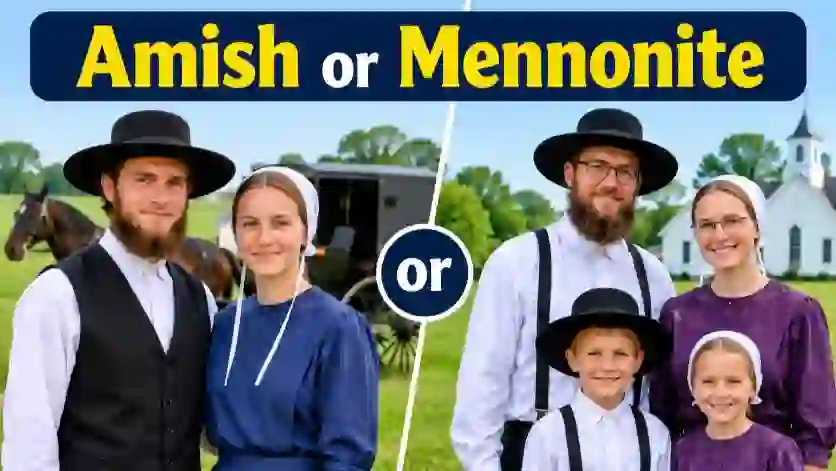
People often confuse the Amish and Mennonites because they share similar religious beliefs, historical roots, and traditional ways of life. However, Amish and Mennonite are two distinct Christian groups within the Anabaptist tradition. The main differences involve their approach to modern technology, clothing, transportation, education, and interaction with the outside world.
Both groups value faith, family, community, simplicity, and peace. Yet they do not follow all the same rules. Many Amish communities limit modern technology and maintain a separate way of life. Most Mennonites, on the other hand, take part in modern society while keeping their Christian beliefs and traditions.
This is why people often search for Amish or Mennonite when they see people wearing plain clothes, traveling in horse-drawn buggies, or living in close-knit communities. Their appearance can look similar, but their daily practices are not always the same.
In this guide, you will learn what Amish and Mennonite mean, where these groups came from, how their beliefs compare, and how to recognize their differences without making common assumptions.
Amish or Mennonite: The Quick Answer
Amish and Mennonites are Christian groups that share Anabaptist roots but differ in how they practice their faith.Communities generally follow stricter rules about technology, clothing, and separation from mainstream society. Most Mennonites have a more flexible approach and use modern technology. However, both groups have conservative and progressive branches.
Amish or Mennonite: Quick Answer
The simplest way to understand Amish or Mennonite is to look at their lifestyles.
- Amish: Generally follow traditional customs, plain clothing, and restrictions on modern technology. Many Old Order Amish use horse-drawn buggies instead of owning cars.
- Mennonite: Follow Anabaptist Christian beliefs but usually have fewer restrictions on technology, transportation, and modern lifestyles.
For example:
- An Old Order Amish family may travel by horse and buggy, while a Mennonite family may drive a car.
- Some Amish communities avoid public electricity, while many Mennonites use electricity in their homes.
- Some conservative Mennonites wear plain clothing, while other Mennonites dress like people in mainstream society.
Important: These are general differences, not rules that apply to every individual. There are conservative Mennonite communities and more progressive Amish-related groups.
What Does Amish or Mennonite Mean?
To understand the difference, it helps to look at each group’s meaning, beliefs, and lifestyle separately.
What Does Amish Mean?
The word Amish refers to members of a Christian religious group that follows the teachings and traditions associated with Jakob Ammann, a Swiss Anabaptist leader.
The Amish formed a separate religious movement in the late 17th century. They place strong importance on faith, family, community, humility, and separation from aspects of mainstream society.
Many traditional Amish communities follow a set of local rules known as the Ordnung. This system guides everyday life, including clothing, technology, transportation, and social activities.
Common Amish practices include:
- Wearing simple and modest clothing.
- Using horse-drawn buggies in Old Order communities.
- Limiting access to certain modern technologies.
- Attending community-based religious services.
- Placing family and church life at the center of daily activities.
- Valuing humility and cooperation.
Not all Amish communities follow exactly the same rules. Each congregation can make decisions about how its members should live.
What Does Mennonite Mean?
The word Mennonite refers to members of a Christian Anabaptist tradition named after Menno Simons, a Dutch religious leader.
Mennonites believe in following the teachings of Jesus Christ. They place importance on peace, community, helping others, adult baptism, and living according to Christian values.
Unlike many traditional Amish communities, most Mennonites participate in modern society. They may drive cars, use smartphones, attend universities, and work in different professions.
Common Mennonite values and practices include:
- Following the teachings of Jesus.
- Supporting peace and nonviolence.
- Helping people in need.
- Valuing family and community.
- Practicing simple and responsible living.
- Supporting religious freedom and service.
Mennonite communities are diverse. Some follow traditional clothing and lifestyle practices, while others look and live much like the general population.
Mennonite Church USA also explains that Mennonite groups differ in how they express their shared Anabaptist beliefs.
The Origin of Amish or Mennonite
Amish and Mennonite history goes back to the Protestant Reformation in 16th-century Europe.
Although these groups eventually became separate branches, they share a common religious background.
Where Did the Mennonites Come From?
The Anabaptist movement began in Europe in the 1500s. Its followers challenged the practice of baptizing infants.
They believed people should choose baptism after they understood and accepted their faith.
In 1536, Menno Simons, a former Dutch Catholic priest, joined the Anabaptist movement. He became an important religious leader and writer.
Over time, many followers of his teachings became known as Mennonites.
Their religious principles included:
- Adult baptism.
- Peace and nonviolence.
- Following the teachings of Jesus.
- Religious independence.
- Supporting and helping other people.
Where Did the Amish Come From?
The Amish developed from the Anabaptist movement in the late 17th century.
A Swiss religious leader named Jakob Ammann wanted stronger religious discipline and greater separation from mainstream society.
He also believed church members should follow stricter rules about religious discipline and the treatment of members who broke church expectations.
His disagreements with other Anabaptist leaders led to a division around 1693. His followers became known as the Amish.
Over time, Amish communities developed distinctive clothing, community traditions, and rules about technology.
Why Did Amish and Mennonites Separate?
The separation mainly involved disagreements about church discipline, religious practices, and separation from the outside world.
Jakob Ammann wanted stricter enforcement of church discipline and stronger separation from people who did not follow the community’s religious expectations.
Other Anabaptist leaders disagreed with his approach.
This disagreement created two separate religious traditions that continued to develop over time.
The Young Center for Anabaptist and Pietist Studies at Elizabethtown College provides historical information about the development of both groups.
British English vs American English
Amish and Mennonite are not British and American spelling variations. Both words have the same spelling in British English and American English.
The difference is religious and cultural, not linguistic.
| British English | American English | Example |
| Amish | Amish | The Amish value community life. |
| Mennonite | Mennonite | She belongs to a Mennonite church. |
| Amish community | Amish community | An Amish community lives nearby. |
| Mennonite church | Mennonite church | The Mennonite church supports local families. |
| Amish or Mennonite | Amish or Mennonite | Which group follows this tradition? |
Are There Any Regional Differences?
The words themselves do not change between the United States and the United Kingdom.
However, the communities and their visibility differ by location.
- United States: Amish and Mennonite communities are well established in several states, including Pennsylvania, Ohio, and Indiana.
- United Kingdom: Mennonite communities and Anabaptist organizations exist, but Amish communities are not a common part of everyday British life.
- Canada: Both Amish and Mennonite communities have a presence, especially in parts of Ontario and the Prairie provinces.
What Do Style Guides Recommend?
There is no special British or American spelling rule for these terms.
Follow these simple guidelines:
- Capitalize Amish because it is the name of a religious group.
- Capitalize Mennonite for the same reason.
- Use lowercase for general words such as community, church, and belief unless they are part of a proper name.
- Use the same spelling in academic, professional, and everyday writing.
Which Version Should You Use?
You should choose the term that correctly identifies the religious group you are discussing.
Amish and Mennonite are not interchangeable words. They describe different religious communities, even though they share historical roots.
Here is how to use these terms in different situations.
United States
In the United States, both groups have established communities.
Use Amish when discussing people who belong to an Amish church. Use Mennonite when discussing people who belong to a Mennonite church.
For example:
- Correct: The Amish family traveled by horse and buggy.
- Correct: The Mennonite church organized a community event.
United Kingdom
The same distinction applies in the United Kingdom.
Do not use Amish as a general term for every person who wears plain clothing or follows a traditional Christian lifestyle.
Use the group’s actual religious name whenever possible.
Canada
Canada has both Amish and Mennonite communities.
Some conservative Mennonites have lifestyles that look similar to those of the Amish. However, this does not make the two groups identical.
Use the correct name based on the person’s religious community.
Australia
The terms have the same meanings in Australian English.
If you are writing about these groups for an Australian audience, explain their religious backgrounds rather than assuming readers already know the difference.
International Writing
For international readers, provide a short explanation the first time you use either term.
For example:
“The Amish and Mennonites are Christian communities with shared Anabaptist roots but different traditions.”
This gives readers useful background without adding unnecessary detail.
Academic Writing
In academic writing, identify the specific group whenever possible.
Avoid general statements such as “All Amish reject technology” or “All Mennonites live modern lifestyles.”
Instead, identify the particular community or branch you are discussing.
Business Writing
In business writing, use these terms accurately and respectfully.
For example:
- The company partnered with a Mennonite relief organization.
- The research examines traditional Amish communities.
Avoid describing one group as better, more religious, or more modern than the other.
Common Mistakes
People often make mistakes when comparing Amish and Mennonites because their traditions sometimes look similar.
Here are some common misunderstandings and how to avoid them.
| Incorrect Statement | Correct Statement | Explanation |
| All Mennonites are Amish. | Amish and Mennonites are separate groups. | They share historical roots but have different identities. |
| All Mennonites use horse and buggies. | Most Mennonites use modern transportation. | Some conservative groups are exceptions. |
| All Amish reject every modern technology. | Amish communities selectively limit technology. | Their rules vary by congregation. |
| Amish and Mennonite mean the same thing. | They describe different Christian traditions. | Their histories and practices are not identical. |
| All Mennonites wear plain clothes. | Mennonite clothing varies by community. | Many wear contemporary clothing. |
Mistake 1: Thinking Amish and Mennonites Are the Same
Both groups share Anabaptist beliefs, but they have different religious histories and community practices.
Memory tip: Think of them as religious relatives, not identical groups.
Mistake 2: Assuming All Mennonites Avoid Cars
Many Mennonites drive cars and use modern transportation.
Some conservative Mennonite groups still use horse-drawn buggies.
Memory tip: A horse and buggy does not automatically mean someone is Amish.
Mistake 3: Believing All Amish Reject Technology
The Amish do not necessarily reject every modern invention.
Many communities make decisions based on if a technology supports or harms their religious values and community life.
Memory tip: Remember that Amish communities select technology rather than simply rejecting everything modern.
Mistake 4: Judging Religion by Clothing
Clothing can provide clues about a community’s traditions, but it does not always identify someone’s religion.
Some Mennonites wear plain clothing, while others wear everyday modern clothes.
Memory tip: Religious identity depends on more than appearance.
Everyday Examples of Amish or Mennonite
The best way to understand these terms is to see how they work in everyday sentences.
Both words can appear in emails, articles, news reports, academic writing, and daily conversations.
1. Email Examples
- “I recently learned about the differences between Amish and Mennonite communities.”
- “Could you share more information about the Mennonite church?”
- “Our class will study Amish traditions next week.”
2. Business Writing Examples
- “The organization works with Mennonite communities to support families in need.”
- “The research team visited an Amish community to learn about traditional farming.”
- “The company is studying the history of Mennonite businesses.”
3. News Headlines
- “Amish or Mennonite: Understanding Their Shared History”
- “How Amish Communities Preserve Their Traditional Lifestyle”
- “Mennonite Groups Continue Their Work in Community Service”
4. Blog Examples
- “The Amish are known for their traditional clothing and community customs.”
- “Mennonites follow Anabaptist Christian beliefs.”
- “Although Amish and Mennonites share common roots, their lifestyles can be very different.”
5. Social Media Examples
- “Did you know that Amish and Mennonites have a shared religious history?”
- “Not all Mennonites live without modern technology.”
- “Learn the differences between Amish and Mennonite traditions.”
6. Academic Writing Examples
- “The Amish movement developed from the wider Anabaptist tradition.”
- “Mennonite communities have played an important role in the history of Anabaptist Christianity.”
- “This study compares the religious practices of Amish and Mennonite communities.”
7. Daily Conversation Examples
- “Are the Amish and Mennonites the same?”
- “Do Mennonites drive cars?”
- “Why do some Amish people use horse-drawn buggies?”
- “Do Amish and Mennonites follow the same religion?”
These examples show that both terms are correct. The important thing is to use the right name for the group you mean.
Google Trends & Modern Usage
People search for Amish or Mennonite because the two groups share many visible traditions.
Their clothing, religious beliefs, and community lifestyles can look similar. This often makes it difficult for people to identify the differences.
Why Do People Search for Amish or Mennonite?
There are several common reasons:
- Similar clothing: Some Amish and Mennonite communities wear simple, traditional clothing.
- Religious history: Both groups developed from the Anabaptist movement.
- Transportation: Some conservative Mennonites use horse-drawn buggies, like many Amish communities.
- Technology: People want to know why some communities limit electricity, cars, phones, and the internet.
- Religious beliefs: Both groups emphasize Christian faith, peace, and community.
Regional Popularity
The terms are especially relevant in places where Amish and Mennonite communities have a visible historical presence.
In the United States, Pennsylvania, Ohio, and Indiana are well-known areas for these communities. Canada also has established Amish and Mennonite populations.
In other English-speaking countries, people may search for these terms to understand religious history and traditional lifestyles.
Modern Usage
Today, both words are widely used in educational articles, documentaries, news reports, and religious discussions.
The term Amish often brings to mind horse-drawn buggies, plain clothing, and traditional communities.
The term Mennonite covers a much wider range of lifestyles, from conservative rural communities to modern urban congregations.
Does Google Trends Show Which Term Is More Popular?
Search popularity can change based on location, time, and current interest.
Without checking a defined Google Trends comparison and date range, it would be misleading to claim that one term receives more searches than the other.
For website owners and writers, the best approach is to understand the search intent behind the comparison. Readers generally want to know if Amish and Mennonites are the same, how their beliefs differ, and how to recognize each group.
Quick Comparison Table
The following table summarizes the main differences between Amish and Mennonites.
| Feature | Amish | Mennonite |
| Religious background | Anabaptist | Anabaptist |
| Historical development | Separate movement from 1693 | Roots in the 16th-century Anabaptist movement |
| Technology | Often restricted | Usually more widely accepted |
| Transportation | Many Old Order groups use horse and buggy | Most use cars |
| Clothing | Often plain and distinctive | Plain or modern |
| Education | Traditional Old Order communities often end formal schooling at eighth grade | Varies, with many supporting higher education |
| Electricity | Often limited in traditional communities | Commonly used |
| Community life | Often more separate from mainstream society | Generally more connected to wider society |
| Religious services | Often held in homes in Old Order communities | Usually held in church buildings |
| Lifestyle | Often traditional | Ranges from conservative to modern |
Remember: This table describes general patterns, not every congregation. There are different Amish and Mennonite branches, and their rules can vary.
Key Takeaways
- Amish and Mennonites are two distinct Christian groups.
- Both share roots in the Anabaptist movement.
- The Amish developed as a separate movement in 1693.
- Mennonites are generally more open to modern technology.
- Many Old Order Amish use horse-drawn buggies instead of owning cars.
- Some conservative Mennonites also wear plain clothing and use buggies.
- Both groups value faith, family, peace, and community.
- Their clothing and lifestyle alone do not always identify their religious background.
FAQs About Amish or Mennonite
1. Are Amish and Mennonites the Same?
No. Amish and Mennonites are separate Christian groups with shared Anabaptist roots. They have similar religious values, including peace, community, and adult baptism. However, they differ in their history, church rules, clothing, technology, and daily lifestyles.
2. What Is the Main Difference Between Amish and Mennonites?
The main difference is how they practice their faith in everyday life. Traditional Amish communities generally follow stricter rules about technology and separation from mainstream society. Most Mennonites have fewer lifestyle restrictions and participate more freely in modern society.
3. Do Amish and Mennonites Believe in Jesus?
Yes. Both groups are Christian and believe in Jesus Christ. They emphasize following his teachings through faith, peaceful living, service, and community support. Their religious traditions share important Anabaptist principles, although their church practices can differ.
4. Do Mennonites Drive Cars?
Yes. Most Mennonites drive cars and use modern transportation. However, some conservative Mennonite groups prefer horse-drawn buggies. Their transportation choices depend on their church traditions and community rules.
5. Why Do Amish People Avoid Modern Technology?
Many traditional Amish communities limit certain technologies because they believe some modern conveniences can weaken family relationships, community connections, and religious values. However, they do not reject every invention. Different communities allow different technologies according to their local rules.
6. Can Amish People Become Mennonites?
Yes. People can leave an Amish community and join a Mennonite church if they meet that church’s membership requirements. Some Amish-related groups have also developed into distinct communities with more flexible rules about technology and modern life.
7. Do Amish and Mennonites Wear the Same Clothes?
Not always. Many Amish wear plain, distinctive clothing as part of their religious traditions. Some conservative Mennonites also dress plainly, but many Mennonites wear modern clothing. Dress styles depend on the beliefs and rules of each community.
8. Are Mennonites More Modern Than Amish?
Generally, yes. Most Mennonites use modern transportation, electricity, phones, and computers. Traditional Amish communities place more restrictions on these technologies. However, there are conservative Mennonite groups and different Amish communities, so this is not a universal rule.
9. Where Do Amish and Mennonites Live?
Amish and Mennonite communities live in several countries. In North America, well-known settlements can be found in Pennsylvania, Ohio, Indiana, and parts of Canada. Mennonites also live in many other countries around the world.
10. Can Someone Be Both Amish and Mennonite?
Generally, Amish and Mennonite refer to separate religious identities. However, some historical and contemporary groups use names such as Amish Mennonite. These groups have connections to Amish traditions but are not necessarily members of Old Order Amish churches.
Conclusion
The difference between Amish or Mennonite comes down to their religious history, community traditions, and approach to modern life. Both groups share Anabaptist roots and believe in following the teachings of Jesus Christ. They also value peace, family, humility, and helping others.
However, traditional Amish communities generally follow stricter rules about technology, clothing, transportation, and interaction with mainstream society. Most Mennonites have a more flexible approach and participate in modern life while maintaining their religious beliefs.
It is also important to remember that neither group is completely the same everywhere. Some Mennonites follow very traditional lifestyles, while other Mennonites live much like the wider population. Amish communities also differ in how they apply their religious rules.
The easiest way to remember the difference is this: Amish and Mennonites share the same religious roots, but they follow different traditions and lifestyles.
If you found this comparison helpful, explore more educational articles to learn about religious terms, cultural differences, and commonly confused words.
Read more about!
- Silencer or Suppressor: What’s the Difference?
- Azure or AWS: What’s the Difference and Which Is Better?
- Proved or Proven: Which Is Correct? (Meaning and Examples)

I’m Olivia Parker, a grammar and English writing enthusiast passionate about making English simple and easy to understand. Through Wordsblog, I share clear explanations, useful grammar tips, and practical writing guidance to help readers write with confidence. My goal is to make learning English easier, one word at a time.