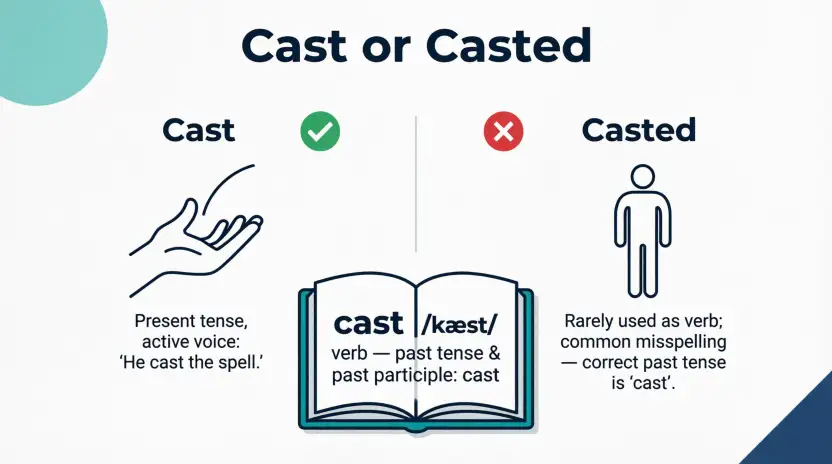
If you are unsure if to say “cast” or “casted,” the correct choice depends on the verb cast and the type of sentence you are writing. In standard English, cast is normally used for the present, past, and past participle forms. Casted is generally not the standard past tense of cast.
This can confuse writers because many English verbs add -ed to form the past tense. For example, call becomes called and paint becomes painted. But cast is an irregular verb, so it keeps the same form in common standard usage: cast, cast, cast.
You may see casted in informal speech, online writing, or specialized contexts, but that does not make it the usual standard form. This guide explains when to use cast, why casted appears, how British and American English treat the words, and how to avoid common mistakes.
Cast or Casted: Quick Answer
The short answer is simple: use “cast” in most cases, not “casted.”
The verb cast is irregular and normally has the same form in the present, past, and past participle:
- Present: I cast the fishing line.
- Past: I cast the fishing line yesterday.
- Past participle: I have cast the fishing line many times.
The same pattern applies to several meanings of cast:
- Movies: The director cast her in the lead role.
- Fishing: He cast the line into the water.
- Voting: She cast her vote.
- Magic: The wizard cast a spell.
- Light or shadow: The tree cast a shadow.
So, when you are choosing between cast or casted, cast is the safe standard choice.
What Does Cast or Casted Mean?
What Does “Cast” Mean?
Cast is a versatile verb with several meanings. It can mean to throw something, choose an actor for a role, give a vote, produce a shadow, or perform an act such as casting a spell.
Examples:
- She cast her vote early.
- The director cast him as the villain.
- The lamp cast a soft glow.
- He cast the fishing line into the lake.
- The magician cast a spell.
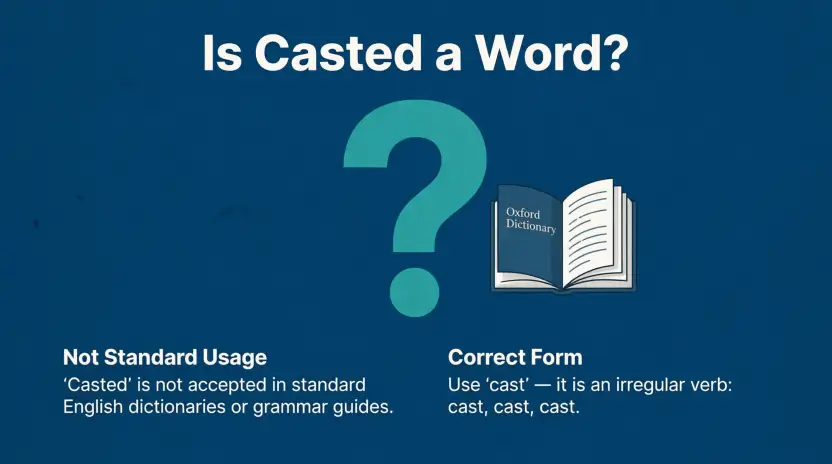
The important grammar point is that cast does not normally change to “casted” in the past tense.
Is “Casted” a Word?
You may encounter casted, but it is not the normal standard past form of cast.
In everyday standard English, use:
cast → cast → cast
rather than:
cast → casted → casted
If you are writing an essay, article, email, report, or other formal content, cast is generally the better choice.
The Origin of Cast or Casted
Cast is an old English verb with a long history. It has been used for centuries with meanings connected to throwing, putting, sending, or shaping something.
Over time, cast developed many related meanings. A person can cast a stone, cast a vote, cast a shadow, or cast an actor in a role.
The verb retained its unchanged past form in standard English. This is similar to other irregular verbs that do not simply add -ed, although each verb has its own history.
The form casted can appear because English speakers often apply the regular -ed pattern to verbs. However, standard usage generally keeps cast as the past and past participle.
British English vs American English
Both British and American English normally use cast as the past tense and past participle of cast.
| British English | American English | Example |
| cast | cast | She cast her vote. |
| cast | cast | The director cast him in the role. |
| cast | cast | The tree cast a shadow. |
| cast | cast | He cast the line into the river. |
There is no major British-American difference that makes casted the normal past tense.
Some specialized industries or informal communities may use casted, but general standard English favors cast.
For formal writing, it is best to follow the standard form unless you have a specific reason to reproduce a specialized usage.
Which Version Should You Use?
United States
Use cast in standard American English.
The director cast three new actors.
United Kingdom
Use cast in standard British English.
She cast her vote yesterday.
Canada
Cast is the normal choice in Canadian English.
He cast his ballot before the deadline.
Australia
Australian English also normally uses cast.
The actor was cast in the new series.
International Writing

If your audience is international, choose cast. It is widely understood and avoids unnecessary confusion.
Academic Writing
Use cast in essays, research papers, assignments, and other formal academic writing.
Business Writing
Use cast in professional emails, reports, presentations, and business documents.
Common Mistakes
Mistake 1: Using “Casted” as the Normal Past Tense
Incorrect in standard usage:
The director casted her in the movie.
Correct:
The director cast her in the movie.
Why?
Cast is an irregular verb that normally keeps the same form in the past.
Memory tip:
Think:
Today I cast. Yesterday I cast. I have cast.
Mistake 2: Adding “-ed” Automatically
Incorrect:
He casted his vote yesterday.
Correct:
He cast his vote yesterday.
Many regular English verbs use -ed, but cast does not normally follow that pattern.
Mistake 3: Using “Casted” in Formal Writing
Less suitable:
The producer casted the actor in the leading role.
Better:
The producer cast the actor in the leading role.
This is especially important in professional, academic, and published writing.
Everyday Examples of Cast
Emails
The committee cast its votes during the meeting.
We have cast our votes and are waiting for the results.
Business Writing
The director cast the project team after reviewing the applications.
The new design cast a different light on the company’s brand.
News Headlines
Voters Cast Ballots Across the Country
Director Casts New Actor in Leading Role
Headlines often use cast or casts depending on the tense.
Blogs
The sunset cast a golden glow over the beach.
I cast my first fishing line early in the morning.
Social Media
Just cast my vote! 🗳️
The new series has finally cast its main characters.
Academic Writing
Participants cast their votes anonymously.
The object cast a shadow on the surface.
Daily Conversation
I cast my vote yesterday.
Who was cast as the main character?
He cast the line too far.
Google Trends & Modern Usage
People search “cast or casted” because casted looks natural to many English learners and writers. Regular verbs often form their past tense by adding -ed, so it is easy to assume that cast works the same way.
In general modern English usage, cast remains the standard form for the past tense and past participle.
The word casted can still appear in some online writing and specialized contexts. Its presence does not mean that it should replace cast in general formal English.
For writers who want clear, widely accepted English, cast is the most practical choice.
Quick Comparison Table
| Version | Meaning | Correct? | Region | Example |
| cast | Past tense of throw/send | Yes | US, UK, Canada, Australia | He cast the line. |
| cast | Past tense of vote | Yes | International | She cast her vote. |
| cast | Past tense of choose an actor | Yes | International | They cast him in the film. |
| cast | Past participle | Yes | International | She has cast her vote. |
| casted | Alternative past form | Generally avoid | Some informal/specialized use | Avoid in standard writing. |
Key Takeaways
- Cast is the standard form in most English contexts.
- The past tense of cast is normally cast.
- The past participle is also cast.
- Casted is uncommon in standard English.
- British and American English generally use cast.
- Use cast in academic and professional writing.
- The correct pattern is cast, cast, cast.
- When in doubt, choose cast.
FAQs About Cast or Casted
1. Is “casted” grammatically correct?
Casted can be found in English, especially in some informal or specialized contexts, but it is not the usual standard past tense of cast. In general writing, use cast instead. For example, write “The director cast her in the film,” not “The director casted her in the film.”
2. Is it “cast” or “casted” in the past tense?
The standard past tense is cast. For example, “She cast her vote yesterday.” The word does not normally take -ed when used as the past tense. This makes cast an irregular verb with an unchanged past form.
3. Is “cast” the past tense of “cast”?
Yes. Cast is both the present and past form of the verb. For example, “I cast my vote today” and “I cast my vote yesterday” are both grammatically correct. The surrounding words or time expressions show which tense is being used.
4. Should I say “I casted my vote” or “I cast my vote”?
Say “I cast my vote.” This is the standard form in English. For example: “I cast my vote before work.” The past-tense form remains cast, even though many regular English verbs use -ed.
5. Is it “cast” or “casted” in movies?
Use cast. For example, “The studio cast a new actor in the lead role.” You can also say “She was cast as the main character.” Casted is not the normal standard form for general movie and entertainment writing.
6. Is “casted” ever used in English?
Yes, you may encounter casted in some informal, regional, or specialized uses. However, it is not the normal standard past form of cast. If your goal is clear and conventional English, especially in formal writing, cast is the safer choice.
7. What are the three forms of the verb “cast”?
The common three forms are cast, cast, cast. The base form is cast, the simple past is cast, and the past participle is also cast. Example: “They cast the actors,” “They cast the actors yesterday,” and “They have cast the actors.”
8. Is “was cast” correct?
Yes. “Was cast” is correct and very common. For example, “She was cast in the lead role.” Here, cast is the past participle used with the passive construction was.
9. Why do people say “casted”?
People may say casted because they apply the common English rule of adding -ed to make a past tense. This pattern works for many regular verbs, such as walk/walked, but cast is an irregular verb and normally remains unchanged.
10. What is the easiest way to remember cast vs casted?
Remember the three-part pattern: cast, cast, cast. Think of the sentence, “Today I cast, yesterday I cast, and I have cast.” If you are writing standard English and are unsure, choose cast rather than casted.
Conclusion
When choosing between cast or casted, use cast in standard English. The verb cast normally keeps the same form in the present, past, and past participle: cast, cast, cast.
This applies to many common meanings. You can cast a vote, cast a shadow, cast a fishing line, cast a spell, or cast an actor in a role. In each case, the past form normally remains cast.
The form casted does appear in some informal and specialized contexts, but it is not the usual choice for general English. This is especially important when writing essays, business documents, articles, emails, or other formal content.
For US, UK, Canadian, Australian, and international readers, cast is the clear standard choice.
Remember: when the past tense of “cast” is needed, keep it simple: cast, cast, cast.
Read more about!
- Choice or Prime: What’s the Differenc?
- Horsie or Horsey: Which Spelling Is Correct?
- Heels or Heals: Which Word Is Correct?

I’m Olivia Parker, a grammar and English writing enthusiast passionate about making English simple and easy to understand. Through Wordsblog, I share clear explanations, useful grammar tips, and practical writing guidance to help readers write with confidence. My goal is to make learning English easier, one word at a time.







2 thoughts on “Cast or Casted: Which Is Correct?”