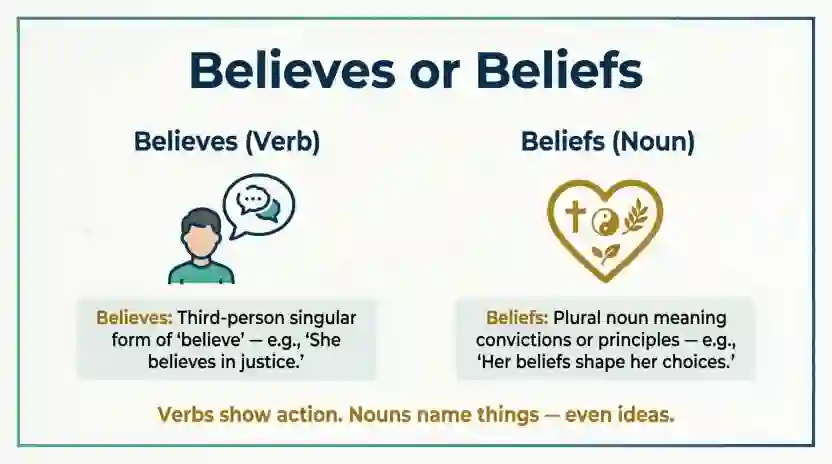
Have you ever wondered if to write believes or beliefs? Both words are correct, but they have different meanings and uses. Believes is a verb that describes what someone thinks is true, while beliefs is a plural noun that refers to ideas or opinions a person accepts as true.
The confusion often comes from their similar spelling and connection to the word believe. However, the final letters change the role of each word in a sentence. Choosing the wrong one can make your writing unclear or grammatically incorrect.
For example, you might write, “She believes in herself” or “Her beliefs shape her decisions.” Both sentences are correct because each word performs a different job.
Understanding the difference between believes and beliefs can help you write better emails, school assignments, blog posts, and everyday messages. You will also learn how to use each word, avoid common grammar mistakes, and choose the correct form in different situations. By the end of this guide, you will have a simple way to remember which word belongs in your sentence.
Believes or Beliefs: Quick Answer
Believes is the third-person singular form of the verb believe. Use it when talking about what one person or thing thinks is true. Beliefs is the plural form of the noun belief. Use it when referring to two or more ideas, opinions, or principles that someone accepts as true.
Examples:
- She believes that hard work leads to success.
- His beliefs influence his choices.
- Everyone believes in something different, and people may have different beliefs.
The easiest way to remember the difference is that believes describes an action or state of thought, while beliefs names ideas or convictions.
What Does Believes or Beliefs Mean?
Although believes and beliefs come from the same base word, they serve different grammatical purposes. Knowing if your sentence needs a verb or a noun will help you choose the correct spelling.
What Does Believes Mean?
Believes is a verb. It describes what a person thinks is true, accepts as real, or trusts.
It is used with third-person singular subjects in the present simple tense, such as he, she, it, or a singular name.
Examples:
- Maria believes that honesty matters.
- He believes the story is true.
- The scientist believes more research is needed.
- My teacher believes in my abilities.
In each sentence, believes tells us what someone thinks, trusts, or considers true.
Use believes when you need to describe what one person or thing thinks.
What Does Beliefs Mean?

Beliefs is the plural form of the noun belief. A belief is an idea, opinion, principle, or conviction that someone accepts as true.
Examples:
- Her beliefs guide her decisions.
- Their religious beliefs are important to them.
- Personal beliefs can influence behavior.
- His political beliefs changed over time.
In these examples, beliefs names the ideas or principles people hold. It does not describe the act of believing.
Use beliefs when you are talking about multiple ideas, values, opinions, or convictions.
What Is the Difference Between Believe, Believes, Belief, and Beliefs?
These four words are related, but each has a specific grammatical role.
| Word | Part of speech | Meaning | Example |
| Believe | Verb | To accept something as true | I believe you. |
| Believes | Verb | What a singular third-person subject thinks is true | She believes you. |
| Belief | Noun | One idea or conviction | My belief is strong. |
| Beliefs | Noun | More than one idea or conviction | Our beliefs differ. |
Remember that believe and believes are verb forms, while belief and beliefs are nouns.
The Origin of Believes and Beliefs
The words believes and beliefs developed from the same word family. Understanding their history can help explain why their spelling differs.
Where Does the Word Believe Come From?
The verb believe comes from Old English belȳfan or gelȳfan, forms associated with believing, trusting, or holding something to be true. The word developed over time into the modern English verb believe.
Today, it can describe accepting a statement as true, trusting someone, or holding an opinion about something.
For example:
- I believe your explanation.
- She believes in equal opportunities.
- They believe the plan will work.
Why Is It Believes Instead of Believs?
English spelling rules explain the change from believe to believes.
When forming the third-person singular present tense of a verb ending in a consonant followed by y, the y usually changes to ies. However, believe ends in e, not y. Therefore, we add s to form believes.
Examples:
- Believe → believes
- Live → lives
- Love → loves
The noun follows a related but distinct spelling pattern. The word belief ends in f, and its plural changes the f to v before adding es.
- Belief → beliefs
- Leaf → leaves
- Knife → knives
This explains why the correct noun is beliefs, not believs or beliefes.
The two forms follow different spelling patterns because one is a verb and the other is a noun.
British English vs American English
There is no difference between British and American English when it comes to the standard spelling of believes and beliefs. Both forms are used in the same way in both varieties of English.
| British English | American English | Example |
| Believes | Believes | She believes the news. |
| Belief | Belief | His belief is important. |
| Beliefs | Beliefs | Their beliefs are different. |
Are Believes and Beliefs Spelled Differently in the UK and US?
No. Unlike some words that have different British and American spellings, believes and beliefs remain the same in both regions.
For example, British writers may use colour, while American writers usually use color. However, neither believes nor beliefs changes spelling across these regions.
What About Canadian and Australian English?
Canadian and Australian English also use believes and beliefs with the same spelling and meaning.
The correct choice depends on the grammar of the sentence, not the country where you are writing.
When editing an article, report, email, or academic paper, focus on if you need a verb or a noun. You do not need to change either word to match a regional spelling preference.
Which Version Should You Use?
The correct word depends on what you want to say. Both forms are standard English, but they are not interchangeable.
United States
Use believes when describing what someone thinks or accepts as true. Use beliefs when referring to the ideas or principles someone holds.
- Correct: He believes the results are accurate.
- Correct: His beliefs influence his decisions.
United Kingdom
British English follows the same rules.
- Correct: She believes in lifelong learning.
- Correct: Her beliefs are important to her.
Neither word is more British than the other.
Canada
Canadian English uses both forms in the same way.
- Correct: The student believes the answer is correct.
- Correct: The students discussed their beliefs.
Australia
Australian English also follows the same standard grammar rules.
- Correct: The manager believes the project will succeed.
- Correct: The team’s beliefs shape its values.
International Writing
For international audiences, use believes for a verb and beliefs for a plural noun. These spellings are widely understood and do not require regional adjustment.
If your readers include English learners, a short explanation or clear example can help them understand the difference.
Academic Writing
In academic writing, use believes when describing a researcher’s view or a person’s position. Use beliefs when discussing a group of ideas, assumptions, or convictions.
Examples:
- The author believes that education improves opportunity.
- The study examines students’ beliefs about learning.
In formal academic work, make sure that claims about a researcher’s position accurately reflect the source. Do not use believes as a substitute for evidence when you mean that a claim has been demonstrated.
Business Writing
In business writing, believes can express a person’s judgment or expectation. Beliefs can refer to values or principles held by an individual or organization.
Examples:
- The director believes the proposal is practical.
- The company’s beliefs are reflected in its workplace values.
For a more direct business style, you can often replace vague statements with specific evidence.
For example, instead of writing, “We believe the product is effective,” you might write, “Customer feedback indicates that the product is effective,” if that statement is supported by the available evidence.
Common Mistakes
Writers sometimes confuse believes and beliefs because both come from the word believe. The following examples show how to correct the most common errors.
| Incorrect Example | Correct Example | Explanation |
| She beliefs in kindness. | She believes in kindness. | The sentence needs a verb. |
| His believes are strong. | His beliefs are strong. | The sentence needs a plural noun. |
| They believes in fairness. | They believe in fairness. | Use believe with they. |
| He has many belief. | He has many beliefs. | Use the plural noun after many. |
| I have a strong beliefs. | I have a strong belief. | Use the singular noun after a. |
| She believe in herself. | She believes in herself. | Use believes with she in the present simple. |
| Their believs are different. | Their beliefs are different. | The correct plural spelling is beliefs. |
| He has several beliefes. | He has several beliefs. | Do not add es directly to belief. |
Mistake 1: Using Beliefs as a Verb
Incorrect: She beliefs that everyone deserves respect.
Correct: She believes that everyone deserves respect.
Why? The sentence describes what she thinks is true, so it needs the verb believes.
Mistake 2: Using Believes as a Noun
Incorrect: His believes are based on experience.
Correct: His beliefs are based on experience.
Why? The sentence refers to ideas he holds, so it needs the plural noun beliefs.
Mistake 3: Forgetting Subject-Verb Agreement
Incorrect: They believes in hard work.
Correct: They believe in hard work.
Why? In the present simple tense, believes goes with third-person singular subjects such as he, she, and it. Use believe with I, you, we, and they.
A Simple Memory Tip
Ask yourself one question: Am I describing what someone thinks, or am I naming the ideas they hold?
- If you are describing what someone thinks, use believes.
- If you are naming multiple ideas, use beliefs.
For example, “She believes in fairness” describes what she thinks. “Her beliefs include fairness and honesty” names her ideas.
This simple test works in most everyday sentences.
Everyday Examples of Believes and Beliefs
Seeing both words in different situations makes their roles easier to understand.
1. Emails
Believes:
“Sarah believes that the revised schedule will work for everyone.”
Beliefs:
“Our discussion helped us understand each other’s beliefs about teamwork.”
In the first example, believes describes Sarah’s opinion. In the second, beliefs refers to ideas about teamwork.
2. Business Writing
Believes:
“The manager believes the new strategy will improve customer service.”
Beliefs:
“The organization’s beliefs are reflected in its commitment to customer care.”
Use the verb for a person’s judgment and the noun for principles or values.
3. News Headlines
Believes:
“Local Resident Believes New Plan Will Help the Community”
Beliefs:
“New Survey Explores Public Beliefs About Education”
The first headline describes an individual’s opinion. The second refers to views held by members of the public.
4. Blogs
Believes:
“She believes that daily practice can improve writing skills.”
Beliefs:
“Personal beliefs can influence how people communicate.”
Both examples are suitable for informative blog posts. The correct word depends on if the sentence describes an opinion or refers to ideas.
5. Social Media
Believes:
“He believes in learning something new every day.”
Beliefs:
“Our beliefs shape how we respond to life’s challenges.”
Both words work naturally in social media captions, motivational posts, and personal updates.
6. Academic Writing
Believes:
“The researcher believes the findings require further investigation.”
Beliefs:
“The paper examines students’ beliefs about online learning.”
In academic writing, believes identifies a position, while beliefs describes the ideas being studied.
7. Daily Conversation
Believes:
“My brother believes that exercise improves his mood.”
Beliefs:
“Our beliefs are not always the same, but we respect each other.”
These examples show that the distinction applies to everyday speech as well as formal writing.
Google Trends and Modern Usage
People may search for believes or beliefs because the words look similar, share the same root, and often appear in sentences about opinions, values, and personal views.
The main issue is grammatical rather than regional. Both words are standard in American, British, Canadian, and Australian English. The challenge is knowing if a sentence requires a verb or a noun.
Why Do People Search for Believes or Beliefs?
Several common questions explain this search:
- Is believes a noun or a verb?
- Is beliefs the plural of believe?
- Why does belief become beliefs?
- Should I write “she believes” or “her beliefs”?
- What is the difference between believe, belief, believes, and beliefs?
These questions often arise when people are learning English, proofreading an assignment, or writing professional content.
Which Word Is More Common?
Both words are widely used, but their frequency depends on the subject and sentence structure. A text that describes what people think may use believes, while a text discussing values, culture, religion, or opinions may use beliefs.
Without a specific, verified Google Trends comparison, it would be misleading to claim that one word is more popular in a particular country or to provide invented search figures.
How Can You Choose the Right Word Today?
Do not choose based on which word looks more familiar or appears more often in search results. Instead, check the grammar of your sentence.
- “He believes the claim.” The sentence needs a verb.
- “His beliefs affect his choices.” The sentence needs a plural noun.
Search trends can help identify the questions readers ask, but grammar determines the correct answer.
Quick Comparison Table
| Version | Meaning | Correct? | Region | Example |
| Believes | Third-person singular verb | Yes | All major English varieties | She believes the story. |
| Beliefs | Plural noun | Yes | All major English varieties | Her beliefs are clear. |
| Believe | Base verb | Yes | All major English varieties | I believe you. |
| Belief | Singular noun | Yes | All major English varieties | It is my belief. |
| Believs | Incorrect spelling | No | None in standard English | Use believes instead. |
| Beliefes | Incorrect spelling | No | None in standard English | Use beliefs instead. |
The key difference is grammatical function. Believes describes what a singular third-person subject thinks, while beliefs names multiple ideas or convictions.
Key Takeaways
- Believes is a verb that describes what someone thinks or accepts as true.
- Beliefs is the plural noun form of belief.
- Use believes with he, she, it, or a singular name in the present simple tense.
- Use beliefs when referring to multiple ideas, values, opinions, or convictions.
- Both spellings are correct in British, American, Canadian, and Australian English.
- The spelling changes from belief to beliefs because the final f becomes v before adding es.
- Do not write believs or beliefes in standard English.
- To choose correctly, decide if your sentence needs a verb or a noun.
FAQs About Believes or Beliefs
1. What Is the Difference Between Believes and Beliefs?
Believes is a verb that describes what someone thinks is true. Beliefs is a plural noun that refers to ideas or convictions someone holds. For example, “She believes in honesty” uses a verb, while “Her beliefs include honesty and fairness” uses a plural noun. The correct choice depends on the role the word plays in the sentence.
2. Is Believes a Correct Word?
Yes, believes is a correct English word. It is the third-person singular present form of the verb believe. Use it with subjects such as he, she, it, or a singular name. For example, “David believes the explanation” is correct. Do not use believes as a plural noun when referring to a person’s ideas or opinions.
3. Is Beliefs a Correct Word?
Yes, beliefs is the correct plural form of the noun belief. It refers to two or more ideas, opinions, or principles that people accept as true. For example, “Their beliefs differ” is correct. Remember that beliefs names the ideas themselves, while believes describes what someone thinks or accepts as true.
4. Is Beliefs the Plural of Believe?
No. Beliefs is the plural form of the noun belief, not the verb believe. The verb believe changes to believes when used with a third-person singular subject in the present simple tense. For example, “I believe” and “she believes” are correct verb forms. To name multiple convictions, use beliefs.
5. Why Does Belief Become Beliefs?
The noun belief becomes beliefs because English spelling often changes a final f to v before adding es in certain plural forms. This pattern also appears in words such as leaf and knife. Their plurals are leaves and knives. The correct plural spelling is therefore beliefs, not beliefes.
6. Should I Write She Believes or She Beliefs?
Write “she believes.” The subject she needs the third-person singular present form of the verb believe. For example, “She believes in hard work” is correct. The word beliefs is a noun, so it would fit a sentence such as “Her beliefs are important.” Check if you need an action or an idea.
7. Are Believes and Beliefs Different in British and American English?
No. British and American English use the same spellings and grammatical rules for believes and beliefs. The same is true of standard Canadian and Australian English. Unlike words such as colour and color, these words do not have regional spelling variations. Always select the form that fits the sentence.
8. Can I Use Believes and Beliefs in the Same Sentence?
Yes. You can use both words in the same sentence because they have different grammatical roles. For example, “She believes that her beliefs should guide her actions” is correct. The first word is a verb describing what she thinks, while the second is a noun referring to the ideas she holds.
9. What Is the Difference Between Belief and Beliefs?
Belief is a singular noun, while beliefs is its plural form. Use belief when referring to one idea or conviction, as in “It is my belief that everyone deserves respect.” Use beliefs when referring to several ideas, as in “Their beliefs influence their decisions.” The word belief is not a verb.
Conclusion
Choosing between believes and beliefs becomes easy once you understand their grammatical roles. Both words are correct, but they cannot replace each other in every sentence.
Use believes when describing what a person or thing thinks, accepts as true, or trusts. For example, “She believes that practice improves skills.” Use beliefs when talking about multiple ideas, opinions, values, or convictions. For example, “Her beliefs influence her choices.”
The distinction is the same in British, American, Canadian, and Australian English. You do not need to change either spelling to suit a particular region. Instead, focus on the subject, the meaning, and the part of speech your sentence requires.
If you are unsure which word to choose, read your sentence again and ask if you are describing what someone thinks or naming the ideas they hold. That quick check will prevent most mistakes.
Remember: a person believes something, but a person may hold many beliefs.
For more simple explanations of confusing English words, explore related grammar guides on Wordsblog and keep improving your everyday writing.
Read more about!
- Vizio vs. TCL: Which TV Brand Is Better?
- Goedert or Kincaid: Who Should You Start in 2026?
- Sudafed or DayQuil: Which Is Better for a Cold?

I’m Olivia Parker, a grammar and English writing enthusiast passionate about making English simple and easy to understand. Through Wordsblog, I share clear explanations, useful grammar tips, and practical writing guidance to help readers write with confidence. My goal is to make learning English easier, one word at a time.







1 thought on “Believes or Beliefs: Which Word Is Correct?”