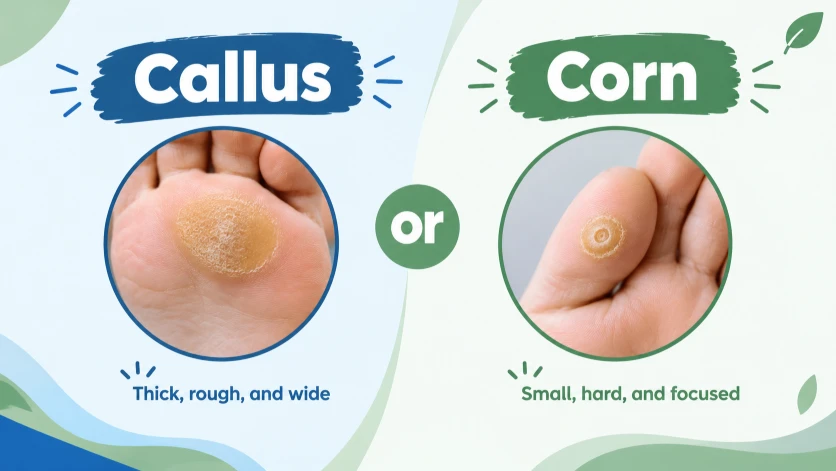
A callus and a corn are both areas of thick, hard skin, but they differ in shape, size, and the way they feel. A callus is usually a broad, flat patch of thick skin, while a corn is a smaller, more focused area with a hard center that can hurt when pressed. Both often develop on the feet because of repeated friction or pressure.
People often search for “callus or corn” because the two conditions can look alike. You might notice rough skin on your heel, a hard spot under your foot, or a painful bump on a toe. Knowing the difference can help you understand what may be causing the problem and how to protect your skin.
Although corns and calluses are usually harmless, they can become painful if the pressure continues. Tight shoes, repeated walking, standing for long periods, and certain activities can all contribute to their development.
In this guide, you will learn how to tell a corn from a callus, where each one appears, what causes them, and how to care for your feet safely. You will also discover when it is best to seek medical advice.
Callus or Corn: Quick Answer
A callus is a wide, thick patch of skin caused by repeated pressure or friction. A corn is a smaller, more concentrated area of hardened skin that often has a firm center and may cause pain when pressed.
Here are three simple examples:
- Callus: A thick, rough patch on the heel after repeated walking.
- Corn: A small, painful spot on the top or side of a toe where a shoe rubs.
- Hand callus: A thick patch on the palm caused by lifting weights or using hand tools.
Both are protective responses to repeated pressure. The main difference is that calluses spread over a larger area, while corns tend to form in smaller, more focused spots. [1][2]
What Does Callus or Corn Mean?
Understanding the meaning of each term makes it easier to recognize the difference.
What Is a Callus?
A callus is a thickened area of skin that develops when the skin faces repeated pressure, rubbing, or friction. This thickening helps protect the skin underneath.
Calluses usually have these features:
- A broad, rough, or hardened patch.
- Skin that may look yellowish or feel dry.
- A flat or slightly raised surface.
- Little or no pain in many cases.
Calluses commonly form on the heels, balls of the feet, and palms of the hands. For example, a person who lifts weights regularly may develop calluses where a bar repeatedly rubs against the palms.
A callus does not always indicate a problem. Some thickening on the feet is a normal response to daily activity. However, a large, cracked, or painful callus may need attention.
What Is a Corn?
A corn is a small, concentrated area of thickened skin that often develops over a bony part of the foot. Unlike a typical callus, it may have a hard central core.
Common signs of a corn include:
- A small, round, hard bump.
- A firm center surrounded by thicker skin.
- Tenderness when direct pressure is applied.
- Discomfort when wearing shoes or walking.
Hard corns often appear on the tops or sides of the toes. Soft corns can develop between the toes, where moisture makes the thickened skin softer.
Corns are often painful because their concentrated shape can place pressure on the tissue beneath them. However, not every corn hurts.
Are Corns and Calluses the Same Thing?
No. They are closely related, but they are not exactly the same.
Both develop as the skin responds to repeated pressure or friction. The main differences are their shape, size, and typical location.
A callus usually covers a wider area. A corn is generally smaller and more focused, often with a central core. Both can occur on the feet, but calluses also commonly develop on the hands.
The Origin of Callus and Corn
The words callus and corn have different histories, even though both are used to describe thickened skin.
Where Does the Word Callus Come From?
The English word callus comes from Latin callum, meaning hard skin or a hard, thick covering. The term reflects the firm texture of the skin that develops through repeated pressure or rubbing.
In medical language, the related term callosity can describe an area of hardened skin. The medical term hyperkeratosis describes an increase in the outer skin layer, which may occur in calluses and other skin conditions.
Where Does the Word Corn Come From?
The word corn has long been used in English for a small, hard area of thickened skin, especially on the foot. Its familiar meaning also refers to grain, but in foot care, it describes a specific skin condition.
The name is often associated with the small, firm, grain-like appearance of a corn. This is a helpful way to remember the term, although the appearance of an individual corn can vary.
Why Are the Terms Often Confused?

Corns and calluses develop through the same basic process. Repeated pressure or friction causes the outer layer of skin to thicken.
Because both can look yellow, rough, or hard, it can be difficult to tell them apart just by looking. Their size, location, texture, and tenderness can provide clues, but a healthcare professional may be needed if the diagnosis is uncertain.
British English vs American English
There is no major British-American spelling difference between callus and corn when referring to foot conditions. Both terms are understood in the United Kingdom and the United States.
| British English | American English | Example |
| Callus | Callus | A callus formed on her heel. |
| Corn | Corn | The corn hurt when she wore tight shoes. |
| Calluses | Calluses | The weightlifter developed calluses on his hands. |
| Corns | Corns | The podiatrist treated two painful corns. |
Are There Different Spellings?
The usual spelling is callus in both British and American English. Its standard plural is calluses.
The word calli is also used as a plural in some specialist contexts, but calluses is the clearer choice for general readers.
The word corn is spelled the same way in both varieties of English. Its meaning depends on context: it may refer to grain or to a small area of hardened skin.
Which Term Should You Use?
Use corn when you mean the small, concentrated area of thickened skin. Use callus when you mean the broader patch of hardened skin.
For example:
- British English: “The podiatrist checked the corn on my toe.”
- American English: “The podiatrist checked the callus on my heel.”
Both sentences are natural and correct. The distinction is about the condition being described, not regional spelling.
Which Version Should You Use?
The correct word depends on the skin condition, not the country where you are writing.
United States
Use callus for a broad patch of thick skin and corn for a smaller, concentrated spot. These are the standard terms used in American medical information.
United Kingdom
Use the same distinction in British English. The NHS uses both corns and calluses when explaining foot care.
Canada
Canadian English generally follows the same usage. Both terms are understood, and neither requires a special Canadian spelling.
Australia
Australian English also uses corn and callus for these conditions. When writing for a general audience, explain the difference through location, appearance, and symptoms.
International Writing
For an international audience, define both terms the first time they appear. This is useful for readers who may know the conditions but be unfamiliar with the English names.
For example: “A callus is a broad patch of thickened skin, while a corn is a smaller area with a concentrated hard center.”
Academic Writing
In academic or medical writing, use the terms accurately and support medical claims with reliable sources. If the distinction is important to your research, explain the features used to classify each condition.
Business Writing
For healthcare websites, product descriptions, or foot-care services, use plain English. Avoid suggesting that a product can always distinguish or remove a corn or callus without professional assessment.
Common Mistakes
People often confuse corns and calluses because both involve hard skin. These examples show how to use the terms correctly.
| Incorrect or unclear example | Better example | Explanation |
| “A large, broad patch is always a corn.” | “A broad patch is more typical of a callus.” | Corns are generally smaller and more focused. |
| “Every hard spot on the foot is a callus.” | “A small, painful spot may be a corn.” | Other skin conditions can also cause hard spots. |
| “Callus and corn are two spellings of the same word.” | “A callus and a corn are different conditions.” | They share a cause but have different features. |
| “Calluses only develop on feet.” | “Calluses can also develop on hands.” | Repeated friction can thicken skin in several areas. |
| “A corn always hurts.” | “A corn may or may not be painful.” | Pain varies from person to person. |
Memory Tip
Remember this simple rule:
- Callus = a wider patch.
- Corn = a smaller, concentrated spot.
This is a useful guide, not a guaranteed diagnosis. If a spot changes, bleeds, becomes very painful, or does not improve, get medical advice rather than relying on appearance alone.
Everyday Examples of Callus and Corn
These examples show how the terms work in everyday English.
1. Daily Conversation
- “I have a callus on my heel from walking so much.”
- “My corn hurts when I wear these shoes.”
Both sentences are natural. The first describes a broader area of thick skin, while the second describes a painful, focused spot.
2. Emails
Example:
“Hello, I have developed a painful corn on my little toe. Could I arrange an appointment to have it checked?”
This is a clear way to describe the problem when contacting a foot-care clinic.
3. Business Writing
Example:
“Our foot-care service offers assessments for corns and calluses and advice on reducing pressure.”
This wording is appropriate for a healthcare website because it describes the service without promising a particular result.
4. News Headlines
Examples of natural headlines include:
- “How to Tell a Corn from a Callus”
- “Foot Care Tips for Painful Corns and Calluses”
- “Why Tight Shoes Can Cause Hard Skin”
These headlines use the terms accurately and make the subject clear to readers.
5. Blogs
Example:
“If you notice a rough patch on your heel, it may be a callus. A small, painful bump on a toe may be a corn, especially if your shoes rub against it.”
The words may and especially are important because appearance alone cannot confirm a diagnosis.
6. Academic Writing
Example:
“Corns and calluses are areas of thickened skin associated with repeated pressure or friction, but they often differ in size, shape, and location.”
This sentence gives a clear comparison without making an absolute claim about every case.
7. Social Media
Example:
“Wondering if you have a corn or a callus? A broad patch of hard skin is more typical of a callus, while a small, focused spot may be a corn. Persistent pain deserves professional advice.”
This format works well for an educational post because it gives a quick answer and includes a sensible safety reminder.
Google Trends & Modern Usage
People search for “callus or corn” because they want to identify a hard spot on their foot, understand why it hurts, or decide what to do next.
The search intent is mainly informational and health-related. Readers often want a quick comparison before looking for treatments, footwear advice, or professional care.
Why Do People Search for “Callus or Corn”?
Common reasons include:
- A hard patch has appeared on the heel or ball of the foot.
- A small bump on a toe hurts inside a shoe.
- The reader wants to know if a corn or callus needs treatment.
- The reader wants to prevent the problem from returning.
- The reader is unsure if the spot could be another skin condition.
Which Term Is More Popular?
There is no verified search-volume dataset presented here, so it would be misleading to claim that callus or corn is more popular worldwide.
Search interest can vary by country, season, footwear habits, and the wording used in a search. Someone may search for “painful corn on toe,” while another person may use “hard skin on heel” without knowing the medical term.
Google Trends can help compare search interest for terms such as corn on toe, callus on foot, and corns and calluses. Its results show relative interest over a selected time and location, not the exact total number of searches.
What Does Modern Usage Tell Us?
Both terms remain common in everyday and medical English. Healthcare websites often discuss them together because they share causes and some treatment methods.
For readers, the most useful approach is to learn the basic difference without assuming that every hard skin spot fits neatly into one category.
Quick Comparison Table
| Feature | Callus | Corn |
| Meaning | A broad area of thickened skin | A small, focused area of thickened skin |
| Typical shape | Wide, rough, or uneven patch | Small, round, concentrated spot |
| Common location | Heel, ball of foot, palm | Top, side, or area between toes |
| Central core | Usually not distinct | Often has a firm central core |
| Pain | Often painless, but may crack or hurt | May hurt when pressed |
| Common cause | Repeated pressure or friction | Focused pressure or friction |
| Spelling | Callus | Corn |
| British usage | Correct | Correct |
| American usage | Correct | Correct |
| Main clue | Wider patch of thick skin | Smaller, more concentrated spot |
The table provides general clues, not a way to diagnose every skin problem. A plantar wart, for example, can sometimes resemble a corn or callus.
Key Takeaways
- A callus is usually a broad patch of thickened skin.
- A corn is usually a smaller, more concentrated area of hardened skin.
- Both can develop because of repeated friction or pressure.
- Calluses often appear on the heels, balls of the feet, and hands.
- Corns commonly develop on or between the toes.
- The words are spelled the same way in British and American English.
- Well-fitting shoes and pressure-relieving pads may help prevent both conditions.
- People with diabetes or poor circulation should seek professional advice before attempting self-treatment.
FAQs About Callus or Corn
1. What is the main difference between a callus and a corn?
A callus is usually a broad, thick patch of skin, while a corn is a smaller, more concentrated area that often has a hard center. Both develop because of repeated pressure or friction. Corns are more likely to feel painful when pressed, but either condition can cause discomfort.
2. How can I tell if I have a corn or a callus?
Look at the size, shape, and location of the spot. A broad, rough patch on the heel or ball of the foot is more typical of a callus. A small, round spot on a toe may be a corn. These signs are not definitive, so seek medical advice if you are unsure.
3. Which is more painful, a corn or a callus?
Corns are often more painful when pressed because their concentrated shape can place pressure on the tissue underneath. Calluses are often painless, but thick skin can crack and become sore. Pain depends on the location, thickness, and cause, so neither condition is always more painful.
4. Can a callus turn into a corn?
A callus does not simply turn into a corn as a normal stage of development. Both form in response to repeated friction or pressure, but they tend to develop different patterns of thickened skin. A changing or painful spot should be assessed if you cannot tell what it is.
5. How do you get rid of a corn or callus?
Reducing the pressure that caused it is an important first step. Well-fitting shoes, cushioned socks, and protective pads may help. Some people can gently soften and file thick skin, but never cut it off yourself. If you have diabetes or poor circulation, seek professional advice before treatment.
6. Are corns and calluses dangerous?
Most corns and calluses are not serious, but they can become painful, crack, or develop complications. Seek medical advice if the area bleeds, produces discharge, becomes severely painful, or does not improve. People with diabetes, poor circulation, or a weakened immune system should not try to treat them on their own.
7. Can you get a callus on your hands?
Yes. Hand calluses commonly form when the skin experiences repeated friction or pressure. Weightlifting, playing guitar, gardening, and using hand tools can all contribute. These calluses help protect the skin, but excessive thickening or painful cracks may need attention.
8. Is a corn the same as a plantar wart?
No. A corn is a focused area of thickened skin caused by pressure or friction. A plantar wart is caused by a human papillomavirus infection and may develop on the sole of the foot. The two can look similar, so a healthcare professional can help distinguish them when the diagnosis is uncertain.
9. Should I cut off a corn or callus?
No. Cutting hardened skin with scissors, blades, or other sharp tools can cause injury and infection. Instead, reduce friction and pressure and seek professional advice if the area is painful or persistent. If you have diabetes or poor circulation, do not attempt home removal without medical guidance.
10. When should I see a doctor for a corn or callus?
Seek medical advice if you have severe pain, bleeding, redness, swelling, discharge, or signs of infection. You should also get advice if the area does not improve with appropriate care. If you have diabetes, poor circulation, or a weakened immune system, consult a healthcare professional before trying to treat the problem yourself.
Conclusion
Knowing the difference between a callus and a corn can help you understand what may be happening to your skin. A callus usually forms as a broad patch of thick skin, while a corn tends to be a smaller, more concentrated spot with a firm center. Both commonly develop because of repeated friction or pressure, especially on the feet.
The same basic prevention steps can help with both conditions. Wear comfortable shoes that fit well, use suitable cushioning when needed, and avoid repeated rubbing on the affected area. Do not cut away hard skin yourself, and seek professional advice if the spot is painful, persistent, bleeding, or showing signs of infection.
Although these clues are useful, not every hard spot is a corn or callus. Other skin conditions can look similar, so a healthcare professional can help if you are uncertain. People with diabetes or poor circulation should get medical advice before attempting self-treatment.
Remember: a wider patch is more typical of a callus, while a smaller, focused spot is more typical of a corn. If this guide helped clear up the confusion, explore more practical health and word-choice guides on Wordsblog.
Read more about!
- CT or MRI: What’s the Difference?
- Yoto or Tonies: Which Audio Player Is Better?
- Realizes or Realises: Which Spelling Is Correct?

I’m Olivia Parker, a grammar and English writing enthusiast passionate about making English simple and easy to understand. Through Wordsblog, I share clear explanations, useful grammar tips, and practical writing guidance to help readers write with confidence. My goal is to make learning English easier, one word at a time.