
When you have a stuffy nose, a blocked sinus, or a chest full of mucus, choosing the right medicine can be confusing. Mucinex or Sudafed may both help relieve congestion, but they work in different ways.
Mucinex (guaifenesin) is an expectorant. It helps thin mucus in your airways so you can cough it up more easily. Sudafed (pseudoephedrine) is a decongestant. It reduces swelling in the nasal passages, making it easier to breathe through your nose.
The best choice depends on your symptoms. If you have thick chest mucus, Mucinex may be more useful. If your nose feels blocked or your sinuses are congested, Sudafed may be a better option.
However, these medicines have different side effects, precautions, and interactions. Some products also contain extra active ingredients. This guide explains how they compare, when each may help, and what to consider before taking either one.
Mucinex or Sudafed: What’s the Difference?
Mucinex and Sudafed treat different types of congestion.Contains guaifenesin, which loosens thick chest mucus and makes coughing easier. Sudafed contains pseudoephedrine, which reduces swelling in the nasal passages and helps relieve a blocked nose. Choose Mucinex for chest mucus and Sudafed for nasal congestion, based on your health needs.
Mucinex or Sudafed: Quick Answer
The main difference between Mucinex and Sudafed is how they relieve congestion.
- Choose Mucinex: When thick mucus builds up in your chest and you have a productive cough.
- Choose Sudafed: When your nose is blocked or you have sinus pressure.
- Consider both: They may sometimes be used together because they have different active ingredients. Ask a pharmacist first, especially if you take other medicines.
Here are three simple examples:
- You have a wet cough and thick mucus in your chest. Mucinex may help.
- Your nose is blocked, and you struggle to breathe through it. Sudafed may help.
- You have both chest mucus and a blocked nose. A healthcare professional can help you decide if both treatments are suitable.
Neither medicine cures a cold, flu, or sinus infection. They only help manage certain symptoms.
What Do Mucinex and Sudafed Mean?
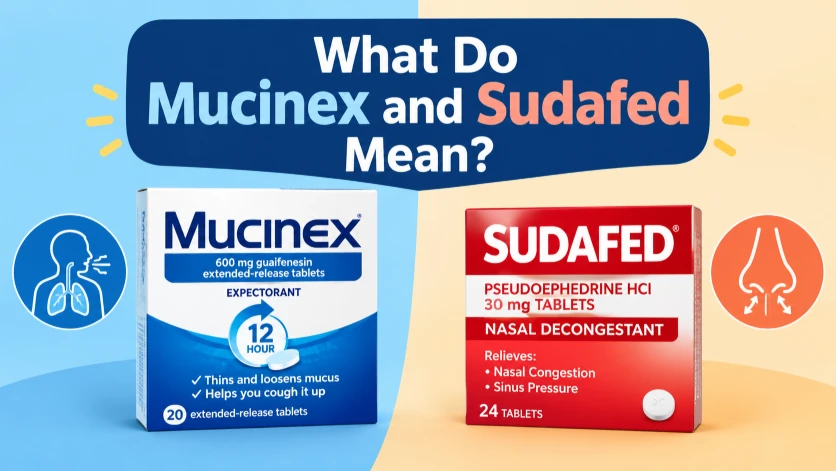
Although people often compare these brands, Mucinex and Sudafed are not the same type of medicine.
Understanding their active ingredients makes the difference easier to remember.
What Is Mucinex?
Mucinex is a brand of over-the-counter medicine commonly used to relieve chest congestion.
Its standard chest congestion formula contains guaifenesin, an expectorant.
An expectorant helps thin and loosen mucus in your airways. This makes it easier to cough up phlegm.
Mucinex may help when you experience:
- Thick mucus in your chest.
- A wet or productive cough.
- Difficulty clearing phlegm from your airways.
- Chest congestion during a cold.
The standard Mucinex formula does not directly open blocked nasal passages. It is designed to help clear mucus from the chest.
Important: Mucinex also sells combination products. For example, Mucinex DM contains guaifenesin and dextromethorphan, a cough suppressant. Always check the active ingredients before taking it.
What Is Sudafed?
Sudafed is a brand of decongestant products.
In the United States, traditional Sudafed products commonly contain pseudoephedrine.
Pseudoephedrine is a nasal decongestant. It works by narrowing blood vessels in the swollen nasal passages. This reduces swelling and makes it easier for air to move through your nose.
Sudafed may help with:
- A blocked or stuffy nose.
- Sinus pressure.
- Nasal congestion caused by a cold.
- Congestion linked to allergies.
However, Sudafed does not thin chest mucus like guaifenesin does.
Some Sudafed products contain additional ingredients. The brand name alone does not tell you exactly what is inside the medicine
The Origin of Mucinex and Sudafed
Mucinex and Sudafed are brand names, not two different spellings of the same word.
Their histories are connected to the development and marketing of medicines for cold and respiratory symptoms.
The Origin of Mucinex
Mucinex is a commercial brand associated with products that help relieve mucus-related symptoms.
Its standard chest congestion tablets contain guaifenesin. This ingredient has an expectorant effect.
The name Mucinex is a brand name, so it does not have a British or American spelling alternative.
The Origin of Sudafed
Sudafed is also a commercial brand name.
Its traditional pseudoephedrine products are designed to relieve nasal congestion. Pseudoephedrine has been used as a decongestant for many years.
The brand name remains the same in English-speaking markets, although product ingredients, strengths, and availability can differ.
The important distinction: Mucinex and Sudafed are brand names. Guaifenesin and pseudoephedrine are the active ingredients that explain how their standard products work.
British English vs American English
Mucinex and Sudafed are not spelling variations. They are medicine brands, and their availability and product ranges differ between countries.
| British English | American English | Example |
| Decongestant | Decongestant | Medicine for a blocked nose |
| Expectorant | Expectorant | Medicine that loosens chest mucus |
| Pharmacy | Drugstore or pharmacy | A place to buy medicine |
| Paracetamol | Acetaminophen | A common pain reliever |
| Pseudoephedrine | Pseudoephedrine | Active ingredient in decongestants |
| Guaifenesin | Guaifenesin | Active ingredient in expectorants |
Regional Differences
United States: Mucinex and Sudafed are familiar brands. Their products include different formulations, so check the Drug Facts label.
United Kingdom: Sudafed products are available, but their ingredients and formulations may differ from American products. Mucinex is not a standard UK pharmacy brand in the same way it is in the US.
Canada: Both brands and equivalent medicines may have different product names or formulations. Check Health Canada’s product information.
Australia: Do not assume that an American brand or formulation is available locally. Ask a pharmacist about equivalent active ingredients.
Style Guides and Publishing Preferences
There is no special British or American spelling rule for Mucinex or Sudafed.
When writing about these medicines:
- Keep brand names capitalized.
- Use generic ingredient names when discussing their medical effects.
- Follow local medicine terminology.
- Identify the country when discussing a specific product.
For example:
- American English: Mucinex contains guaifenesin.
- British English: Pseudoephedrine is used to relieve a blocked nose.
The active ingredient matters more than the brand name.
Which Version Should You Use?
The right medicine depends on your location, symptoms, medical history, and the product’s active ingredients.
United States
If you have thick chest mucus, a standard guaifenesin product such as Mucinex may help.
If you have a blocked nose or sinus congestion, a pseudoephedrine product such as traditional Sudafed may be more suitable.
Read the Drug Facts label before buying either medicine.
United Kingdom
Sudafed products are available in the UK, but not every product contains pseudoephedrine.
Ask a pharmacist which formulation is appropriate for your symptoms. Check the active ingredients rather than relying on the brand name.
Canada
Check the product label and Health Canada’s Drug Product Database.
A guaifenesin product may help with chest mucus, while pseudoephedrine may help with nasal congestion.
Australia
Ask a local pharmacist about medicines containing guaifenesin or suitable nasal decongestants.
Do not assume that a US product has the same ingredients or availability in Australia.
International Writing
When writing for an international audience, use generic medicine names.
For example:
- Guaifenesin is an expectorant.
- Pseudoephedrine is a decongestant.
This makes your information clearer to readers who may not recognize American brand names.
Academic Writing
Use the generic ingredient names in research papers and educational materials.
You can mention the brand names in brackets when relevant.
Example:
“Guaifenesin (found in standard Mucinex products) is an expectorant used to relieve chest congestion.”
Business Writing
Use the official product names and accurate ingredient information.
Avoid describing all Mucinex products as guaifenesin-only medicines or all Sudafed products as pseudoephedrine-only medicines.
Different formulas may contain additional active ingredients.
Common Mistakes When Comparing Mucinex and Sudafed
Many people assume these medicines do the same thing because both appear in cold and flu medicine sections.
Here are common mistakes to avoid.
| Incorrect assumption | Correct information | Explanation |
| Mucinex and Sudafed are identical. | They have different main ingredients. | One loosens mucus; the other reduces nasal swelling. |
| Mucinex clears a blocked nose. | Standard Mucinex targets chest mucus. | Guaifenesin is an expectorant. |
| Sudafed removes chest mucus. | Pseudoephedrine targets nasal congestion. | It is a decongestant. |
| All Mucinex products have one formula. | Mucinex sells combination products. | Some contain extra active ingredients. |
| All Sudafed products contain pseudoephedrine. | Formulas vary by country and product. | Always check the label. |
Mistake 1: Choosing Medicine Without Checking Symptoms
A blocked nose and a mucus-filled chest are different problems.
Choosing a medicine based only on the word “congestion” can lead to the wrong choice.
Mistake 2: Ignoring Active Ingredients
Brand names can hide important differences.
For example, Mucinex DM contains a cough suppressant as well as an expectorant. Some Sudafed products also contain pain relievers or antihistamines.
Mistake 3: Taking More Than One Cold Medicine Without Checking
Two products may contain the same active ingredient.
Taking both can lead to an accidental overdose.
Memory tip: Think of Mucinex as mucus relief for your chest and Sudafed as a solution for a stuffy nose.
Everyday Examples of Mucinex and Sudafed
These examples show how to discuss the two medicines in everyday situations.
1. Emails
Example:
“Hi, I have a chesty cough today, so I am going to ask the pharmacist if Mucinex may help.”
This example uses Mucinex in the context of chest mucus.
2. Business Writing
Example:
“Mucinex and Sudafed contain different active ingredients and are intended to relieve different congestion symptoms.”
This is a clear way to explain their differences in a health-related report.
3. News Headlines
Example:
“Mucinex or Sudafed: Understanding the Difference Between Chest and Nasal Congestion”
This headline directly addresses the comparison.
4. Blogs
Example:
“If you are comparing Mucinex vs Sudafed, start by identifying if your main problem is chest mucus or a blocked nose.”
This sentence naturally includes the comparison keyword.
5. Social Media
Example:
“Not all congestion medicines work the same way. Mucinex helps loosen chest mucus, while pseudoephedrine helps relieve nasal congestion.”
This is a simple educational post.
6. Academic Writing
Example:
“Guaifenesin is classified as an expectorant, whereas pseudoephedrine is classified as a nasal decongestant.”
This wording is more suitable for formal writing.
7. Daily Conversation
Example:
- “I have thick mucus in my chest. Would Mucinex help?”
- “My nose is completely blocked. Is Sudafed suitable?”
- “Can a pharmacist help me choose between these medicines?”
These examples show how to use both brand names naturally.
Mucinex vs Sudafed: Side Effects and Safety
Choosing the correct medicine is important, but understanding its possible side effects is just as important.
Mucinex Side Effects
Standard guaifenesin products can cause side effects such as:
- Nausea.
- Vomiting.
- Headache.
- Dizziness.
Drink enough water and follow the product directions.
The standard Mucinex label advises speaking with a doctor if your cough lasts more than seven days, returns, or occurs with a fever, rash, or persistent headache.
Sudafed Side Effects
Pseudoephedrine can cause:
- Restlessness.
- Nervousness.
- Difficulty sleeping.
- Dry mouth.
- Headaches.
- Nausea.
- Increased heart rate or blood pressure.
It may not be suitable for people with high blood pressure, heart disease, diabetes, glaucoma, thyroid problems, or an enlarged prostate.
Speak with a pharmacist or doctor before using it if you have these conditions or take other medicines.
Can You Take Mucinex and Sudafed Together?
Sometimes, yes.
Guaifenesin and pseudoephedrine have different purposes, so a healthcare professional may recommend using them together when someone has both chest mucus and nasal congestion.
However, this does not mean every Mucinex and Sudafed product can be combined.
Before taking them together:
- Check the active ingredients in both products.
- Look for additional cough, cold, or allergy medicines.
- Avoid taking duplicate ingredients.
- Ask a pharmacist if you take prescription medicines or have an existing health condition.
- Follow the dosage instructions on each label.
Do not combine products simply because they have different brand names.
Important Safety Information
Pseudoephedrine is not suitable for everyone. In the UK, the MHRA advises against its use in people with severe or uncontrolled high blood pressure or severe kidney disease.
Very rarely, serious conditions involving reduced blood flow to the brain have been reported. Stop taking pseudoephedrine and seek urgent medical help if you develop a sudden severe headache, confusion, seizures, or changes in vision.
Pregnant or breastfeeding people should seek professional advice before using either medicine.
For children, always check the specific product’s age restrictions. The standard US Mucinex 600 mg extended-release tablet label says not to use it in children under 12.
Google Trends and Modern Usage
Mucinex or Sudafed is a comparison keyword that reflects a common consumer question: which medicine is better for a particular type of congestion?
People often search for these terms when they have cold symptoms and want quick relief.
Regional Popularity
Both brand names are particularly relevant to US-focused medicine searches.
However, brand availability differs across countries.
- United States: Both names are familiar in over-the-counter medicine shopping.
- United Kingdom: Sudafed is a familiar pharmacy brand, while generic ingredient searches can be more useful for Mucinex comparisons.
- Canada: Product names and formulations may differ.
- Australia: Generic ingredient names are useful when searching for alternatives.
These are general market observations, not measured Google Trends rankings.
Modern Usage
People increasingly search for specific questions rather than broad terms such as “cold medicine.”
Common searches include:
- Mucinex or Sudafed for sinus congestion.
- Is Mucinex better than Sudafed?
- Can you take Mucinex and Sudafed together?
- Mucinex vs Sudafed for chest congestion.
- Which is better for a stuffy nose?
- Guaifenesin vs pseudoephedrine.
These searches show why a clear explanation of active ingredients is useful.
Why Do People Confuse Them?
There are three main reasons:
- Both brands sell products used for cold-related symptoms.
- Both appear in the congestion medicine category.
- Some products contain multiple ingredients, which can make comparisons confusing.
The easiest way to avoid confusion is to identify the type of congestion first.
Google Trends note: No numerical search-volume figures or regional rankings are claimed here. A live Google Trends comparison would be needed to establish which brand is searched more often in a particular country and period.
Quick Comparison Table: Mucinex vs Sudafed
| Version | Main ingredient | Correct use | Region | Example |
| Mucinex (standard) | Guaifenesin | Chest mucus | US and selected markets | Wet cough |
| Sudafed (traditional US formula) | Pseudoephedrine | Nasal congestion | US | Blocked nose |
| Mucinex DM | Guaifenesin + dextromethorphan | Chest mucus and cough suppression | US | Cough with mucus |
| Sudafed combination products | Varies | Depends on ingredients | Varies | Cold symptoms |
Product formulations and availability vary. Always check the package for active ingredients and local directions.
Key Takeaways
- Mucinex and Sudafed are different medicines.
- Standard Mucinex contains guaifenesin.
- Guaifenesin helps loosen thick chest mucus.
- Traditional US Sudafed contains pseudoephedrine.
- Pseudoephedrine helps reduce nasal swelling and congestion.
- Mucinex is generally more relevant to a wet cough.
- Sudafed is generally more relevant to a blocked nose.
- Check active ingredients, warnings, and dosage instructions before combining medicines.
FAQs About Mucinex or Sudafed
1. Is Mucinex or Sudafed better for congestion?
It depends on the type of congestion. Mucinex may help when you have thick mucus in your chest, while Sudafed may help when your nose is blocked. Neither is automatically better for every cold. Choose based on your symptoms and check the active ingredients before taking either medicine.
2. Can you take Mucinex and Sudafed together?
Some people can take standard guaifenesin and pseudoephedrine products together because they work differently. However, combination formulas may contain additional ingredients that create risks. Check both labels and ask a pharmacist before combining them, especially if you have high blood pressure or take prescription medicines.
3. Is Mucinex better than Sudafed for a stuffy nose?
Standard Mucinex is not designed to relieve a stuffy nose. It contains guaifenesin, which helps loosen mucus in the chest. Sudafed containing pseudoephedrine is designed to relieve nasal congestion by reducing swelling inside the nasal passages.
4. Is Sudafed better than Mucinex for chest congestion?
No, not usually. Traditional Sudafed contains pseudoephedrine, which targets nasal congestion. Mucinex contains guaifenesin, which helps thin and loosen chest mucus. If your main symptom is thick phlegm, a standard guaifenesin product may be more suitable.
5. Does Mucinex help with sinus pressure?
Standard Mucinex is not a nasal decongestant. It helps loosen mucus in the airways, but it does not directly reduce swelling in the nasal passages. A suitable nasal decongestant may help with sinus pressure caused by congestion. Ask a pharmacist about the safest option.
6. Does Sudafed help loosen mucus?
Sudafed containing pseudoephedrine does not work as an expectorant. It reduces swelling in the nasal passages, allowing mucus and air to move more freely. Guaifenesin, found in standard Mucinex, is the ingredient used to loosen thick chest mucus.
7. Which works faster, Mucinex or Sudafed?
There is no single answer because the medicines treat different symptoms. The time needed for relief depends on the active ingredient, formulation, and individual response. Immediate-release and extended-release products also work differently. Follow the instructions on the specific product rather than assuming all versions act at the same speed.
8. Can Mucinex or Sudafed cure a cold?
No. Neither medicine cures the common cold or removes the virus causing it. They provide temporary relief from certain symptoms. Mucinex helps loosen chest mucus, while pseudoephedrine helps relieve nasal congestion. Rest, fluids, and appropriate symptom care can support recovery.
9. Is Mucinex or Sudafed safer for high blood pressure?
Standard guaifenesin-only Mucinex is generally less likely to affect blood pressure than pseudoephedrine. Sudafed containing pseudoephedrine can raise blood pressure and may be unsuitable for people with hypertension. Combination products can have additional risks, so speak with your doctor or pharmacist before using either.
10. What is the main difference between guaifenesin and pseudoephedrine?
Guaifenesin is an expectorant that thins mucus in the airways and makes coughing up phlegm easier. Pseudoephedrine is a decongestant that narrows swollen blood vessels in the nasal passages. They have different purposes and should not be treated as interchangeable medicines.
Conclusion: Mucinex or Sudafed?
Choosing between Mucinex or Sudafed becomes easier when you understand what each medicine does. Although both are used for congestion-related symptoms, they contain different active ingredients and work in different ways.
Mucinex, in its standard guaifenesin formula, helps loosen thick mucus in the chest. It may be a better choice when you have a wet cough and struggle to clear phlegm. Sudafed containing pseudoephedrine works differently. It reduces swelling in the nasal passages and may help when you have a blocked nose or sinus congestion.
Neither medicine cures a cold or flu. Both also have possible side effects and safety warnings. Your health conditions, other medicines, and the exact product formula matter when making a choice.
The final recommendation: Consider Mucinex for chest mucus and Sudafed for nasal congestion. Always check the active ingredients and ask a pharmacist if you are unsure.
Understanding the ingredient is more important than choosing the brand. Share this guide with someone who needs help understanding the difference!
Read more about!

I’m Olivia Parker, a grammar and English writing enthusiast passionate about making English simple and easy to understand. Through Wordsblog, I share clear explanations, useful grammar tips, and practical writing guidance to help readers write with confidence. My goal is to make learning English easier, one word at a time.








3 thoughts on “Mucinex or Sudafed: Which Is Better for Congestion?”