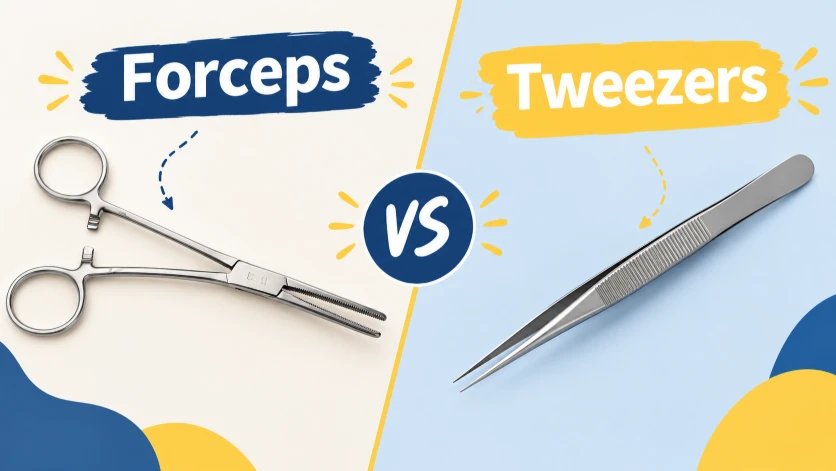
Forceps and tweezers both help people grip, hold, or remove small objects, but they are not always used for the same tasks. Forceps are tools commonly used in medicine, surgery, laboratories, and other settings that need controlled handling. Tweezers are small gripping tools often used to pluck hairs, remove splinters, handle tiny parts, or work with delicate objects.
People often search for “forceps or tweezers” because the tools can look very similar. Both may have two arms that come together at the tips, and both can help a person pick up something too small to hold easily with their fingers. However, their design, grip, and intended use can differ.
Choosing the right word depends on the tool and the task. A medical professional may use forceps to hold tissue or grasp an object during a procedure. Someone grooming their eyebrows will usually reach for tweezers instead.
In this guide, you will learn the meaning of each word, its origin, the differences between British and American English, common mistakes, and practical examples. You will also discover which term fits medical, everyday, academic, and business writing.
Forceps or Tweezers: The Quick Answer
Forceps and tweezers are gripping tools, but their names often reflect different designs and uses.commonly associated with medical, surgical, and laboratory work, while tweezers are often used for grooming and handling small objects. The terms can overlap because some tools called forceps resemble tweezers. Always consider the tool’s design and purpose.
Forceps or Tweezers: Quick Answer
The main difference between forceps and tweezers is their typical purpose and design.
- Forceps: Often used in medical procedures, surgery, laboratories, and scientific work to grasp, hold, or manipulate objects.
- Tweezers: Usually used for grooming, removing splinters, handling small components, and picking up tiny objects.
- Both: Can have two arms that meet at gripping tips, although their shapes and mechanisms vary.
Examples:
- A surgeon may use surgical forceps to hold tissue during a procedure.
- A person may use tweezers to remove a stray eyebrow hair.
- A laboratory worker may use either tool, depending on the sample and the instrument’s design.
The important point is that these words are not always interchangeable. In medical and technical writing, use the specific name given to the instrument.
What Do Forceps or Tweezers Mean?
Understanding the definitions of forceps and tweezers makes it easier to choose the correct term.
What Are Forceps?
Forceps are gripping instruments used to hold, grasp, lift, or manipulate objects. Many designs have two arms or jaws that meet when pressure is applied, but some forceps use hinges, locks, or other mechanisms.
Forceps are common in healthcare, surgery, dentistry, laboratories, and scientific research.
Common types include:
- Surgical forceps: Used to grasp tissue or other materials during medical procedures.
- Dressing forceps: Used to handle dressings or materials during wound care.
- Laboratory forceps: Used to handle samples or small objects.
- Obstetric forceps: Special instruments used in certain assisted childbirth procedures by trained professionals.
The exact function depends on the type of forceps. Some are designed to grip delicate tissue, while others hold objects firmly.
Example: “The laboratory technician used forceps to transfer the small specimen.”
What Are Tweezers?
Tweezers are small tools used to grasp or pluck objects that are difficult to handle with fingers. Many have two flexible arms joined at one end. Pressing the arms together brings their tips into contact.
Tweezers are common in personal care, electronics, crafts, and everyday household tasks.
Common types include:
- Eyebrow tweezers: Used to remove unwanted hairs.
- Pointed tweezers: Used to grip tiny objects or help remove splinters.
- Flat-tip tweezers: Used to handle objects that need a broader contact surface.
- Precision tweezers: Used for delicate work, including handling small electronic components.
Example: “She used tweezers to remove a tiny splinter from her finger.”
Are Forceps and Tweezers the Same Thing?
Not exactly. Both tools can grip small objects, and some instruments called forceps are very similar to tweezers. However, forceps often refers to a broader range of gripping instruments, including hinged medical tools, while tweezers usually refers to small, spring-action tools.
The best term depends on the instrument’s recognized name, construction, and intended purpose.
The Origin of Forceps and Tweezers
The two words have different histories, which helps explain why they developed distinct meanings.
Where Does the Word “Forceps” Come From?
The word forceps comes from Latin. It is traditionally connected with words meaning “to take” or “to carry away,” and it has long been associated with gripping instruments.
English adopted the term for tools used to grasp objects, especially in medical and technical settings. Over time, the word became established in the names of many specialized instruments.
Today, forceps remains a standard term in medicine, surgery, dentistry, and laboratory science.
Where Does the Word “Tweezers” Come From?

The word tweezers is linked to the French word étuis, meaning cases or small containers, through an older English form, tweeze. The modern plural word developed as the name for small gripping tools.
Tweezers became closely associated with personal grooming and the handling of small objects. Their familiar spring-action design makes them useful for tasks that require careful control.
Why Are the Words Different Today?
The distinction developed through the tools’ traditional uses and the terminology adopted by different professions.
- Medical and scientific fields often use specific names such as forceps.
- Personal care and everyday tasks commonly use tweezers.
- Some tools have overlapping designs, so their names may vary by context.
The words do not represent a simple distinction between old and new tools. Both remain in modern use.
British English vs American English
Forceps and tweezers have broadly the same meanings in British and American English. The main difference is not spelling or regional preference. It is the context in which each word is used.
| Context | British English | American English | Example |
| Medical procedures | Forceps | Forceps | The clinician selected the appropriate forceps. |
| Eyebrow grooming | Tweezers | Tweezers | She bought a new pair of tweezers. |
| Removing a splinter | Tweezers | Tweezers | He used tweezers to remove the splinter. |
| Laboratory work | Forceps or tweezers | Forceps or tweezers | The technician handled the sample carefully. |
| Precision electronics | Tweezers or precision forceps | Tweezers or precision forceps | The technician used precision tweezers. |
| Assisted childbirth | Obstetric forceps | Obstetric forceps | The specialist explained the procedure. |
Do British and American Writers Use Different Terms?
There is no major regional rule that makes forceps British and tweezers American, or vice versa.
Both varieties use the two words. The preferred term usually depends on the type of instrument, the profession, and the intended meaning.
For formal writing, follow the terminology used by the relevant medical organization, manufacturer, laboratory, or style guide. This is more reliable than assuming that one word belongs to a particular country.
Which Version Should You Use?
Choose the word that accurately describes the instrument and the task.
United States
Use forceps for medical, surgical, and many laboratory instruments. Use tweezers for eyebrow grooming, splinter removal, and many small household tasks.
Example: “The nurse prepared the dressing forceps.”
United Kingdom
The same distinction applies in British English. Forceps is standard medical terminology, while tweezers is the usual everyday word for small gripping tools.
Example: “I need tweezers to remove this splinter.”
Canada
Canadian English generally follows the same pattern as British and American English in this context. Use the instrument’s established name rather than choosing a term based on spelling conventions.
Example: “The technician used forceps to handle the specimen.”
Australia
Australian English also uses both terms in much the same way. In healthcare and technical settings, use the recognized name of the instrument.
Example: “The laboratory worker selected a pair of precision tweezers.”
International Writing
For an international audience, choose the most familiar term for the intended task.
- Use forceps when discussing a specific medical or technical instrument.
- Use tweezers for grooming and common household uses.
- Explain the tool’s function if readers may not recognize its name.
Academic Writing
In academic work, use the instrument’s precise technical name. If a research paper identifies an instrument as forceps, do not casually replace that term with tweezers.
When relevant, include the instrument type, model, or manufacturer so readers can identify the equipment.
Business Writing
In product descriptions, purchasing documents, and workplace instructions, use the official product name.
For example, a supplier might list “stainless steel surgical forceps” or “precision electronic tweezers.” These descriptions help buyers distinguish between products with different purposes.
Common Mistakes When Using Forceps and Tweezers
Writers sometimes confuse these terms because the tools can look alike. The following examples show how to use them more accurately.
| Incorrect or less suitable example | Better example | Explanation |
| She used surgical tweezers to hold tissue during the procedure. | She used surgical forceps to hold tissue during the procedure. | Use the instrument’s recognized medical name when known. |
| I need forceps to pluck my eyebrows. | I need tweezers to pluck my eyebrows. | Tweezers is the usual word for this grooming task. |
| The technician used tweezers, but the equipment label says forceps. | The technician used forceps, as specified on the equipment label. | Technical documentation should preserve the official name. |
| The lab worker picked up the specimen with some tool. | The lab worker picked up the specimen with laboratory forceps. | A specific term gives readers more useful information. |
| One tweezer was left on the table. | A pair of tweezers was left on the table. | Tweezers is commonly treated as a plural noun. |
Memory Tip
Remember this simple guide:
- Forceps = often medical or technical.
- Tweezers = often grooming or small everyday tasks.
This is a useful starting point, not an absolute rule. Some precision tools may legitimately be described by either term, depending on their design and established name.
Everyday Examples of Forceps and Tweezers
These examples show how the two words appear in different types of writing.
1. Emails
Forceps: “Please confirm that the correct sterile forceps are available for the scheduled procedure.”
Tweezers: “Could you order another pair of precision tweezers for the repair station?”
Both examples use the term that best fits the workplace task.
2. Business Writing
Forceps: “The supplier provides several types of surgical forceps for clinical use.”
Tweezers: “The electronics team requires anti-static precision tweezers for handling small components.”
In product descriptions, specific terminology helps prevent purchasing errors.
3. News Headlines
Forceps: “Hospital Updates Guidance on Surgical Instruments”
Tweezers: “Simple Tweezers Help Remove Tiny Splinters Safely”
These are illustrative headlines, not actual news reports.
4. Blogs
Forceps: “How to Identify Common Types of Medical Forceps”
Tweezers: “How to Choose Tweezers for Eyebrow Grooming”
A blog should use the term that matches its subject and explain any technical language that readers may not know.
5. Social Media
Forceps: “A closer look at the instruments used in modern laboratory work.”
Tweezers: “The right tweezers can make delicate craft projects easier.”
Short posts still benefit from accurate terminology.
6. Academic Writing
Forceps: “The specimen was transferred using sterile forceps according to the laboratory protocol.”
Tweezers: “Precision tweezers were used to position the small component during assembly.”
In academic writing, avoid changing an instrument’s name unless there is a clear reason to do so.
7. Daily Conversation
Forceps: “The dentist used forceps during the procedure.”
Tweezers: “Do you have tweezers? I have a splinter.”
These are natural examples of how the words are commonly used.
Google Trends and Modern Usage
People search for “forceps or tweezers” because they want to know if the tools are the same, which one to use, or which name is correct for a particular instrument.
The search can reflect several needs:
- Definition: Readers want a clear explanation of each tool.
- Product selection: Buyers need to distinguish medical forceps from grooming or precision tweezers.
- Medical education: Students want to understand the names of common instruments.
- English learning: ESL learners and writers want to use the correct word in a sentence.
- Technical accuracy: Professionals need to describe equipment correctly.
Which Word Is More Common?
The words appear in different contexts, so their overall popularity does not tell the whole story. Tweezers is familiar in everyday grooming and household use, while forceps is strongly associated with medical and technical terminology.
This is a general observation about usage, not a measured Google Trends result. No numerical search-volume figures or regional rankings are claimed here.
Why Do People Confuse Them?
The main reason is their similar function. Both can pick up or hold small objects, and some designs have similar shapes.
However, the intended use and technical name matter more than appearance alone. A medical instrument should not automatically be called tweezers just because it has two arms, and a small grooming tool does not need to be called forceps.
For the best results, use the recognized name of the actual tool.
Quick Comparison Table: Forceps vs Tweezers
| Feature | Forceps | Tweezers |
| Meaning | Instruments used to grasp or hold objects | Small tools used to grip or pluck objects |
| Main uses | Medical, surgical, dental, and laboratory tasks | Grooming, splinter removal, crafts, and precision handling |
| Typical design | May be spring-action, hinged, locking, or specialized | Often two flexible arms joined at one end |
| Common users | Healthcare workers, scientists, and technicians | General users, beauty professionals, and technicians |
| Everyday example | Surgical forceps | Eyebrow tweezers |
| Correct word? | Yes, for instruments recognized as forceps | Yes, for tools recognized as tweezers |
| Regional differences | Broadly the same in the US and UK | Broadly the same in the US and UK |
Key Takeaways
- Forceps and tweezers are both gripping tools, but their typical uses differ.
- Forceps are common in medicine, surgery, dentistry, and laboratory work.
- Tweezers are common in grooming, splinter removal, crafts, and delicate handling.
- Some forceps and tweezers look alike, so their names can overlap.
- British and American English use both words in broadly the same way.
- Academic and professional writing should follow the instrument’s recognized name.
- Use tweezers for ordinary eyebrow grooming and forceps when referring to a specific medical instrument.
- When in doubt, check the manufacturer’s description or the terminology used by the relevant profession.
FAQs About Forceps or Tweezers
1. What is the main difference between forceps and tweezers?
Forceps are commonly used for medical, surgical, dental, and laboratory tasks, while tweezers are often used for grooming and handling small objects. Their designs can overlap, so the exact difference depends on the instrument. In professional settings, the official instrument name is the best guide.
2. Are forceps and tweezers the same thing?
No, not exactly. They share the purpose of gripping objects, but they are not always interchangeable terms. Forceps can include specialized medical instruments with hinges, locking mechanisms, or particular jaw designs. Tweezers usually refers to small tools with two arms that meet when pressed together.
3. Are tweezers a type of forceps?
The terms sometimes overlap in technical and product descriptions, but tweezers are not universally classified as a type of forceps. Their classification depends on the design and the terminology used in the relevant field. When identifying an instrument, use its established name rather than assuming one term includes the other.
4. Can I use tweezers instead of forceps?
That depends on the task. Tweezers may work for simple tasks such as handling small objects, but they are not a suitable substitute for every medical or laboratory instrument. Medical procedures require the correct equipment and trained professionals. Follow the relevant procedure and equipment instructions.
5. Which tool is used to remove splinters?
Tweezers are commonly used to grasp and remove a visible splinter when it can be safely reached. Use clean tweezers and avoid digging deeply into the skin. Seek medical advice if the splinter is deeply embedded, causes significant pain, or shows signs of infection.
6. Why do doctors use forceps?
Doctors and other trained healthcare professionals use different types of forceps to grasp, hold, or manipulate tissue and other materials during specific procedures. The design depends on the medical task. Not all forceps serve the same purpose, and some are intended only for particular procedures.
7. Is “forceps” singular or plural?
Forceps has the same form in both singular and plural use, although the sentence may make the intended meaning clearer. For example, “The surgeon selected a forceps” can refer to one instrument, while “The surgeon selected several forceps” refers to multiple instruments. Some writers use “a pair of forceps” for clarity.
8. Is “tweezers” singular or plural?
Tweezers is normally treated as a plural noun in everyday English. For one tool, people commonly say “a pair of tweezers.” For example, “I bought a new pair of tweezers.” This pattern is similar to other paired tools, such as scissors.
9. Do British and American English use different words for forceps and tweezers?
No major difference separates British and American English in this case. Both varieties use forceps for many medical and technical instruments and tweezers for grooming and small-object handling. The best choice depends on the tool’s function and recognized name, not the country.
10. Which word should I use in formal writing?
Use the specific name of the instrument whenever possible. In a medical report, laboratory protocol, or academic paper, forceps may be the correct technical term. In a general article about eyebrow grooming or removing splinters, tweezers is usually more natural. Follow relevant professional guidance when applicable.
Conclusion: Forceps or Tweezers?
The difference between forceps and tweezers comes down to their usual purposes, designs, and established names. Forceps are commonly associated with medical, surgical, dental, and laboratory work. Tweezers are more often used for grooming, removing splinters, crafting, and handling small objects.
The words can overlap because both describe gripping tools, and some instruments have similar shapes. That is why it is important to consider more than appearance when choosing the correct term.
For everyday writing, use tweezers when discussing eyebrow grooming or picking up a tiny object. Use forceps when referring to a recognized medical or technical instrument. In academic, business, and professional writing, check the instrument’s official name and follow the terminology used in that field.
There is no major British-versus-American spelling difference to worry about. The same practical distinction works in both varieties of English.
Remember: choose the word that matches the tool’s purpose and recognized name, not just its shape. If you found this guide helpful, explore more word comparisons on Wordsblog to improve your English with confidence.
Read more about!
- CT or MRI: What’s the Difference?
- Yoto or Tonies: Which Audio Player Is Better?
- Realizes or Realises: Which Spelling Is Correct?

I’m Olivia Parker, a grammar and English writing enthusiast passionate about making English simple and easy to understand. Through Wordsblog, I share clear explanations, useful grammar tips, and practical writing guidance to help readers write with confidence. My goal is to make learning English easier, one word at a time.







1 thought on “Forceps or Tweezers: What’s the Difference?”