A metaphor and an analogy both help explain ideas, but they do it in different ways. A metaphor describes one thing as another to create a vivid image or express an idea, while an analogy compares two things to explain how they are similar. Knowing the difference helps you write clearly, understand literature, and make difficult ideas easier to grasp.
People often search for “metaphor or analogy” because the two terms seem closely related. Both use comparisons, and some examples can fit both categories. However, they do not serve exactly the same purpose. A metaphor often makes a statement more powerful or memorable, while an analogy usually explains a relationship, process, or concept.
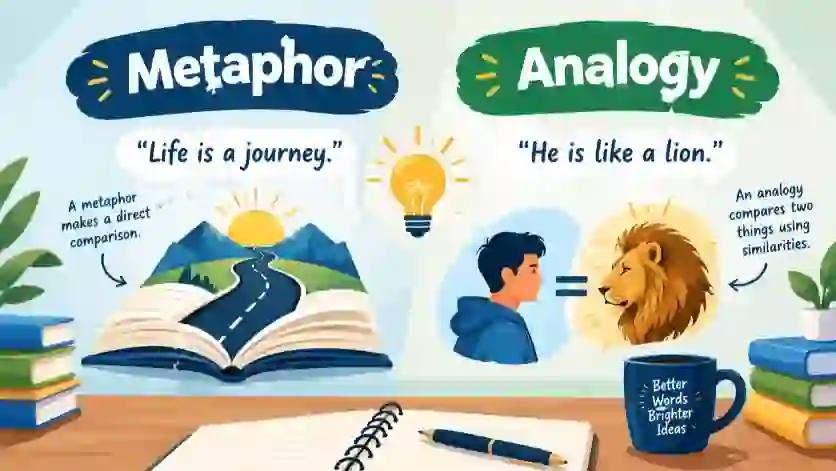
For example, saying “Time is money” is a metaphor. It presents time as money to show that time has value. Saying “Managing your time is like managing your money because both require careful planning” is an analogy. It explains a similarity between two things.
In this guide, you will learn the meaning of each term, how they differ, where the words came from, and how to use them in everyday conversations, schoolwork, emails, and professional writing. You will also find practical examples and answers to common questions.
Metaphor or Analogy: The Quick Answer
A metaphor describes one thing as another to suggest a shared quality, while an analogy compares two things to explain a similarity or relationship. For example, “Her voice is music” is a metaphor. “Her voice is like a musical instrument because both can create different moods” is an analogy. A metaphor can form part of an analogy, but an analogy often provides a fuller explanation.
Metaphor or Analogy: Quick Answer
The main difference between a metaphor and an analogy is their purpose.
- Metaphor: Creates a direct comparison to express an idea vividly.
- Analogy: Explains an idea by showing how it resembles something more familiar.
- Both: Use similarities to help readers or listeners understand a message.
Consider these examples:
- Metaphor: “The classroom was a zoo.” This suggests that the classroom was noisy or chaotic.
- Analogy: “A classroom without clear rules is like a team without a coach because both can struggle to stay organized.”
- Metaphor within an analogy: “Ideas are seeds. Just as seeds need water and sunlight to grow, ideas need time and effort to develop.”
The first example creates an image. The second explains a relationship. The third uses a metaphor as the starting point for a longer comparison.
What Does Metaphor or Analogy Mean?
To understand the difference, it helps to examine each term separately.
What Is a Metaphor?
A metaphor is a figure of speech that describes one thing as another to suggest a shared quality. It does not usually mean that the two things are literally the same.
For example, consider this sentence:
“Her heart is made of gold.”
The sentence does not mean that her heart contains real gold. Instead, it suggests that she is kind, generous, and caring.
Metaphors make writing more vivid because they help readers picture an idea rather than simply read a description.
More examples include:
- “Life is a journey.” This presents life as a path filled with experiences and choices.
- “He has a heart of stone.” This suggests that he is unkind or emotionally distant.
- “The news was a ray of sunshine.” This means the news brought happiness or hope.
- “She is the backbone of the team.” This suggests that she provides essential support.
Metaphors appear in poetry, novels, speeches, advertisements, blogs, and everyday conversations.
A metaphor does not need to use the words like or as. When a comparison uses those words, it may be a simile instead. For example, “Her smile is sunshine” is a metaphor, while “Her smile is like sunshine” is a simile.
What Is an Analogy?
An analogy compares two different things to explain a similarity between them. It often connects an unfamiliar idea to something the audience already understands.
For example:
“Learning a language is like learning to play an instrument. Both require practice, patience, and regular feedback.”
This comparison helps readers understand why language learning takes time.
Here are more examples:
- “The brain is like a computer in some ways because both process information, but the brain works very differently from a digital machine.”
- “Running a business is like tending a garden because both require planning, regular care, and patience.”
- “An engine is to a car what a heart is to the human body because each plays a central role in keeping its system working.”
- “Studying for an exam is like training for a race because consistent preparation is more useful than last-minute effort.”
Analogies are common in teaching, science communication, persuasive writing, and problem-solving. They can also help people explain technical ideas to beginners.
However, an analogy is not proof that two things are identical. A good analogy highlights a useful similarity while recognizing that the two things may differ in other ways.
How Are Metaphors and Analogies Related?
Both devices use comparison, but they usually emphasize different things.
A metaphor often creates meaning through an image. An analogy often develops meaning by explaining a relationship.
For example, “The internet is a highway” is a metaphor. It suggests that information travels between destinations.
An analogy might expand that comparison: “The internet is like a highway system because data travels along connected routes, and different routes can carry traffic to different destinations.”
The metaphor gives readers a simple image. The analogy explains the comparison in more detail.
The Origin of Metaphor and Analogy
The two words have different histories, which helps explain their meanings today.
Origin of Metaphor
The word metaphor comes from the Greek word metaphora, meaning a transfer or carrying across. It is related to the Greek elements meta, meaning across or beyond in this formation, and pherein, meaning to carry.
The idea behind the word is that meaning is transferred from one thing to another. When a writer says, “The world is a stage,” the word stage carries its associations with acting and performance into a description of life.
The term became established in discussions of language and rhetoric, including classical Greek philosophy. Today, metaphor is a central concept in literature, communication, and the study of how people understand abstract ideas.
Origin of Analogy
The word analogy comes through Latin from Greek analogia, meaning proportion or correspondence. It is connected with the idea of a relationship between things.
This history reflects how analogies work. They do not merely place two things side by side. They often explain how a relationship in one situation resembles a relationship in another.
For example, a teacher might compare the relationship between a key and a lock with the relationship between a password and a protected account. The objects differ, but the comparison helps explain their related functions.
Why Their Meanings Sometimes Overlap
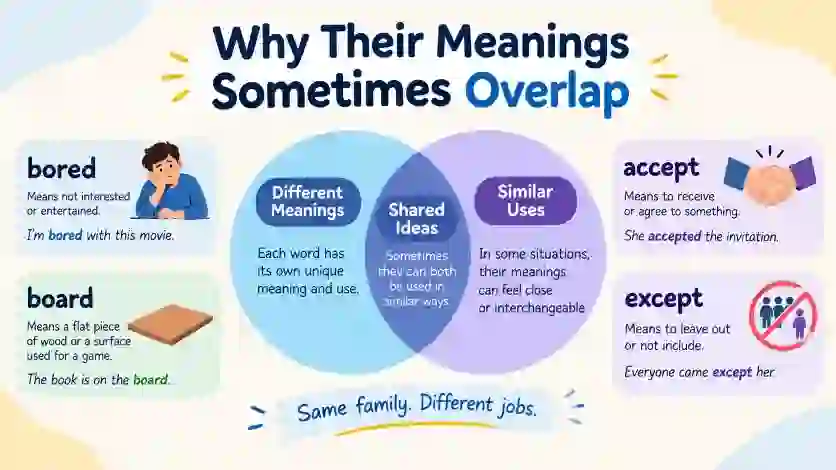
Metaphor and analogy have remained closely related because both use similarities to communicate ideas.
A metaphor can be the foundation of an analogy. A longer analogy can also contain several metaphors. The difference depends on how the comparison is used, not simply on the words in the sentence.
British English vs American English
Metaphor and analogy have the same basic meanings in British English and American English. Neither word has a separate British or American spelling, and writers in both regions use them in literature, education, business, and everyday communication.
| Feature | British English | American English | Example |
| Spelling of metaphor | Metaphor | Metaphor | “The city is a jungle.” |
| Spelling of analogy | Analogy | Analogy | “A battery is like a small energy store.” |
| Meaning of metaphor | Direct figurative comparison | Direct figurative comparison | “Time is money.” |
| Meaning of analogy | Comparison that explains a similarity | Comparison that explains a similarity | “Learning is like building a house.” |
| Common contexts | Education, literature, conversation | Education, literature, conversation | Both terms appear in essays and speeches. |
There is no meaningful regional difference in the definitions. Any differences in examples, tone, or style usually come from the audience, subject, or publication rather than the variety of English.
Style guides may differ in how they recommend formatting quotations, capitalizing titles, or handling punctuation. Those rules do not change the meanings of metaphor and analogy.
Which Version Should You Use?
You do not need to choose between a British and American version of these terms. Both are standard in English. Instead, choose the device that best expresses your intended meaning.
United States
Use metaphor when you want to describe something figuratively, and use analogy when you want to explain a similarity. Both terms are suitable for American school assignments, workplace documents, and published writing.
United Kingdom
The same distinction applies in British English. A metaphor can strengthen a creative description, while an analogy can make a difficult concept easier to understand.
Canada
Both terms are standard in Canadian English. Follow the terminology used by your teacher, publisher, or organization if you are writing for a specific audience.
Australia
Australian English uses metaphor and analogy in the same way. In schoolwork and professional communication, explain the comparison clearly and avoid analogies that could confuse readers.
International Writing
For an international audience, choose simple examples that people from different backgrounds can understand. A comparison involving everyday activities, such as learning, cooking, or traveling, may be clearer than one based on a local sport or cultural reference.
Academic Writing
Use metaphors to discuss figurative language, themes, imagery, and meaning. Use analogies to clarify a concept or explain a relationship.
In academic work, make sure an analogy supports your reasoning rather than replacing evidence. Similarity between two examples does not automatically prove that they share every feature.
Business Writing
Metaphors can make a message memorable, such as “We need to build a stronger foundation.” Analogies can help explain complex processes, such as comparing a company’s workflow to a relay race in which each team member depends on the previous person’s work.
Choose a comparison that fits the audience and the message. In formal reports, explain any comparison that could be misunderstood.
Common Mistakes
Writers often confuse metaphors and analogies because both involve comparisons. These examples show how to distinguish them.
| Incorrect or confusing example | Better example | Explanation |
| “A metaphor always uses the word like.” | “Her words were daggers.” | A metaphor can make a direct comparison without like or as. |
| “An analogy is just another name for a metaphor.” | “A metaphor creates an image; an analogy explains a similarity.” | The terms are related but not interchangeable in every context. |
| “The brain is a computer, so it works exactly like one.” | “The brain is like a computer in some ways because both process information.” | An analogy highlights selected similarities, not complete identity. |
| “He runs like the wind” is definitely a metaphor. | “He runs like the wind” is a simile. | The word like signals an explicit comparison commonly classified as a simile. |
| “This analogy proves my argument is true.” | “This analogy helps explain my argument.” | An analogy can clarify an idea, but it does not prove a claim by itself. |
Memory Tip
Use this simple rule:
- Metaphor = image. It describes one thing as another.
- Analogy = explanation. It compares relationships or features to make an idea clearer.
This is a useful guide rather than an absolute rule. Some metaphors explain ideas, and some analogies create memorable images.
Everyday Examples of Metaphor and Analogy
The best way to learn the difference is to see how both devices work in real situations.
1. Emails
Metaphor: “Your feedback was a guiding light during this project.”
This describes the feedback as a source of light to show that it was helpful.
Analogy: “Reviewing this proposal is like checking a map before a journey because it helps us spot problems before we move forward.”
This comparison explains why reviewing the proposal matters.
2. Business Writing
Metaphor: “Customer trust is the foundation of our business.”
The word foundation emphasizes how important trust is.
Analogy: “A business team is like a rowing crew because everyone must work in coordination to move forward.”
The analogy explains the value of teamwork.
3. News Headlines
Metaphor: “A Wave of Change Sweeps Through the Industry”
The word wave presents a large change as a powerful movement.
Analogy: “Why This Market Shift Is Like a Domino Effect”
The comparison suggests that one event may trigger several others. A news article would need to explain the actual connection.
4. Blogs
Metaphor: “Good Writing Is a Bridge Between Ideas and Readers.”
This presents writing as a bridge that connects people with information.
Analogy: “Editing a blog post is like polishing a window because both processes help people see something more clearly.”
The analogy explains the purpose of editing.
5. Social Media
Metaphor: “My inbox is a mountain today.”
This exaggerates the amount of email waiting to be handled.
Analogy: “Building a daily habit is like saving small amounts of money because little efforts can add up over time.”
The analogy makes a general lesson easier to remember.
6. Academic Writing
Metaphor: “The novel is a mirror reflecting social inequality.”
The mirror represents how the novel reveals aspects of society.
Analogy: “A scientific model is like a simplified map because it highlights important features while leaving out some details.”
This comparison explains how a model can be useful without representing every part of reality.
7. Daily Conversation
Metaphor: “You are my rock.”
This means the person provides strength and support.
Analogy: “Learning to cook is like learning to drive because both require practice before you become confident.”
The comparison connects two familiar learning experiences.
8. Teaching and Learning
Metaphor: “Curiosity is the engine of discovery.”
This presents curiosity as the force that drives learning.
Analogy: “Learning a new skill is like building a wall because each new layer depends on the work already completed.”
This helps explain why basic skills matter before advanced ones.
These examples show that neither device is limited to poetry or formal writing. Both can improve explanations, although the best choice depends on if you want to create an image or explain a relationship.
Google Trends and Modern Usage
Metaphor and analogy remain useful terms in education, writing, literature, communication, and critical thinking. People may search for them when studying figures of speech, preparing essays, teaching English, or trying to identify the right term for a comparison.
Common searches include:
- Metaphor vs analogy
- What is the difference between a metaphor and an analogy?
- Metaphor examples for students
- Analogy examples in everyday life
- Is a metaphor the same as an analogy?
- Metaphor, simile, and analogy differences
These searches reflect a clear learning need: people want definitions that are easy to remember and examples that show how the terms work.
A precise regional popularity ranking cannot be established from general knowledge alone. Without checking a defined Google Trends time range, region, and comparison settings, it would be misleading to claim that one term is more popular in a particular country.
The terms also appear in different contexts. Metaphor is often discussed in literary analysis and figurative language, while analogy is frequently used when explaining concepts, relationships, and arguments. However, these are general patterns, not exclusive rules.
For practical writing, understanding the purpose of a comparison is more useful than trying to choose a term based on search popularity.
Quick Comparison Table
| Version | Meaning | Correct? | Region | Example |
| Metaphor | Describes one thing as another | Yes | All English varieties | “Hope is a candle.” |
| Analogy | Explains a similarity between things or relationships | Yes | All English varieties | “Hope is like a candle because it can provide comfort in darkness.” |
| Simile | Makes an explicit comparison, often using like or as | Yes, as a related device | All English varieties | “She is as brave as a lion.” |
| Metaphor used in an analogy | Uses a figurative comparison as part of a fuller explanation | Yes | All English varieties | “Ideas are seeds; like seeds, they need care to grow.” |
Remember that metaphor and analogy are not competing spellings or regional alternatives. They name different but related ways to compare ideas.
Key Takeaways
- A metaphor describes one thing as another to express an idea vividly.
- An analogy compares things or relationships to explain a similarity.
- “Time is money” is a metaphor because it presents time as something valuable.
- “Managing time is like managing money” is an analogy when it explains the similarities between the two activities.
- A metaphor can be part of a longer analogy.
- A simile is another related device, often using like or as.
- British English and American English use metaphor and analogy in the same way.
- Choose a metaphor to create an image and an analogy to make a concept easier to understand.
FAQs
1. What is the main difference between a metaphor and an analogy?
A metaphor describes one thing as another to suggest a shared quality or create an image. An analogy compares two things to explain a similarity or relationship. For example, “Time is money” is a metaphor, while explaining how time management resembles money management is an analogy.
2. Can a metaphor also be an analogy?
Yes. A metaphor can be part of an analogy, especially when a writer develops the comparison to explain an idea. For example, “Ideas are seeds” is a metaphor. Explaining that ideas need time, attention, and suitable conditions just as seeds need care develops the comparison into an analogy.
3. Is an analogy the same as a simile?
No. A simile is a figure of speech that explicitly compares two things, often using like or as. An analogy usually goes further by explaining a similarity. “She shines like the sun” is a simile, while comparing her encouragement to sunlight that helps others grow develops a broader analogy.
4. What is an example of a metaphor?
“The classroom was a zoo” is a metaphor. It suggests that the classroom was noisy or chaotic without saying that it contained actual animals. Other examples include “Time is money,” “He has a heart of stone,” and “Her words were music to my ears.”
5. What is an example of an analogy?
“Learning a language is like learning to play an instrument because both require practice and patience” is an analogy. It compares two learning experiences to explain why regular effort matters. The comparison helps readers understand an unfamiliar or complex idea through something more familiar.
6. Why do people confuse metaphors and analogies?
People confuse the terms because both rely on similarities between different things. A metaphor may communicate an idea through a comparison, while an analogy can use a metaphor to explain that same idea. The easiest way to tell them apart is to consider if the comparison mainly creates an image or develops an explanation.
7. Is “Time is money” a metaphor or an analogy?
“Time is money” is a metaphor because it describes time as money to suggest that time is valuable and should be used wisely. If you explain how budgeting time resembles budgeting money, including the similarities and limits of that comparison, you are developing an analogy.
8. Can an analogy contain a metaphor?
Yes. An analogy can contain one or more metaphors. For example, “Knowledge is a key” is a metaphor. Explaining that knowledge can open opportunities just as a key opens a locked door develops the image into an analogy.
9. Which is better for academic writing, a metaphor or an analogy?
Neither is always better. A metaphor can help analyze themes, express abstract ideas, or describe a concept vividly. An analogy can clarify a difficult process or explain a relationship. In academic writing, use either one when it serves your argument, and support factual claims with relevant evidence.
10. How can I remember the difference between a metaphor and an analogy?
Think of a metaphor as an image and an analogy as an explanation. A metaphor says, “The mind is a garden.” An analogy explains that the mind resembles a garden because both need care and attention to flourish. This memory tip works for many examples, although some comparisons serve both purposes.
Conclusion
Understanding the difference between a metaphor and an analogy can make your writing clearer, stronger, and easier to follow. Both devices use comparison, but they often serve different purposes. A metaphor describes one thing as another to create a vivid image or express a deeper meaning. An analogy explains a similarity between things or relationships, helping readers understand an idea through a familiar example.
For instance, “Life is a journey” is a metaphor because it presents life as a journey. Explaining that life resembles a journey because both involve choices, unexpected challenges, and changing directions develops the comparison into an analogy.
Neither device is limited to creative writing. You can use metaphors in emails, blog posts, speeches, and conversations to make messages memorable. Analogies are especially helpful in lessons, reports, presentations, and academic writing when you need to explain something unfamiliar.
There is no British or American spelling difference to worry about. Focus instead on your purpose, your audience, and the meaning you want to communicate.
The simplest rule to remember is this: a metaphor creates an image, while an analogy explains a connection. Try identifying both in something you read today, and visit Wordsblog for more clear explanations of commonly confused English terms.
Read more about!
- Realizes or Realises: Which Spelling Is Correct
- Forceps or Tweezers: What’s the Difference?
- Callus or Corn: What’s the Difference?

I’m Olivia Parker, a grammar and English writing enthusiast passionate about making English simple and easy to understand. Through Wordsblog, I share clear explanations, useful grammar tips, and practical writing guidance to help readers write with confidence. My goal is to make learning English easier, one word at a time.