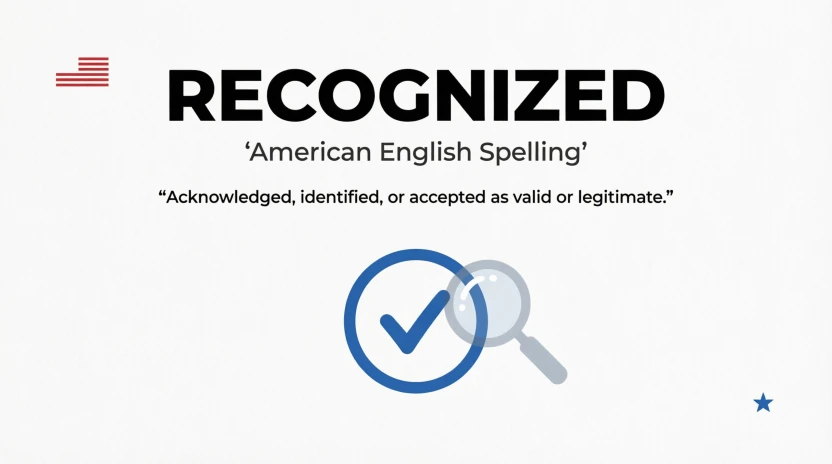
Recognized is the standard spelling in American English, while recognised is the standard spelling in British English. Both words have the same meaning and pronunciation. Use recognized when writing for a US audience and recognised when writing for a UK audience. In Canada and Australia, recognised is generally preferred, although Canadian usage can vary by style guide.
Recognized or Recognised: Quick Answer
The choice between recognized and recognised depends mainly on your audience and the spelling style you follow.
- Recognized: Preferred in American English.
- Recognised: Preferred in British English and commonly used in Australian English.
- Meaning: Both spellings mean identified, acknowledged, or accepted as valid.
Examples:
- American English: The teacher recognized the student’s hard work.
- British English: The teacher recognised the student’s hard work.
- Australian English: The award recognised her contribution.
Neither spelling is inherently wrong. The important thing is to use the form that fits your audience and remain consistent throughout your writing.
What Does Recognized or Recognised Mean?
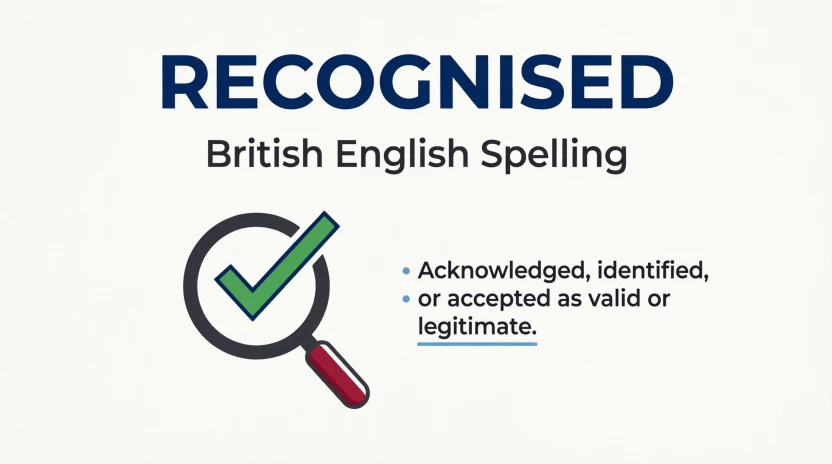
The words recognized and recognised are the past tense and past participle forms of the verb recognize or recognise. They share the same definition, pronunciation, and grammatical function.
The word can have several meanings depending on the context.
1. To Identify Someone or Something
You recognize a person when you know who they are because you have seen or met them before.
Examples:
- I recognized my old teacher at the store.
- She recognised his voice immediately.
- The witness recognized the person in the photograph.
2. To Accept or Acknowledge a Fact
The word can also mean accepting that something is true or exists.
Examples:
- The company recognized the need for change.
- He recognised that he had made a mistake.
- The report recognized the importance of education.
3. To Give Credit for an Achievement
People often use the word when someone receives praise or acknowledgment for their work.
Examples:
- The school recognized her academic success.
- The organization recognised his years of service.
- Her contribution was recognized by the team.
4. To Accept Something as Official or Valid
In legal, political, and professional contexts, recognized or recognised can mean officially accepted.
Examples:
- The institution is recognized by the government.
- The country recognised the new government.
- She holds a nationally recognized qualification.
In every example, either spelling communicates the same meaning. Only the preferred regional spelling changes.
The Origin of Recognized and Recognised
The spelling difference between recognized and recognised developed through different spelling conventions in English. It is part of a wider pattern in which American and British English use different endings for certain words.
The verb recognize ultimately comes from Latin recognoscere, meaning to know again or recall. English adopted the word through French and Latin influences.
Over time, English developed both -ize and -ise spellings in words such as recognize/recognise, organize/organise, and realize/realise.
Why Does American English Use Recognized?
American English generally favors the -ize spelling in words of this type. This convention became common in American dictionaries and publishing standards.
As a result, US writers typically use:
- Recognize
- Recognized
- Recognizing
- Recognition
Notice that recognition does not change to recognisation. It has its own established spelling.
Why Does British English Use Recognised?
British English commonly uses -ise in this word, so recognised is widely accepted and preferred by many UK publishers and writers.
However, British English does not always require -ise. Some British dictionaries and style guides accept or prefer -ize in certain words. Oxford spelling, for example, uses -ize in many words of this type.
Therefore, it is more accurate to say that recognised is the common British form, not that recognized is always incorrect in Britain.
Is the Difference About Meaning?
No. The spelling does not change the definition, grammatical role, or pronunciation.
The difference is mainly a matter of regional convention and editorial style. If you are writing for a specific publication, follow its preferred spelling system.
British English vs American English
The main difference between recognized and recognised is the spelling used in each variety of English.
| British English | American English | Example |
| Recognised | Recognized | She recognised the problem. |
| Recognise | Recognize | I recognize that name. |
| Recognising | Recognizing | He is recognising the signs. |
| Recognition | Recognition | She received recognition for her work. |
The first three forms show the common regional spelling difference. The noun recognition is spelled the same way in both varieties.
Regional Differences
United States: Recognized is the normal spelling in schools, newspapers, business documents, and most American publications.
United Kingdom: Recognised is widely used in everyday writing and by many British publishers. Some UK style guides also accept recognized.
Canada: Both forms appear, but Canadian English often follows British-style spellings in words such as recognised. Individual publishers and organizations may choose different standards.
Australia: Recognised is the usual spelling in Australian English.
What Do Style Guides Say?
Style guides help writers maintain consistent spelling, punctuation, and formatting.
- American publications commonly follow US spelling conventions.
- Many British publications use -ise spellings.
- Oxford-style spelling uses -ize in many words, including recognize.
- Canadian and Australian publications generally follow their own national or organizational style guides.
The best approach is to check the rules of your school, employer, publisher, or target publication rather than assuming that every country follows one fixed rule.
Which Version Should You Use?
Choosing between recognized and recognised is simple once you know who will read your writing.
United States
Use recognized for American readers.
Examples:
- The company recognized his talent.
- She was recognized for her research.
- The school recognized the student’s achievement.
This is the safest choice for US websites, essays, resumes, and business communications.
United Kingdom
Use recognised if you are following standard British spelling conventions.
Examples:
- The government recognised the organization.
- Her work was recognised across the country.
- He recognised the importance of the change.
If a British publisher uses Oxford spelling or another house style that prefers -ize, follow that guide instead.
Canada
For Canadian readers, check your organization’s spelling policy. Recognised is common, but recognized is also used in Canadian publications.
If you are writing a school assignment, follow your teacher’s instructions. For professional writing, use the company’s or publisher’s established style.
Australia
Use recognised for most Australian writing.
Examples:
- The award recognised her contribution.
- He was recognised for his leadership.
- The qualification is recognised nationally.
This form is appropriate for Australian websites, schoolwork, and general business writing.
International Writing
For a global audience, either form can work. Choose one spelling convention and apply it consistently.
For example, if your website primarily targets US readers, use recognized. If your content targets the UK, Australia, or readers accustomed to British spelling, recognised is usually the better choice.
Avoid switching between the two forms without a clear reason.
Academic Writing
Academic writing should follow the required style guide or the institution’s rules.
- For an American university, recognized is generally the safer option.
- For a British university, recognised is often appropriate.
- For international research, follow the journal’s author guidelines.
Consistency matters more than choosing one form as universally superior.
Business Writing
Use the spelling that matches your customers, clients, or company’s preferred style.
For example, an American company might write, “Your payment has been recognized.” A British company might write, “Your payment has been recognised.”
Both sentences are correct. The choice reflects the company’s spelling convention, not a difference in meaning.
Common Mistakes With Recognized and Recognised
Although both spellings are correct, writers sometimes choose the wrong form for their audience or mix spelling styles in the same document.
| Incorrect or Inconsistent Example | Better Example | Explanation |
| The US report recognised the issue. | The US report recognized the issue. | Use standard US spelling for American writing. |
| The UK report recognized the issue. | The UK report recognised the issue. | Use standard British spelling when following an -ise style. |
| She recogniszed the error. | She recognised the error. | Recogniszed is not a standard spelling. |
| He has recognize the problem. | He has recognized the problem. | The present participle after has is recognized or recognised. |
| The team recognised the award, then recognized the winner. | The team recognised the award, then recognised the winner. | Keep the spelling consistent in British-style writing. |
The first two examples are not universally incorrect in every editorial context. They are better choices when the goal is to follow the usual spelling convention of the stated region.
Common Grammar Errors
1. Using the wrong verb form
Incorrect: She has recognise the mistake.
Correct: She has recognised the mistake.
After has, use the past participle. The same rule applies to recognized in American English.
2. Confusing the verb with the noun
Correct: The teacher recognized the student.
Correct: The teacher gave the student recognition.
Recognized and recognised are verb forms. Recognition is a noun and keeps the same spelling in both varieties of English.
3. Changing spelling styles halfway through a document
A document may use either spelling convention, but mixing them can make the writing look unedited.
Memory Tip
Remember this simple rule:
- US = recognized
- UK and Australia = recognised
For Canada, check the relevant style guide. This shortcut covers common usage, although individual publishers may use different conventions.
Everyday Examples of Recognized and Recognised
These examples show how both spellings work in real situations.
1. Emails
American English:
Your request has been recognized and forwarded to the appropriate team.
British English:
Your request has been recognised and forwarded to the appropriate team.
Both versions sound natural. Choose the one that matches the spelling style used by your organization.
2. Business Writing
American English:
The company recognized the need to improve customer service.
British English:
The company recognised the need to improve customer service.
The meaning remains the same in reports, proposals, and company updates.
3. News Headlines
American English:
Local Teacher Recognized for Outstanding Service
British English:
Local Teacher Recognised for Outstanding Service
News organizations typically follow their own editorial rules. The spelling may vary between publications, even when the headline describes the same event.
4. Blog Articles
American English:
Five Signs You Have Recognized a Common Grammar Mistake
British English:
Five Signs You Have Recognised a Common Grammar Mistake
If you run a grammar website, use the spelling that best fits your intended readership. Consistent regional spelling can also make your content easier for readers to follow.
5. Social Media
American English:
So happy to be recognized for my hard work!
British English:
So happy to be recognised for my hard work!
Social media allows informal language, but the usual regional spelling preferences still apply.
6. Academic Writing
American English:
The study recognized several limits in the earlier research.
British English:
The study recognised several limits in the earlier research.
Use the form required by your university or journal. Also, make sure the sentence accurately describes what the study did.
7. Daily Conversation
American English:
I recognized you from school!
British English:
I recognised you from school!
The words are pronounced the same way. In speech, listeners generally cannot tell which spelling the speaker would use in writing.
8. Professional Qualifications
American English:
This is a nationally recognized qualification.
British English:
This is a nationally recognised qualification.
This construction is common in education, training, and employment contexts.
9. Official Documents
American English:
The agency recognized the organization as an approved provider.
British English:
The agency recognised the organisation as an approved provider.
In British-style writing, organization may also be spelled organisation. Keep related spelling choices consistent with your selected style.
Google Trends and Modern Usage
People search for recognized or recognised because spell-checkers, websites, books, and official documents sometimes display different spellings. A writer may see one form in an American article and another in a British document and wonder if one is a mistake.
The main explanation is regional spelling preference, not a difference in meaning.
Which Spelling Is More Popular?
The answer depends on the country and the type of writing being examined.
- In the United States: Recognized is the usual form.
- In the United Kingdom: Recognised is common, though recognized appears in some publications.
- In Australia: Recognised is the usual form.
- In Canada: Both spellings appear, depending on the publisher and style guide.
These statements describe general spelling conventions. They are not numerical Google Trends findings.
Why Do People Search for This Keyword?
Several common situations lead people to compare the two spellings:
- They are writing an essay, report, email, or blog post.
- A spell-checker flags a word that looks correct to them.
- They are writing for readers in another country.
- They want to know if recognised is a spelling mistake.
- They are learning English and want to understand British and American spelling.
Does Google Prefer Recognized or Recognised?
Neither spelling is universally better for every search. The appropriate choice depends on the target audience, the wording of the query, and the overall usefulness of the page.
For a US-focused article, recognized is the natural choice. For a UK-focused article, recognised is usually more suitable.
There is no need to repeat both forms unnaturally throughout an article. Explain the difference clearly, then use the form that fits your readers.
Without a specific Google Trends comparison, it would be misleading to claim exact search volumes, percentages, or a worldwide winner.
Quick Comparison Table: Recognized vs Recognised
| Version | Meaning | Correct? | Region | Example |
| Recognized | Identified or acknowledged | Yes | United States; also used elsewhere | She was recognized for her work. |
| Recognised | Identified or acknowledged | Yes | United Kingdom and Australia; also used elsewhere | She was recognised for her work. |
| Recognize | Present-tense verb | Yes | Common US form | I recognize that name. |
| Recognise | Present-tense verb | Yes | Common UK and Australian form | I recognise that name. |
| Recognition | The act of identifying or acknowledging | Yes | Both | She received recognition. |
The key point is that recognized and recognised have the same meaning. The spelling you choose should match your audience or the style guide you follow.
Key Takeaways
- Recognized is the standard spelling in American English.
- Recognised is common in British and Australian English.
- Both forms have the same meaning and pronunciation.
- Neither spelling is universally wrong.
- Canadian English may use either form, depending on the style guide.
- Oxford-style spelling accepts recognize in many contexts, including British writing.
- Use one spelling convention consistently throughout a document.
- The noun recognition is spelled the same way in American and British English.
FAQs About Recognized or Recognised
1. Is recognized or recognised correct?
Both recognized and recognised are correct English spellings. Recognized is the usual American form, while recognised is common in British and Australian English. They have the same meaning and pronunciation. Choose the spelling that fits your audience or the style guide you need to follow.
2. Is recognized American or British English?
Recognized is most closely associated with American English. It is the standard spelling in most US publications and educational materials. However, it is also accepted by some British dictionaries and style guides, including Oxford-style spelling. Therefore, it is not exclusively American.
3. Is recognised British English?
Yes. Recognised is a common and widely accepted spelling in British English. It is also the usual spelling in Australian English. However, some British publishers prefer recognized, so always check the relevant style guide when writing for a particular publication.
4. Do recognized and recognised mean the same thing?
Yes. Both words can mean identified, acknowledged, accepted, or officially approved. For example, “She was recognized for her work” and “She was recognised for her work” express the same idea. The difference is spelling preference, not meaning.
5. Is recognised spelled incorrectly in American English?
In standard American English, recognized is the expected spelling. An American editor may change recognised to recognized to follow US conventions. However, recognised is a valid English spelling, even though it is not the usual American form.
6. Should I use recognized or recognised in academic writing?
Follow your university’s requirements, journal guidelines, or assigned style guide. American institutions generally expect recognized, while many British institutions use recognised. Consistency throughout your paper is important, especially when writing formal essays, research papers, and dissertations.
7. Which spelling is used in Canada, recognized or recognised?
Both forms appear in Canadian English. Recognised is common in Canadian writing that follows British-style spelling conventions, while recognized is also used. If you are preparing a Canadian publication or school assignment, check the relevant style guide rather than relying on a single universal rule.
8. Is recognized or recognised used in Australia?
Recognised is the usual spelling in Australian English. You will commonly see it in Australian education, business, and general writing. For example, “She was recognised for her contribution” follows the standard Australian preference. Use recognized only when a particular style guide calls for it.
9. How do you spell recognizing or recognising?
Both spellings are correct. Recognizing is the usual American form, while recognising is common in British and Australian English. For example, an American writer might say, “I am recognizing the signs,” while a British writer might use “I am recognising the signs.”
10. Does the spelling change the pronunciation?
No. Recognized and recognised are pronounced the same way in standard English. The difference appears in writing, not in the usual spoken form. Both spellings can be used to describe identifying a person, acknowledging a fact, or giving credit for an achievement.
Conclusion: Recognized or Recognised?
The choice between recognized and recognised is simple once you understand regional spelling conventions. Both words are correct, and both have the same meaning. The difference is that American English generally prefers recognized, while British and Australian English commonly use recognised.
If you are writing for a US audience, choose recognized. If your readers are mainly in the UK or Australia, recognised is usually the better option. For Canadian and international writing, check your style guide and keep your spelling consistent.
Remember that British English does not always reject -ize spellings. Some British dictionaries and publishers accept them, so your choice may depend on the publication’s rules.
For students, bloggers, business writers, and English learners, the most useful approach is to identify your audience before you start writing. This small step helps you avoid unnecessary editing and makes your content feel natural to your readers.
The final takeaway: Recognized is common in American English, recognised is common in British English, and both are correct.
If this guide helped you understand the difference, explore more word comparisons on Wordsblog to improve your English spelling and word choice.
Read more about!
- Jynx or Jinx: Which Spelling Is Correct?
- DayQuil or Mucinex: Which One Works Better?
- T568A or B: Which Ethernet Wiring Standard Is Best?

I’m Olivia Parker, a grammar and English writing enthusiast passionate about making English simple and easy to understand. Through Wordsblog, I share clear explanations, useful grammar tips, and practical writing guidance to help readers write with confidence. My goal is to make learning English easier, one word at a time.







2 thoughts on “Recognized or Recognised: Which Spelling Is Correct?”