If you are wondering if “camper” and “RV” mean the same thing, the short answer is: sometimes, but not always.
In American English, RV means recreational vehicle and is a broad term for vehicles designed for travel, camping, and living. Camper is a more informal term that can refer to several types of camping vehicles.
The confusion happens because camper can describe both a person who camps and a vehicle used for camping. An RV can also include different types of vehicles, such as motorhomes, travel trailers, fifth wheels, and camper vans. Dictionaries also show that regional English uses these words differently.
This guide explains camper or RV, the difference between the terms, their regional usage, common mistakes, and which word works best in American, British, Canadian, and international English.
Camper or RV: Featured Snippet & AI Overview
Camper and RV are related terms, but they are not always identical. In American English, RV means recreational vehicle and is a broad category. Camper is a less precise term that can refer to a camping vehicle, including some RVs and towable campers. For precise writing, use RV for the broad category and name the specific type when possible.
Camper or RV: Quick Answer
The easiest way to remember the difference is:
- RV = a broad term for a recreational vehicle.
- Camper = a common, informal term for a camping vehicle.
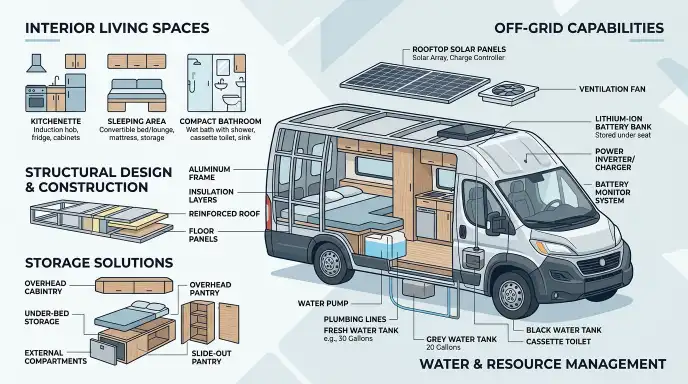
- Motorhome = an RV that has its own engine.
- Travel trailer = a towable RV without its own engine.
- Camper van = a van fitted for sleeping and living.
- Fifth wheel = a towable RV designed to connect to a special hitch in a pickup truck.
For example:
- “We bought an RV for our cross-country trip.”
This is broad and natural American English. - “We bought a camper that we can tow behind our SUV.”
This suggests a towable camping vehicle. - “They rented a camper van for the weekend.”
This identifies a specific type of camping vehicle.
So, every camper may be described as an RV in some contexts, but not every RV would normally be called a camper.
What Does Camper or RV Mean?
What Does “Camper” Mean?
The word camper has more than one meaning.
It can mean a person who camps, such as:
“The campers stayed near the lake.”
It can also refer to a vehicle designed for camping or living while traveling. Oxford lists camper as a North American term for a large vehicle designed for people to live and sleep in while traveling. It also lists a towable vehicle as another North American use of camper.
This makes camper a flexible word.
What Does “RV” Mean?
RV is short for recreational vehicle.
It is a broad American English term for a vehicle designed for recreation, travel, and temporary living. Oxford defines an RV as a large vehicle designed for people to live and sleep in while traveling.
The term can cover different vehicle types.
For example:
- Motorhomes
- Camper vans
- Travel trailers
- Fifth-wheel trailers
- Other recreational camping vehicles
Because of this, RV is usually the more precise category term in American English.
Is a Camper an RV?
Often, yes.
A camper can be an RV when it is designed for recreational travel and temporary living. However, camper is less specific, so its exact meaning depends on context.
That is why someone might say:
“We rented an RV.”
while another person might casually say:
“We rented a camper.”
Both may be talking about a similar vehicle.
The Origin of Camper or RV
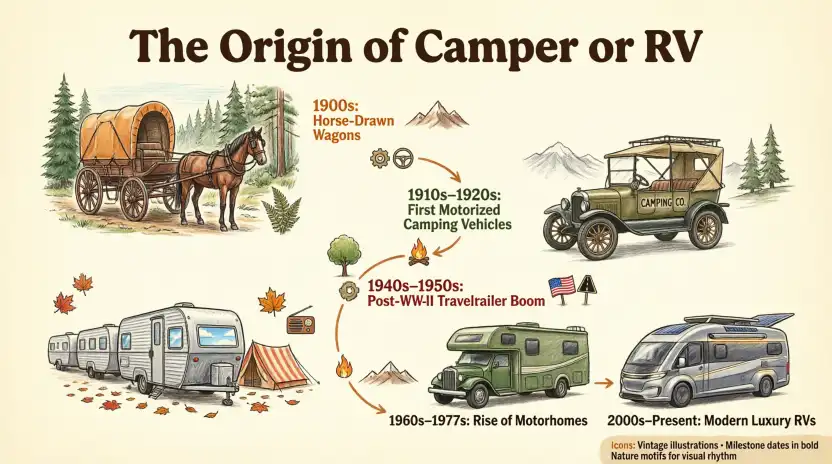
The two terms developed from different ideas.
Origin of “Camper”
Camper comes from camp, with the suffix -er, which commonly forms a noun for a person or thing associated with an action.
In its basic sense, a camper is someone who camps. Over time, the word also became associated with camping equipment and vehicles used for camping.
The vehicle meaning is therefore closely connected to the activity of camping and temporary outdoor living.
Origin of “RV”
RV is an abbreviation of recreational vehicle.
The phrase is descriptive. It combines:
- recreational = related to leisure or recreation
- vehicle = something used for transportation
Modern dictionaries use RV as the American English abbreviation for recreational vehicle.
The important point is that RV developed as a broad category name, while camper has a more informal and flexible history.
British English vs American English
Regional vocabulary creates much of the confusion around camper or RV.
In American English, RV is common. In British English, people often use camper, camper van, or motorhome for vehicles that Americans may call RVs. For a towable vehicle, British English commonly uses caravan, while American English often uses camper or trailer.
| Meaning | British English | American English | Example |
| Large vehicle you can live in | Motorhome / camper | RV / motorhome / camper | “We rented an RV.” |
| Van fitted for camping | Camper van | Camper van / RV | “They traveled in a camper van.” |
| Towable holiday vehicle | Caravan | Travel trailer / camper | “The caravan was parked at the campsite.” |
| Broad category | Camper / motorhome | RV | “The RV has a kitchen.” |
Oxford specifically identifies RV as North American English and camper/camper van as British equivalents in relevant contexts.
A Key Regional Difference
Be careful with caravan.
In British English, a caravan can mean a towable vehicle used for holidays. In American English, caravan usually does not carry this everyday vehicle meaning
Which Version Should You Use?
The best choice depends on your audience.
United States
Use RV when you mean the broad category.
Examples:
“We rented an RV for our vacation.”
“The RV has a full kitchen.”
Use camper when the context is casual or when you mean a particular camping vehicle.
United Kingdom
Use camper, camper van, motorhome, or caravan, depending on the vehicle.
For a self-powered vehicle, motorhome is often a clear choice. For a towable holiday vehicle, caravan is standard British vocabulary.
Canada
Both RV and camper can be understood. If you are writing for a broad Canadian audience, RV is a useful general term, while the specific vehicle type can make your meaning clearer.
Australia
Australian English commonly uses terms such as caravan, campervan, and motorhome. The best word depends on the type of vehicle and the audience.
International Writing
For international readers, avoid assuming that everyone uses RV in the same way.
A clear phrase such as:
“We rented a recreational vehicle (RV).”
defines the term on first use.
Academic Writing
Use the most precise term possible.
Instead of:
“The camper was used for research travel.”
write:
“The recreational vehicle was used for field research.”
If the exact type matters, name it.
Business Writing
Use RV, recreational vehicle, motorhome, or travel trailer according to the subject.
Avoid using camper if it could create uncertainty about the vehicle type.
Common Mistakes
Mistake 1: Assuming Camper and RV Are Always Identical
Incorrect:
“Every RV is called a camper.”
Better:
“Camper is a common informal term for some recreational vehicles.”
Why: RV is a broad category, while camper is less precise.
Memory tip:
RV = category. Camper = casual term.
Mistake 2: Using Caravan for an American Audience
Less natural in American English:
“We bought a caravan for our road trip.”
More natural:
“We bought a travel trailer for our road trip.”
In British English, however, caravan is the normal term for this type of towable holiday vehicle.
Mistake 3: Calling Every Camper a Motorhome
A motorhome is a vehicle with its own engine and living space.
A travel trailer can have beds, a kitchen, and other living facilities but does not have its own engine.
So:
“We towed the motorhome behind the truck.”
may be inaccurate if the vehicle is actually a travel trailer.
Mistake 4: Forgetting the Other Meaning of Camper
Camper can also mean a person who camps.
For example:
“There were 50 campers at the site.”
Here, campers means people, not vehicles. Cambridge also lists this person-related meaning separately from its vehicle meaning.
Everyday Examples
Emails
“We are planning to rent an RV for our summer trip.”
Business Writing
“The company provides services for RV owners and recreational vehicle travelers.”
News Headlines
“RV Travelers Prepare for the Summer Season”
Blogs
“Choosing the right camper can make your weekend trip much easier.”
Social Media
“Our new camper is ready for the road!”
Academic Writing
“The researchers used a recreational vehicle as a mobile field base.”
Daily Conversation
“Are you taking the RV or the camper?”
All of these can be natural when the context makes the meaning clear.
Google Trends & Modern Usage
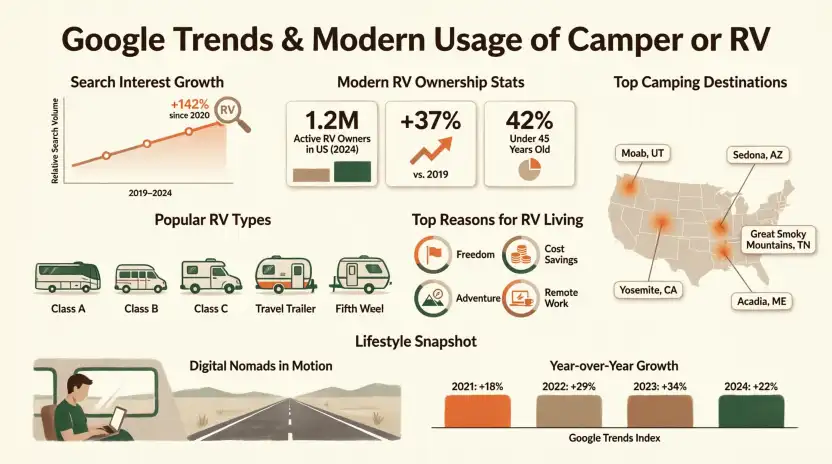
People search “camper or RV” because these terms overlap in everyday American English. A person shopping for a camping vehicle may see RV, camper, motorhome, camper van, travel trailer, and fifth wheel used for related products.
Modern usage also depends heavily on region and context. Dictionary sources show a clear North American preference for RV as a broad term, while British English uses camper, camper van, and motorhome, and commonly uses caravan for a towable holiday vehicle.
Search interest around recreational vehicles can also vary by season and travel patterns. Rather than relying on unverified search-volume claims, it is safer to say that searches commonly increase when people are planning vacations, road trips, camping trips, or vehicle purchases.
The most important modern usage rule is simple: choose the word that tells your reader exactly what you mean.
Quick Comparison Table
| Version | Meaning | Correct? | Region | Example |
| RV | Recreational vehicle | Yes | Mainly US/North America | “We rented an RV.” |
| Camper | Camping vehicle or person who camps | Yes | Common in North America | “We bought a camper.” |
| Motorhome | Motorized vehicle with living space | Yes | US, UK, international | “The motorhome has a bedroom.” |
| Camper van | Van designed for camping | Yes | UK, US, international | “They travel in a camper van.” |
| Travel trailer | Towable recreational vehicle | Yes | Mainly US | “The travel trailer is lightweight.” |
| Caravan | Towable holiday vehicle | Yes | Mainly UK and some other regions | “We stayed in a caravan.” |
Oxford and Cambridge both distinguish the regional uses of these terms, especially RV, camper, motorhome, and caravan.
Key Takeaways
- RV means recreational vehicle.
- Camper is a broader, more casual word with more than one meaning.
- An RV can be a motorhome, camper van, travel trailer, or another recreational vehicle.
- A motorhome has its own engine.
- A travel trailer is towed by another vehicle.
- British English commonly uses caravan for a towable holiday vehicle.
- American English commonly uses RV as the broad category.
- For precise writing, use the exact vehicle type when it matters.
FAQs About Camper or RV
1. Is a camper the same as an RV?
Not always. RV is a broad term meaning recreational vehicle, while camper is a more informal term that can refer to several camping vehicles. In everyday American English, people may use the two words interchangeably, but they are not exact synonyms in every context.
2. Is an RV called a camper?
An RV can be called a camper in casual American English, especially when discussing camping or travel. However, RV is more precise when you mean the general category of recreational vehicles. If the exact vehicle matters, use terms such as motorhome, camper van, or travel trailer.
3. What is the difference between a camper and a motorhome?
A motorhome is a motorized vehicle designed to provide living space while traveling. Camper is a less specific word and can refer to a motorhome or a towable camping vehicle. Therefore, every motorhome may be described casually as a camper, but the word camper does not tell you exactly which type it is.
4. Is a travel trailer a camper or an RV?
A travel trailer can be both. In American usage, a travel trailer is a type of RV because it is designed for recreational travel and temporary living. It can also be called a camper in casual conversation. Unlike a motorhome, it does not have its own engine and must be towed.
5. Do British people say RV?
British English can use RV, especially when referring to American usage or in international contexts, but everyday British vocabulary more commonly includes camper, camper van, motorhome, and caravan. Oxford specifically identifies RV as North American English and gives British equivalents.
6. Do Americans say caravan?
Americans may understand caravan, but it is not the usual everyday term for a towable holiday vehicle. American English commonly uses travel trailer, trailer, or camper for this meaning. British English commonly uses caravan.
7. Is “camper” correct American English?
Yes. Camper is a normal American English word. It can mean someone who camps or a vehicle used for camping. American dictionaries also recognize camper as a vehicle term and relate it to motorhomes, RVs, and trailers.
8. Which is better: camper or RV?
For general American writing, RV is usually better when you mean the whole category of recreational vehicles. Use camper when the tone is casual or when the specific context makes the meaning clear. If precision matters, use the exact term, such as motorhome or travel trailer.
9. What does RV stand for?
RV stands for recreational vehicle. It is a common American English abbreviation for a vehicle designed for recreation, travel, and temporary living. Oxford lists RV as the abbreviation of recreational vehicle.
10. What is the British word for RV?
There is no single British replacement for every use of RV. Depending on the vehicle, British English commonly uses motorhome, camper, camper van, or caravan. A motorhome is generally self-powered, while a caravan is a towable vehicle.
Conclusion
The difference between camper or RV is mainly one of scope and context. RV, short for recreational vehicle, is a broad American English term for vehicles designed for recreational travel and living. Camper is more flexible and informal. It can refer to a camping vehicle, a person who camps, or a specific type of recreational vehicle.
For American readers, RV is usually the safest general term. If you know the exact vehicle, an even better choice is to use motorhome, camper van, travel trailer, or fifth wheel. For British readers, terms such as motorhome, camper van, and caravan may sound more natu
The best rule is simple: use “RV” for the broad category and the specific vehicle name when precision matters.
If you are building a grammar or word-choice site, this distinction also makes a useful reference for readers who want to understand regional English.
Read more about1
- Bose or Beats: Which Headphones Are Better?
- Verry or Very: Which Spelling Is Correct?
- Prefix or Suffix: Meaning, Differences, Examples, and Usage

I’m Olivia Parker, a grammar and English writing enthusiast passionate about making English simple and easy to understand. Through Wordsblog, I share clear explanations, useful grammar tips, and practical writing guidance to help readers write with confidence. My goal is to make learning English easier, one word at a time.