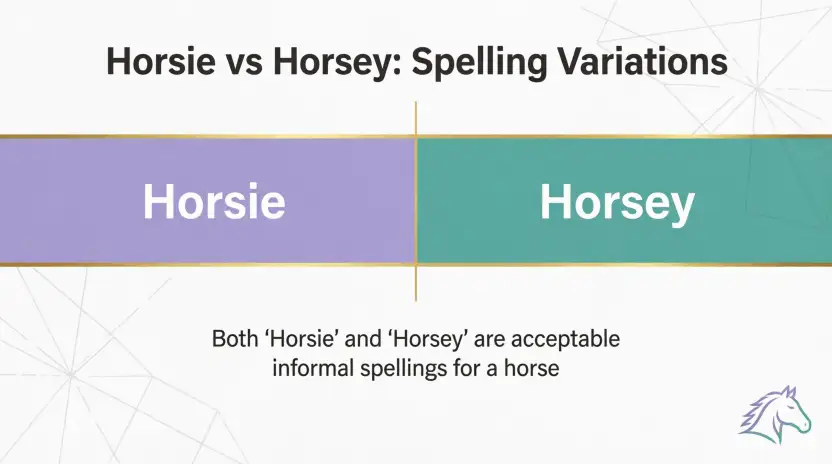
If you are wondering if “horsie” or “horsey” is correct, “horsey” is the standard spelling for the informal word related to a horse. “Horsie” is sometimes used as a playful or childlike spelling, but it is much less standard.
People often search horsie or horsey because both spellings look natural, especially in children’s speech, social media, and casual writing. The confusion comes from the fact that words ending in the sound “-ee” can be spelled in several ways.
In this guide, you will learn what horsey means, if horsie is a real word, how the spellings differ, and which form to use in American, British, and international English. You will also see clear examples for conversation, blogs, social media, and other types of writing.
Horsie or Horsey: Quick Answer
The short answer is simple:
- Horsey: Standard informal spelling.
- Horsie: Playful or childlike variant.
- Formal writing: Avoid both unless the context requires an informal term.
- Everyday casual use: Horsey is the better choice.
Examples
The little girl wanted a horsey toy.
He loves watching horsey videos online.
The child called the animal a horsie.
The third example can work when you are deliberately showing a child’s speech or a playful spelling.
The key point is that horsey is generally the spelling to choose when you need a recognizable informal form.
What Does Horsie or Horsey Mean?
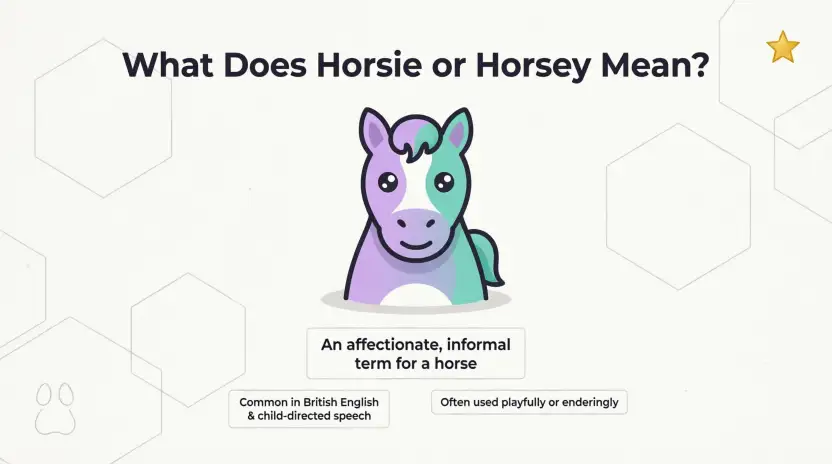
Horsey is an informal word connected with horses. Depending on context, it can describe something that looks, feels, or relates to a horse.
It can also be used as a playful noun, especially when speaking to or about children.
For example:
The child asked for a horsey ride.
Here, horsey has a playful meaning related to riding a horse.
The word may also appear in compounds or casual descriptions where the writer wants a friendly tone.
What about “horsie”?
Horsie is understandable because English speakers often create playful spellings by adding -ie. This is common in speech directed at children.
For example:
- dog → doggie
- cat → kitty
- horse → horsie
However, spelling conventions are not always consistent. That is why horsie may appear online even though horsey is usually the more established spelling for this particular word.
The Origin of Horsie or Horsey
The base word horse has a very long history in English. The modern English word comes from Old English hors, which referred to the animal.
The ending in horsey is different from the basic word itself. The -y ending can be used in English to form adjectives or informal descriptions.
For example:
- horse → horsey
- cloud → cloudy
- dirt → dirty
- wind → windy
In horsey, the ending creates a word associated with horses or something horse-like.
The spelling horsie likely feels natural because English often uses -ie in affectionate or child-directed forms. Words such as doggie, birdie, and kitty make this pattern familiar to English speakers.
That does not mean every -ie spelling is the standard dictionary form. In this case, horsey is generally the safer spelling for ordinary writing.
British English vs American English
The basic distinction between horsey and horsie is not mainly a British-versus-American spelling issue. Both forms can appear in informal English, but horsey is the more useful standard form for general writing.
| British English | American English | Example |
| horsey | horsey | She bought a horsey toy. |
| horsie, as a playful variant | horsie, as a playful variant | The child asked for a horsie. |
The important point is that you should not assume horsie is the British spelling and horsey is the American spelling.
This is different from well-known regional spelling pairs such as colour/color or centre/center.
Publishing preferences
For articles, websites, school assignments, and general publishing, horsey is normally the clearer choice.
If you are writing dialogue for a young child, a story, or a playful social media post, horsie may be useful when the spelling itself is meant to sound childish.
Which Version Should You Use?
Your choice depends on the type of writing.
United States
Use horsey when you need the informal word in ordinary American English.
Use horsie only when you intentionally want a playful or childlike tone.
United Kingdom
The same basic advice applies. Horsey is the safer general spelling.
Canada
For Canadian readers, horsey is also the clearer choice when the informal word is needed.
Australia
Use horsey for general informal writing unless you are deliberately reproducing playful speech.
International Writing
For an international audience, horsey is easier to recognize as the intended spelling.
Academic Writing
Neither form is usually needed in formal academic writing. If the word is necessary because you are discussing a source, quotation, or linguistic example, use the spelling that matches the original context.
Business Writing
Avoid both unless they are part of a brand name, product name, quotation, or informal communication.
For professional writing, simply use horse, horse-related, or another precise term.
Common Mistakes
Mistake 1: Treating “horsie” and “horsey” as equal standard spellings
Incorrect assumption:
Horsie and horsey are always interchangeable.
Better approach:
Use horsey as the general informal spelling.
Explanation:
“Horsie” can be understood, but it has a more playful or childlike feel.
Memory tip:
Think horse + y = horsey.
Mistake 2: Using “horsie” in formal writing
Less suitable:
The report describes a horsie figure in the artwork.
Better:
The report describes a horse-like figure in the artwork.
Explanation:
Formal writing usually benefits from precise and neutral vocabulary.
Mistake 3: Assuming “horsie” is always wrong
Not necessarily:
The toddler pointed at the horse and said, “Horsie!”
This can be completely appropriate in a story or dialogue.
The issue is not that horsie can never appear. The issue is context.
If you are reproducing a child’s speech, a playful spelling may be exactly what you want.
Everyday Examples
Emails
For a normal email, horse or horse-related is usually better.
We discussed the horse-related activities planned for Saturday.
If the email is casual and personal, horsey could appear in a playful sentence.
Business Writing
Business writing should normally avoid both informal forms.
The company sells horse-themed children’s products.
This is clearer than:
The company sells horsey products.
News Headlines
News writing generally prefers precise language.
Local Farm Opens New Horse-Riding Center
A headline would rarely need horsey or horsie unless the word is part of a name or quotation.
Blogs
Blogs can use horsey when the tone is relaxed.
Five Horsey Gifts for Young Horse Lovers
This works because the headline has a playful, informal style.
Social Media
Social media gives writers more freedom.
My daughter is obsessed with everything horsey! 🐴
A playful version could also be:
She saw a horse and shouted, “Horsie!”
Here, the spelling helps show the speaker’s voice.
Academic Writing
Academic writing should normally use more precise terms.
Instead of:
The painting has a horsey appearance.
You could write:
The painting has features associated with horses.
The exact choice depends on what you are trying to describe.
Daily Conversation
In casual speech, people may use either form depending on their personal style.
Look at that horsey!
This can sound playful, especially when talking with a child.
Look at that horse!
This is the normal neutral version.
Google Trends & Modern Usage
People search horsie or horsey because the two spellings are visually similar and both can make sense in informal English.
The confusion is especially understandable when people encounter horsie in children’s books, social media posts, comments, or casual conversation.
There is also a broader English spelling pattern behind the confusion. Informal words often use endings such as -ie, while adjective-like forms often use -y.
For example:
- horsey
- doggy
- doggie
- birdie
- kitty
These patterns can make it difficult to predict which spelling has become established for a particular word.
Modern online writing also makes informal variants more visible. A spelling that appears in a social media post is not automatically the preferred spelling for edited English.
So when searching horsie or horsey, the important question is not simply if people use both. It is which spelling fits your context.
Quick Comparison Table
| Version | Meaning | Correct? | Region | Example |
| horsey | Informal, horse-related, or playful term | Yes | Broad English use | She loves horsey toys. |
| horsie | Playful or childlike form | Yes, in suitable context | Informal use | The child said, “Horsie!” |
| horse | Standard word for the animal | Yes | All major English varieties | The horse is running. |
| horse-related | Formal description connected with horses | Yes | International | The article covers horse-related sports. |
The table shows why horsey is usually the best answer when the question is specifically about the spelling horsie or horsey.
Key Takeaways
- Horsey is the safer standard spelling for general informal use.
- Horsie can be used as a playful or childlike variant.
- The difference is mainly about usage and tone, not British versus American English.
- Neither form is normally needed in formal academic or business writing.
- Use horsey when you want a casual horse-related expression.
- Use horsie when reproducing playful or childlike speech.
- Use horse or horse-related when you want neutral, professional wording.
- Context matters more than simply asking if one spelling exists.
FAQs
1. Is “horsey” or “horsie” correct?
Horsey is generally the safer spelling for ordinary informal writing. Horsie can also appear, especially as a playful or childlike spelling. If you are writing an article, blog, or general text and need the informal word, choose horsey unless you have a specific reason to reproduce a playful spelling.
2. Is “horsie” a real word?
Yes, horsie can be found as an informal or playful form, especially in child-directed language. However, its use is more limited than horsey. It should not automatically be treated as the preferred spelling simply because English speakers use -ie endings in other affectionate words.
3. Is “horsey” a proper word?
Yes. Horsey is an informal English word associated with horses. Depending on context, it can describe something horse-related or be used playfully when referring to a horse. It is more suitable for casual writing than formal academic or professional writing.
4. Is “horsie” a misspelling of “horsey”?
Not necessarily. Horsie can be an intentional playful spelling rather than a simple spelling mistake. The context matters. In standard edited writing, horsey is usually the better choice, while horsie can work when the writer wants a childish or affectionate tone.
5. Should I use “horsey” in formal writing?
Usually, no. Formal writing should use precise vocabulary. Depending on your meaning, alternatives such as horse, horse-related, equine, or associated with horses may be clearer. If you are quoting someone or discussing a specific informal term, however, horsey may be appropriate.
6. Is “horsey” British or American English?
Horsey is not simply a British or American spelling difference. It can be understood across English varieties as an informal term. The choice between horsey and horsie is more about spelling, tone, and context than a strict regional rule.
7. Why do people spell it “horsie”?
The spelling horsie may feel natural because English uses -ie in many playful and affectionate words, such as doggie and birdie. When people use a word with children or want to make their writing sound cute, they may naturally choose -ie.
8. Can I use “horsie” in a children’s story?
Yes. A children’s story can use horsie if the spelling fits the character’s voice or the playful tone of the story. For example, a child saying “I want a horsie!” can sound natural in dialogue. In that context, the informal spelling can add personality rather than function as a spelling error.
9. Which spelling should I use for SEO: “horsie” or “horsey”?
If your article targets the search query horsie or horsey, include both naturally because they represent the reader’s actual confusion. In your explanatory text, use horsey when referring to the standard informal spelling and explain when horsie may appear.
10. What is the formal word for “horsey”?
There is no single formal replacement that fits every use of horsey. Depending on the sentence, you might use horse-related, equine, or associated with horses. For example, “horse-related activities” is clearer and more professional than “horsey activities” in formal writing.
Conclusion
When choosing between horsie or horsey, horsey is generally the better spelling for standard informal use. It is clear, recognizable, and suitable when you want to describe something related to horses in a casual way.
Horsie is not simply meaningless. It can work as a playful or childlike form, especially in dialogue, children’s content, or informal social media writing. The spelling can help show a speaker’s personality or age.
For formal writing, neither word is usually necessary. Choose a more precise term such as horse-related, equine, or simply horse, depending on your meaning.
The easiest rule is this: use “horsey” for general informal writing, and “horsie” only when the playful spelling is part of the intended voice.
When in doubt, remember: Horsey is the safer spelling, but context decides the best choice.
Read more about!
- Apologising or Apologizing: Which Spelling Is Correct?
- Performa or Proforma: Which Spelling Is Correct?
- Inspite or Despite: The Correct Spelling Explained

I’m Olivia Parker, a grammar and English writing enthusiast passionate about making English simple and easy to understand. Through Wordsblog, I share clear explanations, useful grammar tips, and practical writing guidance to help readers write with confidence. My goal is to make learning English easier, one word at a time.






3 thoughts on “Horsie or Horsey: Which Spelling Is Correct?”