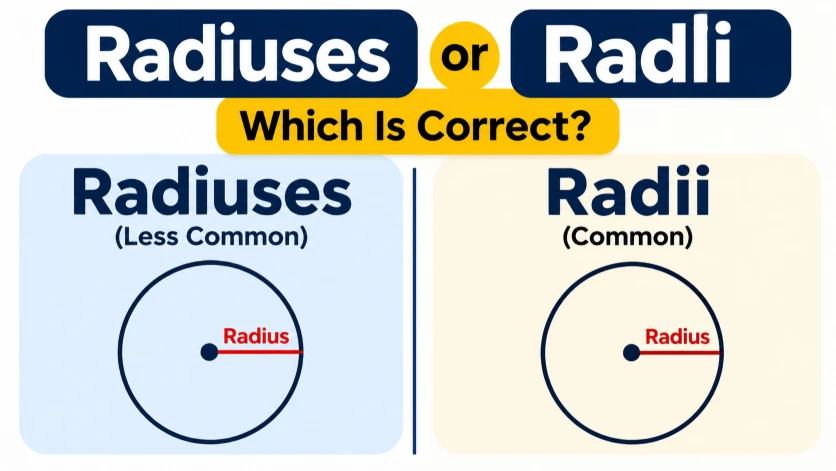
Both “radiuses” and “radii” are correct plural forms of “radius,” but “radii” is the traditional Latin plural and is more common in mathematics and science. “Radiuses” is also accepted in modern English, especially in general writing.
People often search for “radiuses or radii” because the word “radius” comes from Latin and does not follow the usual English plural pattern. Many English nouns form their plurals by adding “-s” or “-es,” but some words borrowed from Latin keep their original plural forms.
For example, “radius” can become “radii” or “radiuses.” Both forms refer to more than one radius, so the choice depends on context and writing style.
In this guide, you will learn the difference between radiuses and radii, understand their meanings, explore grammar rules, and see simple examples of how to use each word correctly.
Quick Answer: Radiuses or Radii?
Both radiuses and radii are correct plural forms of “radius.”
- Radii: The traditional Latin plural, commonly used in mathematics, geometry, and science.
- Radiuses: A regular English plural, often used in general writing.
- Radius: The singular form of both.
Examples:
- The circles have different radii.
- The two shapes have different radiuses.
- The radii of these circles are equal.
Simple rule: Use “radii” in mathematical or scientific writing. Use either “radii” or “radiuses” in general English, depending on your audience and preferred style.
What Does Radius Mean?
Radius is a noun with several meanings. In geometry, it describes the distance from the center of a circle or sphere to its outer edge.
It can also refer to a distance measured from a central point or to one of the two bones in the human forearm.
Examples:
- The radius of the circle is five centimeters.
- The school is within a ten-mile radius of my house.
- The doctor examined the radius bone in his arm.
When you are talking about more than one radius, you need a plural form: “radii” or “radiuses.”
What Does Radii Mean?
Radii is the traditional Latin-derived plural of “radius.” It is widely used in mathematics, geometry, science, and other technical subjects.
The spelling comes from the original Latin plural form, which English has retained.
Examples:
- The two circles have equal radii.
- The mathematician calculated the radii of several spheres.
- The planets have different orbital radii.
- The diagram shows three radii extending from the center.
Why Does Radius Become Radii?
Some English words borrowed from Latin keep their original plural endings.
For example:
| Singular | Plural |
| Radius | Radii |
| Nucleus | Nuclei |
| Alumnus | Alumni |
| Focus | Foci |
| Fungus | Fungi |
These words do not all follow the same modern English plural pattern. Their plural forms are best learned individually.
What Does Radiuses Mean?
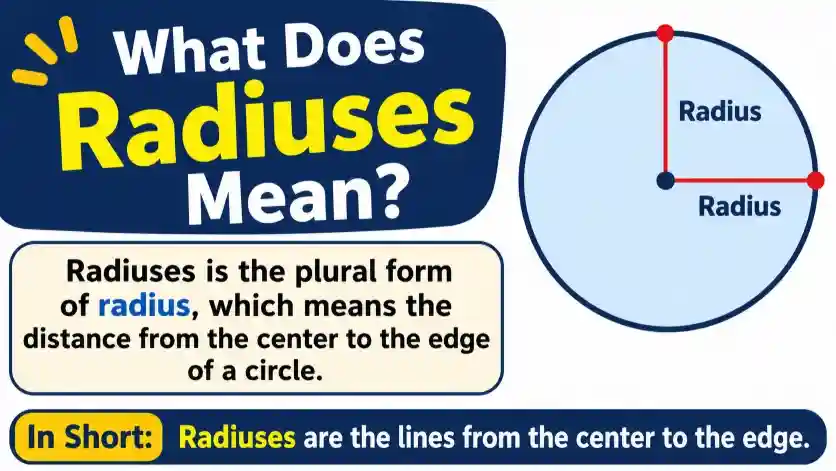
Radiuses is another accepted plural form of “radius.” It follows the regular English pattern of adding “-es” to a noun ending in “-us.”
Although “radii” is the traditional form, “radiuses” is not automatically incorrect.
Examples:
- The designer tested several radiuses for the rounded corners.
- The map displays different radiuses around the city.
- The engineers compared the radiuses of the circular structures.
- The drawing includes curves with different radiuses.
The spelling “radiuses” is recorded in English dictionaries, including Dictionary.com.
Dictionary.com+1
When Can You Use Radiuses?
You can use “radiuses” when referring to multiple radius measurements or distances.
For example:
- The software calculates different radiuses.
- The design includes rounded corners with different radiuses.
- The search areas have different radiuses.
However, if you are writing a mathematics assignment or scientific paper, “radii” is usually the more familiar choice.
Radiuses vs. Radii: Key Differences
Both words are correct plural forms, and they have the same basic meaning.
| Feature | Radiuses | Radii |
| Correct spelling | Yes | Yes |
| Singular form | Radius | Radius |
| Plural form | Radiuses | Radii |
| Word origin | Regular English plural | Traditional Latin plural |
| Common use | General and descriptive writing | Mathematics and technical writing |
| Example | Different radiuses | Different radii |
The main difference is the plural formation, not the meaning.
Is Radii or Radiuses More Common in Mathematics?
Radii is generally the more familiar and traditional choice in mathematical writing.
For example:
- The radii of two circles are equal.
- Calculate the radii of the three spheres.
- The diagram shows the radii of several circles.
However, “radiuses” is also an accepted plural. It is not grammatically wrong simply because a sentence discusses mathematics.
If you are completing a school assignment, writing a textbook, or preparing a scientific paper, choose “radii” unless your teacher, publisher, or style guide specifies otherwise.
English meaning – Cambridge Dictionary+2
How to Use Radiuses and Radii in Sentences
Both forms can be used in sentences about circles, distances, designs, and measurements.
| Using Radiuses | Using Radii |
| The circles have different radiuses. | The circles have different radii. |
| The designer measured the radiuses. | The designer measured the radii. |
| These shapes have equal radiuses. | These shapes have equal radii. |
| The software compares several radiuses. | The software compares several radii. |
| The measurements show different radiuses. | The measurements show different radii. |
Both columns are grammatically acceptable.
Common Mistakes When Using Radius, Radiuses, and Radii
Writers sometimes confuse the singular and plural forms of “radius.” Here are some mistakes to avoid.
| Incorrect | Correct |
| The two circles have different radius. | The two circles have different radii. |
| The radii’s are equal. | The radii are equal. |
| The three radiuseses are different. | The three radiuses are different. |
| The radius of both circles are equal. | The radii of both circles are equal. |
| One radii is five centimeters. | One radius is five centimeters. |
Important: Do not add an apostrophe to make “radii” or “radiuses” plural. Apostrophes are generally used for possession or contractions, not ordinary plurals.
What Is the Difference Between Radius, Radii, and Radiuses?
Understanding the three forms makes the grammar much easier.
| Word | Meaning | Example |
| Radius | One measurement or distance | The circle has a radius of five inches. |
| Radii | More than one radius | The circles have equal radii. |
| Radiuses | More than one radius | The designs have different radiuses. |
Easy rule: Use “radius” for one and “radii” or “radiuses” for more than one.
How Do You Pronounce Radii and Radiuses?
The two plural forms have different pronunciations.
- Radius: RAY-dee-us
- Radii: RAY-dee-eye
- Radiuses: RAY-dee-us-iz
The final sound in “radii” is similar to the word “eye.”
Learning the pronunciation can help you recognize the difference when speaking about multiple measurements.
Key Takeaways
- Both “radiuses” and “radii” are correct plural forms of “radius.”
- “Radius” is the singular form.
- “Radii” is the traditional Latin plural.
- “Radiuses” follows the regular English plural pattern.
- “Radii” is especially familiar in mathematics and science.
- “Radiuses” is also accepted in modern English.
- Both forms have the same basic meaning.
- Follow your preferred dictionary or style guide and remain consistent.
Frequently Asked Questions
1. Is It Radiuses or Radii?
Both are correct. “Radii” is the traditional Latin plural, while “radiuses” is an accepted regular English plural.
2. What Is the Correct Plural of Radius?
The two accepted plural forms are “radii” and “radiuses.” “Radii” is the traditional and widely recognized form.
3. Is Radiuses Grammatically Correct?
Yes. “Radiuses” is a recognized plural form of “radius.” It is not automatically a spelling mistake.
4. Why Is the Plural of Radius Radii?
“Radii” comes from the original Latin plural form. English has retained this form in mathematics, science, and everyday writing.
5. Should I Use Radii or Radiuses in Mathematics?
“Radii” is generally the more familiar choice in mathematical and scientific writing. However, “radiuses” is also an accepted plural.
6. Is Radii Singular or Plural?
“Radii” is plural. The singular form is “radius.”
7. Can I Use Radiuses in Formal Writing?
Yes. “Radiuses” is an accepted English plural. However, “radii” may be more appropriate if your academic or professional style guide prefers the traditional form.
8. What Is the Plural of Radius in British English?
Both “radii” and “radiuses” are accepted in British English. “Radii” is the traditional form.
9. What Is the Plural of Radius in American English?
Both “radii” and “radiuses” are used in American English. “Radii” is especially familiar in mathematical and scientific contexts.
10. Is It Correct to Say Two Radii?
Yes. “Two radii” is grammatically correct because “radii” is a plural form of “radius.”
Conclusion
The choice between “radiuses” and “radii” is easier than it may seem. Both are correct plural forms of the word “radius,” and both refer to more than one radius.
“Radii” is the traditional Latin plural and is especially common in mathematics, geometry, and scientific writing. “Radiuses” follows the regular English plural pattern and is also accepted in modern English.
If you are writing a mathematics assignment or technical article, “radii” is usually the safest choice. For general writing, either form can work.
Remember this simple rule: one radius, two radii, or two radiuses. The important thing is to use the plural form correctly and keep your writing consistent.
Read more about!
- Amish or Mennonite: What’s the Difference?
- Dumbell or Dumbbell: Which Spelling Is Correct?
- Lupus or Rosacea: What’s the Difference?

I’m Olivia Parker, a grammar and English writing enthusiast passionate about making English simple and easy to understand. Through Wordsblog, I share clear explanations, useful grammar tips, and practical writing guidance to help readers write with confidence. My goal is to make learning English easier, one word at a time.