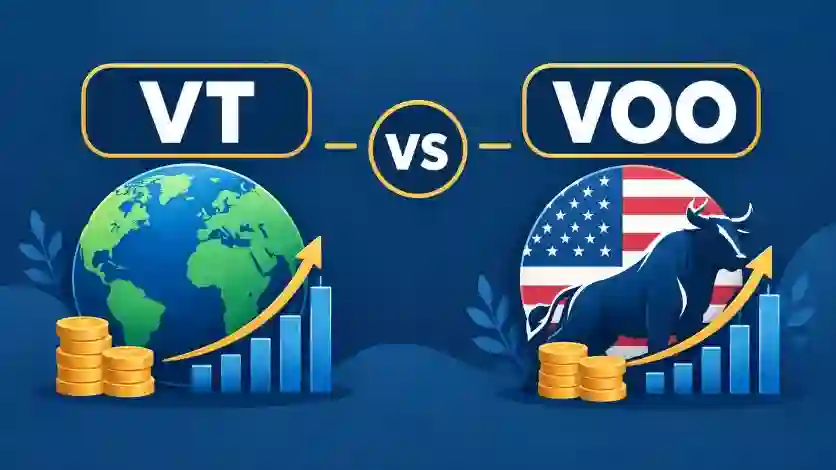
VT vs. VOO is a comparison between two Vanguard stock exchange-traded funds (ETFs). VT invests in stocks from around the world, while VOO focuses on large US companies in the S&P 500 Index. Both offer a simple way to invest in many companies through one fund, but they serve different goals.
Choosing between VT and VOO can be confusing because both hold major companies, including well-known technology businesses. Their portfolios also overlap, so owning both does not always provide as much extra diversification as investors expect.
The main difference is geographic exposure. VT gives you access to US and international stock markets in one fund. VOO concentrates on large American companies. VT may suit investors who want global stock exposure, while VOO may appeal to those who deliberately want a US-focused portfolio.
In this guide, you will learn how VT and VOO differ in their holdings, fees, diversification, risks, and historical performance. You will also see examples of how each fund might fit into a long-term investment plan. By the end, you should have a clearer idea of which approach matches your goals and why neither ETF is automatically the best choice for everyone.
VT vs. VOO: The Quick Answer
VT and VOO are both Vanguard ETFs, but they track different stock indexes.Follows a global stock index that includes companies in developed and emerging markets. VOO tracks the S&P 500 Index, which represents large US companies. VT offers broader geographic diversification, while VOO provides focused exposure to the US stock market at a lower annual expense ratio.
In simple terms:
- Choose VT for consideration: You want one stock ETF with worldwide exposure.
- Consider VOO: You want to focus on large US companies.
- Compare both carefully: You want to balance global diversification, fees, and your existing investments.
Neither fund guarantees a profit, and both can lose value during a market downturn.
What Does VT Mean?
VT is the ticker symbol for the Vanguard Total World Stock ETF. A ticker symbol is the short code used to identify a fund on a stock exchange.
VT seeks to track the FTSE Global All Cap Index. This index covers stocks across developed and emerging markets, including companies of different sizes.
How VT Works
When you buy VT, you gain exposure to a broad range of global companies through one ETF. Its holdings include US businesses and companies based in other countries.
VT can be useful for investors who do not want to choose separate US and international stock funds. It gives them a straightforward way to spread their stock investments across many markets.
However, global diversification does not remove market risk. If stock markets around the world fall, VT can also decline.
Who Might Consider VT?
VT may suit investors who:
- Want exposure to both US and international stocks.
- Prefer a single broad global stock ETF.
- Do not want to decide how much to invest in each country.
- Have a long investment horizon and can tolerate stock market losses.
VT is still an all-stock fund. It does not automatically provide the stability that bonds or cash may offer.
What Does VOO Mean?
VOO is the ticker symbol for the Vanguard S&P 500 ETF. It seeks to track the S&P 500 Index, which represents large US companies across many industries.
The fund gives investors exposure to established American businesses without requiring them to buy each company’s shares separately.
How VOO Works
VOO holds stocks represented in the S&P 500 Index. The index includes companies from sectors such as technology, healthcare, financial services, and consumer goods.
Because the index is weighted by market value, the largest companies have more influence on its performance. This means VOO can become heavily influenced by a relatively small group of very large businesses.
Who Might Consider VOO?

VOO may suit investors who:
- Want broad exposure to large US companies.
- Prefer a low-cost S&P 500 index ETF.
- Believe US large-cap stocks fit their investment plan.
- Already hold international investments elsewhere.
VOO contains many companies, but it is not a global stock fund. Its focus on the US is an important difference from VT.
The Origin of VT and VOO
VT and VOO are financial ticker symbols, not competing spellings of ordinary English words. Their names come from the investment funds they identify.
VT represents Vanguard Total World Stock ETF. VOO represents Vanguard S&P 500 ETF.
Both funds were created to give investors a practical way to follow a stock market index rather than select every stock themselves. This approach is known as passive index investing.
The funds differ because their benchmark indexes cover different markets:
- VT follows the FTSE Global All Cap Index.
- VOO follows the S&P 500 Index.
These indexes determine the types of companies represented in each fund. As their underlying indexes and markets change, fund holdings can change too.
The key distinction is not which ticker is newer or more popular. It is if you want worldwide stock exposure or a portfolio centered on large US companies.
British English vs. American English
VT and VOO do not have British and American spelling variations. They are ticker symbols for US-listed investment funds, so the comparison is about investment exposure rather than language.
| Feature | VT | VOO |
| Full fund name | Vanguard Total World Stock ETF | Vanguard S&P 500 ETF |
| Main exposure | Global stock markets | Large US companies |
| Benchmark index | FTSE Global All Cap Index | S&P 500 Index |
| Geographic coverage | US and international markets | United States |
| Company sizes | Large, mid-sized, and small companies | Primarily large-cap companies |
| Annual expense ratio | 0.06% | 0.03% |
| Diversification | Global | US-focused |
| Main consideration | Broader country exposure | Greater concentration in US stocks |
The expense ratios shown are based on Vanguard’s published fund information available for this comparison. Check the latest fund documents before investing. <Cite refs={[“turn263615search30″,”turn263615search9″,”turn263615search1”]}/>
What the Fee Difference Means
VT’s expense ratio is 0.06%, while VOO’s is 0.03%. These percentages represent annual fund operating expenses, not guaranteed investment returns.
For a hypothetical $10,000 investment, ignoring changes in value and other charges:
- VT would cost about $6 per year.
- VOO would cost about $3 per year.
The difference is about $3 per year for every $10,000 invested. Although fees matter, the difference in market exposure may be more important when deciding which fund fits your goals.
Which Version Should You Use?
There is no single correct choice for every investor. The better option depends on your location, existing portfolio, risk tolerance, and financial goals.
United States
US investors may consider VOO if they want to focus on large American companies. VT may be more suitable if they want international stocks included in one fund.
United Kingdom
UK investors should consider their tax residence, account type, and access to US-listed ETFs before choosing either fund. US-listed ETFs can raise tax and regulatory questions for UK residents, so check the rules that apply to your circumstances.
Canada
Canadian investors should review brokerage access, account eligibility, tax treatment, and possible currency effects. The fact that an ETF is listed in US dollars does not make it suitable for every Canadian account.
Australia
Australian investors should check if their broker allows access to the funds and how foreign investments are treated for tax purposes. Local investment products may also offer different ways to obtain global or US stock exposure.
International Investing
VT may be attractive to investors who want global stock exposure through one fund. VOO may be more appropriate when the investor intentionally wants a US-focused allocation.
Academic Investing
For investment research or a finance assignment, compare the funds using their benchmark indexes, expense ratios, geographic exposure, holdings, and historical performance over matching periods.
Business and Retirement Planning
For retirement accounts or long-term financial planning, consider the role of each fund within the whole portfolio. An ETF should not be chosen solely because it has recently performed better.
Investors who need a balanced portfolio may also need to consider bonds, cash reserves, and their ability to handle losses.
Common Mistakes When Comparing VT and VOO
Investors often focus on one feature and overlook the wider differences between the funds.
| Common mistake | Better approach | Why it matters |
| Assuming VT is only an international fund | Remember that VT includes US stocks too | It provides global exposure, including the US |
| Assuming VOO owns every US stock | Understand that VOO tracks the S&P 500 | It focuses on large US companies |
| Choosing only by past returns | Compare exposure, risk, costs, and goals | Historical performance can change |
| Thinking lower fees guarantee better results | Compare total investment fit | Fees are only one factor |
| Buying both without checking overlap | Review their holdings and portfolio weights | Many VOO stocks are also held by VT |
| Assuming either ETF is risk-free | Prepare for stock market declines | Both funds invest in equities |
A Simple Memory Tip
Think of VT as “World” and VOO as “S&P 500.” VT spreads investments across global stock markets, while VOO focuses on large US companies.
This shortcut helps you remember the main distinction without getting lost in ticker symbols.
Everyday Examples of VT and VOO
These examples show how different investors might think about the two funds. They are educational scenarios, not personalized investment recommendations.
Example 1: A New Investor
Jordan wants to invest in stocks but does not want to choose individual countries. VT may be worth researching because it combines US and international stock exposure in one fund.
Example 2: A US-Focused Investor
Taylor already owns international investments through another fund. Taylor may consider VOO for additional exposure to large US companies, while checking how much the overall portfolio overlaps.
Example 3: A Long-Term Saver
Morgan is saving for a goal many years away. Morgan compares VT and VOO based on diversification, costs, investment horizon, and the ability to withstand market declines rather than relying only on recent returns.
Example 4: An Investor Who Owns Both
Casey buys both VT and VOO, believing this automatically doubles diversification. However, many S&P 500 companies are already included in VT. The combination can increase the portfolio’s emphasis on US large-cap stocks.
Example 5: An Investor Comparing Fees
Alex plans to invest $50,000. At unchanged balances, a 0.06% expense ratio equals about $30 per year, while 0.03% equals about $15. The fee difference is small in dollar terms compared with the potential impact of market movements.
Example 6: A First-Time Investor
Sam sees that one ETF has outperformed the other over a recent period. Rather than buying immediately, Sam checks the time period, reinvested dividends, index coverage, and the risks involved.
The lesson is simple: the right fund depends on what you want your investment to do.
Google Trends and Modern Usage
Searches for “VT vs VOO” generally reflect interest in comparing two popular Vanguard stock ETFs. People often want to know which fund is better for beginners, which has lower fees, which offers more diversification, or which has delivered stronger returns.
The comparison is especially relevant to investors deciding between global stock exposure and a US-focused portfolio.
Why People Search for VT vs VOO
Common reasons include:
- Deciding which ETF to buy for long-term investing.
- Comparing expense ratios and portfolio holdings.
- Understanding the difference between global and US stock exposure.
- Checking if owning both funds makes sense.
- Reviewing historical performance and investment risk.
Which ETF Is More Popular?
Popularity can mean search interest, trading activity, assets under management, or the number of investors who own a fund. These are different measures and should not be treated as interchangeable.
Without a defined, current Google Trends comparison, it would be misleading to claim that one keyword is searched more often than the other.
Do Not Confuse Past Performance With Future Results
VOO has outperformed VT over some historical periods, but results depend on the dates selected. Performance can change as US and international markets take turns leading.
A fair comparison should use the same start and end dates and account for dividends. It should also consider the purpose of each fund rather than treating the highest past return as an automatic winner.
Quick Comparison Table: VT vs. VOO
| Feature | VT | VOO |
| Primary purpose | Global stock exposure | US large-cap stock exposure |
| Index tracked | FTSE Global All Cap | S&P 500 |
| US stocks included | Yes | Yes |
| International stocks included | Yes | No direct international stock exposure |
| Annual expense ratio | 0.06% | 0.03% |
| Geographic diversification | Broader | More concentrated |
| Main potential advantage | Worldwide stock coverage | Lower annual fund fee |
| Main limitation | Still exposed to global stock market risk | More dependent on US large-cap performance |
| Best starting question | Do I want global stock exposure? | Do I want to focus on US large-cap stocks? |
The fee figures above are based on published fund expense information and should be checked against the latest prospectuses. <Cite refs={[“turn263615search30″,”turn263615search9”]}/>
Key Takeaways
- VT is Vanguard Total World Stock ETF.
- VOO is Vanguard S&P 500 ETF.
- VT includes US and international stocks.
- VOO focuses on large US companies.
- VT has a 0.06% expense ratio, compared with 0.03% for VOO, based on the cited fund documents.
- Both funds can lose value during stock market declines.
- Holding both may increase US large-cap exposure because their holdings overlap.
- Choose based on your goals, existing investments, risk tolerance, and account rules rather than recent returns alone.
FAQs About VT vs. VOO
1. Is VT better than VOO?
VT may be a better fit if you want exposure to stock markets around the world through one fund. VOO may suit you better if you specifically want large US companies. Neither is universally better. The right choice depends on your investment goals, current holdings, time horizon, and willingness to accept market risk.
2. Is VOO riskier than VT?
Both are stock ETFs and can suffer significant losses. VOO concentrates on large US companies, while VT spreads its holdings across countries and company sizes. Global diversification can reduce dependence on one country’s market, but it does not eliminate risk. Actual volatility and losses vary over time.
3. Does VT include VOO?
VT does not hold VOO as a fund within the portfolio. However, VT owns many of the same underlying companies represented in the S&P 500 Index. This creates substantial overlap between their stock holdings, even though the two ETFs track different indexes.
4. Can I invest in both VT and VOO?
Yes, an investor can hold both funds in an eligible brokerage account. However, owning both increases exposure to many large US companies already held by VT. Before combining them, decide if you deliberately want a larger US allocation and review your complete portfolio.
5. Which ETF has lower fees, VT or VOO?
VOO has the lower annual expense ratio in the cited fund documents. VOO charges 0.03%, while VT charges 0.06%. On a hypothetical $10,000 balance, that equals approximately $3 versus $6 per year before other costs and changes in value. Always confirm current fees.
6. Which ETF has better historical returns?
The answer depends on the period measured. VOO has outperformed VT over some historical periods, including certain recent long-term comparisons, but this does not guarantee future outperformance. Use matching dates and total returns that account for dividends when making a fair comparison.
7. Is VT a total stock market fund?
VT is a total world stock ETF, not a US-only total stock market fund. It tracks a global index that covers developed and emerging markets. Investors who want exposure to companies across the world may find it useful, but it does not provide a complete portfolio of stocks, bonds, and cash.
8. Is VOO good for beginners?
VOO can be relatively straightforward to understand because it tracks the S&P 500. It provides exposure to many large US companies through one fund. However, beginners should understand that the fund is not globally diversified and can lose value. If it is suitable depends on personal goals and risk tolerance.
9. Which ETF is better for long-term investing?
Both VT and VOO can be used in long-term stock investment strategies. VT offers global diversification, while VOO focuses on US large-cap stocks. The better option depends on your desired geographic allocation, risk tolerance, and other assets. A long investment horizon does not guarantee a positive return.
10. Can UK investors buy VT or VOO?
Access depends on the broker, account type, and rules that apply to the investor. UK retail investors may face restrictions on purchasing US-listed ETFs because of regulatory disclosure requirements. Tax treatment also matters. Check current UK rules and obtain qualified financial or tax advice before investing.
Conclusion: VT vs. VOO
VT and VOO offer two different ways to invest in the stock market. VT provides broad exposure to companies around the world, including the United States, while VOO focuses on large US companies in the S&P 500 Index.
VOO may appeal to those who prefer US-focused exposure and a lower annual expense ratio. Neither fund is guaranteed to outperform the other, and both can decline when stock markets fall.
Before choosing, consider your investment goals, the funds you already own, your time horizon, and the amount of risk you can accept. If you own both, check their overlapping holdings so your actual US exposure is clear.
Remember that a fund’s past performance does not guarantee future results. Fees matter, but diversification and portfolio fit matter too.
The best ETF is not simply the one with the highest past return. It is the one that fits your investment plan. Compare the latest official fund documents and seek qualified advice if you need help deciding.
Read more about!
- CT or MRI: What’s the Difference?
- Yoto or Tonies: Which Audio Player Is Better?
- Realizes or Realises: Which Spelling Is Correct?

I’m Olivia Parker, a grammar and English writing enthusiast passionate about making English simple and easy to understand. Through Wordsblog, I share clear explanations, useful grammar tips, and practical writing guidance to help readers write with confidence. My goal is to make learning English easier, one word at a time.







3 thoughts on “VT vs. VOO: Which ETF Is Better for You?”