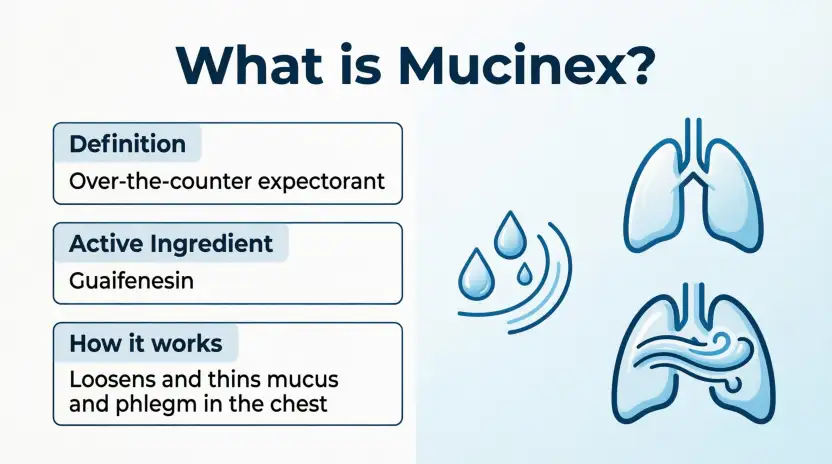
When you have a bad cough, thick mucus, or chest congestion, Mucinex or Robitussin may both seem like reasonable choices. The key difference is that these are brand families, not single medicines, so the right comparison depends on the exact product and its active ingredients.
Some Mucinex products focus on loosening mucus, while others also suppress cough or treat several cold symptoms. Robitussin also has products that suppress cough, loosen mucus, or provide multi-symptom relief.
This is why comparing the brand names alone can be misleading. For example, guaifenesin is an expectorant that helps loosen mucus, while dextromethorphan is a cough suppressant that reduces the urge to cough. Some products contain one ingredient, while others combine several.
In this guide, you will learn what Mucinex and Robitussin actually do, how their common formulas differ, which may fit different symptoms, common mistakes to avoid, and how to compare the labels safely.
Mucinex or Robitussin: Quick Answer
If you are choosing between Mucinex and Robitussin, check the active ingredients first.
A simple way to think about the common formulas is:
- Guaifenesin: helps loosen and thin mucus.
- Dextromethorphan: temporarily suppresses coughing.
- Combination products: may contain both, plus other ingredients for additional symptoms.
For example, a Mucinex extended-release expectorant contains guaifenesin and is designed for chest congestion. Mucinex also sells products containing both guaifenesin and dextromethorphan.
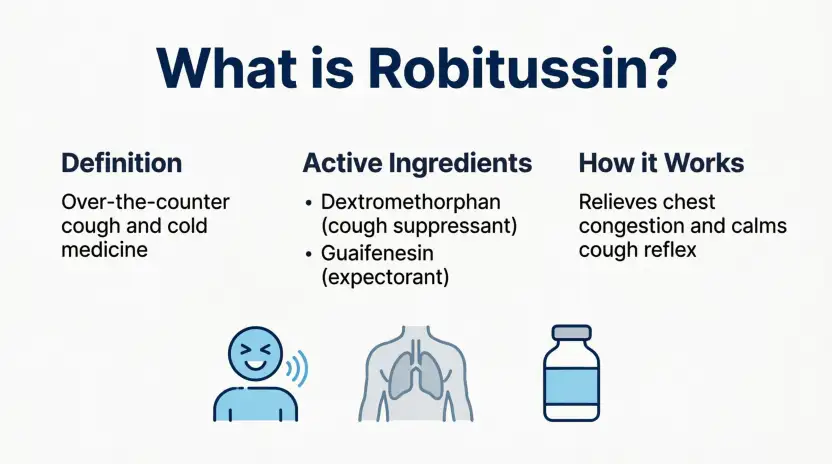
Robitussin likewise has products containing dextromethorphan, guaifenesin, or both. Its official product information specifically explains that DM refers to dextromethorphan, a cough suppressant.
Bottom line: Mucinex is not automatically “better” than Robitussin, and Robitussin is not automatically “better” than Mucinex. Match the active ingredient to the symptom you want to treat.
What Does Mucinex or Robitussin Mean?
Mucinex and Robitussin are brand names used for families of over-the-counter medicines.
They are not two single drugs that can be compared like ibuprofen versus acetaminophen. Each brand has multiple products with different ingredients and purposes.
Mucinex
Mucinex has products for:
- Chest congestion
- Cough
- Mucus
- Nasal congestion
- Cold and flu symptoms
- Fever and pain in certain combination products
For example, Mucinex Extended-Release Expectorant contains guaifenesin, which is an expectorant. It helps thin and loosen mucus so it can be cleared more easily.
Some Mucinex products add dextromethorphan to control coughing. Others contain additional ingredients for symptoms such as fever, pain, or nasal congestion.
Robitussin
Robitussin also has several product types.
Its current product range includes DM products for cough, CF multi-symptom products, children’s products, and other cough-relief options.
The name Robitussin DM is especially important because “DM” indicates dextromethorphan.
Some Robitussin products also contain guaifenesin, which means they can address both coughing and mucus.
The Origin of Mucinex or Robitussin
The important point for this comparison is that Mucinex and Robitussin are brand names, not ordinary English words whose spelling has changed between British and American English.
The names are associated with commercial cough and cold medicine brands.
The medical terms behind many of their products are more useful to understand:
- Mucus: a thick fluid produced by tissues in the respiratory system.
- Guaifenesin: an expectorant used to help loosen mucus.
- Dextromethorphan: a cough suppressant used to temporarily reduce coughing.
This distinction matters because a reader searching “Mucinex or Robitussin” is usually not asking which brand name is grammatically correct. They want to know which medicine matches their symptoms.
British English vs American English
There is no meaningful British-versus-American spelling difference between the brand names Mucinex and Robitussin.
| British English | American English | Example |
| Mucinex | Mucinex | “I bought Mucinex for chest congestion.” |
| Robitussin | Robitussin | “She used Robitussin for her cough.” |
| guaifenesin | guaifenesin | “Guaifenesin helps loosen mucus.” |
| dextromethorphan | dextromethorphan | “Dextromethorphan suppresses coughing.” |
However, product availability and labeling can vary by country.
For that reason, readers outside the United States should not assume that a US product has the same ingredients, strengths, or instructions as a similarly named product sold elsewhere.
Always check the local package label.
Which Version Should You Use?
The better question is not “Which brand is stronger?”
Ask instead:
Which active ingredient matches my main symptom?
United States
For a US reader, compare the Drug Facts panel on the package.
If mucus and chest congestion are your main concern, a guaifenesin-containing expectorant may be relevant. If an irritating cough is the main problem, a dextromethorphan-containing cough suppressant may be relevant.
United Kingdom
Do not assume the US versions are identical to products sold in the UK.
Check the active ingredients and local instructions before using a product.
Canada
Canadian products may have different formulations and labeling.
Read the package rather than choosing based only on the brand name.
Australia
The same rule applies in Australia: check the active ingredients, strength, warnings, and directions on the locally sold product.
International Writing
If you are writing for an international audience, avoid saying simply that “Mucinex is for mucus” or “Robitussin is for cough.”
Those statements can be too broad because both brands have multiple formulations.
Academic Writing
Use the generic drug name when possible.
For example:
“Guaifenesin is an expectorant used to help loosen mucus.”
This is clearer and more precise than relying on a commercial brand name.
Business Writing
If discussing a product in professional content, identify the exact product and its active ingredient.
For example:
“This Mucinex formulation contains guaifenesin.”
That is much more useful than simply saying:
“Mucinex treats congestion.”
Common Mistakes
| Incorrect Example | Correct Example | Explanation | Memory Tip |
| “All Mucinex products are the same.” | “Mucinex has several formulations.” | The brand includes multiple products. | Brand ≠ ingredient |
| “All Robitussin products stop coughing.” | “Some Robitussin products contain cough suppressants.” | Different Robitussin products have different ingredients. | Check the label |
| “Mucinex always contains guaifenesin only.” | “Many Mucinex products contain guaifenesin, but some contain additional ingredients.” | Combination formulas exist. | Read Drug Facts |
| “Robitussin DM means a stronger dose.” | “DM refers to dextromethorphan.” | DM identifies an active ingredient. | DM = dextromethorphan |
| “More ingredients means better medicine.” | “Choose ingredients that match your symptoms.” | Extra ingredients may be unnecessary. | Treat the symptom |
| “You can combine any Mucinex and Robitussin.” | “Check active ingredients before combining products.” | Ingredients can overlap. | Avoid duplicate ingredients |
One of the biggest mistakes is taking two products that contain the same active ingredient without realizing it.
Always read the Drug Facts label.
Everyday Examples
Emails
In an everyday email, you might write:
“I have a bad cough and chest congestion, so I am taking an over-the-counter cough medicine.”
If the exact product matters, name the product and active ingredient.
Business Writing
Professional health content should be precise:
“The product contains guaifenesin, an expectorant that helps loosen mucus.”
This is better than making a broad claim about an entire brand.
News Headlines
A headline might use a broad comparison:
Mucinex or Robitussin: What Is the Difference?
The article should then explain that both are brand families.
Blogs
A helpful blog article can explain the decision this way:
“Look at the active ingredients instead of choosing based only on the brand.”
This directly addresses the reader’s confusion.
Social Media
A short educational post could say:
“Mucinex vs. Robitussin? Don’t compare the brands alone. Compare the active ingredients.”
Academic Writing
Academic writing should favor generic medication names:
“Guaifenesin is an expectorant, while dextromethorphan is a cough suppressant.”
Daily Conversation
Someone might say:
“Should I take Mucinex or Robitussin?”
A useful response is:
“What symptoms are you trying to treat, and what are the active ingredients in the products?”
That question is more accurate than automatically recommending one brand.
Google Trends & Modern Usage
People commonly search “Mucinex or Robitussin”, “Mucinex vs Robitussin,” and similar phrases when they have a cough, mucus, or cold symptoms and want to know which product to choose.
The confusion is understandable because both brands sell cough and cold products, and some products from either brand can contain overlapping ingredients.
Modern product ranges also make simple brand-to-brand comparisons less reliable. Mucinex currently lists products covering chest congestion, cough, cold and flu symptoms, sinus and nasal congestion, sore throat, and pain-related symptoms.
Robitussin likewise offers different categories, including DM cough products and CF multi-symptom products.
Because formulations change, exact product labels are more useful than broad brand comparisons.
No specific Google Trends numbers are stated here because exact regional search data should be checked directly rather than guessed.
Quick Comparison Table
| Version | Meaning | Correct? | Region | Example |
| Mucinex | Brand family of cough and cold medicines | Yes | Commonly US | “Mucinex contains guaifenesin in many formulations.” |
| Robitussin | Brand family of cough and cold medicines | Yes | Commonly US | “Robitussin has several cough formulations.” |
| Mucinex with guaifenesin | Expectorant formulation | Yes | Product-dependent | “It may help loosen mucus.” |
| Robitussin DM | Product naming that includes dextromethorphan | Yes | Product-dependent | “DM identifies dextromethorphan.” |
| Mucinex DM | Mucinex formulation containing guaifenesin and dextromethorphan | Yes | Product-dependent | “It addresses mucus and cough.” |
| Robitussin with guaifenesin | Expectorant-containing formulation | Yes | Product-dependent | “Guaifenesin helps loosen mucus.” |
The exact strength and additional ingredients depend on the product. For example, one Mucinex product contains dextromethorphan and guaifenesin, while another contains guaifenesin alone.
Key Takeaways
- Mucinex and Robitussin are brand families, not single medicines.
- Many Mucinex products contain guaifenesin, an expectorant.
- Many Robitussin products contain dextromethorphan, a cough suppressant.
- Some products from either brand contain both ingredients.
- “DM” refers to dextromethorphan in Robitussin products.
- Always compare the active ingredients, not just the brand name.
- Avoid accidentally taking duplicate ingredients from multiple cold medicines.
- Follow the product’s Drug Facts label and ask a pharmacist when you are unsure.
FAQs
1. Is Mucinex or Robitussin better for a cough?
Neither brand is automatically better for every cough. The active ingredient matters more. Dextromethorphan is used to temporarily suppress coughing, while guaifenesin helps loosen mucus. Because both brands sell different formulations, compare the exact product’s Drug Facts label before choosing.
2. Can you take Mucinex and Robitussin together?
Do not assume that combining them is safe. Some Mucinex and Robitussin products contain overlapping active ingredients, including guaifenesin or dextromethorphan. Taking multiple products can result in taking too much of an ingredient. Check both labels or ask a pharmacist before combining them.
3. Is Mucinex good for mucus?
Many Mucinex products are designed to address mucus and chest congestion. Mucinex Extended-Release Expectorant contains guaifenesin, which helps thin and loosen mucus in the airways. Drink plenty of fluids and follow the package directions when using guaifenesin.
4. Does Robitussin loosen mucus?
Some Robitussin products contain guaifenesin, which helps loosen and thin mucus. Other Robitussin products may focus on suppressing cough or treating multiple symptoms. Therefore, “Robitussin” alone does not tell you exactly what the medicine does. Check the active ingredients on the specific product.
5. What does DM mean in Mucinex or Robitussin?
DM means dextromethorphan when used in these cough-medicine product names. Dextromethorphan is a cough suppressant that temporarily reduces the urge to cough. Some DM products also contain guaifenesin, allowing the formulation to address both coughing and mucus.
6. Which is better for chest congestion, Mucinex or Robitussin?
Look for an expectorant such as guaifenesin if chest congestion and thick mucus are the main symptoms. Both brands have products containing guaifenesin, so the brand name alone is not enough to make the comparison. Check the exact formulation and follow its label.
7. Does Mucinex stop coughing?
Some Mucinex products contain dextromethorphan and are intended to control cough. Other Mucinex products contain guaifenesin without a cough suppressant. Therefore, you should check the active ingredients instead of assuming every Mucinex product works the same way.
8. Can children take Mucinex or Robitussin?
Age recommendations vary by the exact product. Some adult formulations should not be used by young children, while certain children’s products have separate age directions. Do not use an adult product based only on the brand name. Check the exact label and ask a pediatrician or pharmacist when unsure.
9. Is dextromethorphan safe with other medicines?
Dextromethorphan can interact with certain medicines. MedlinePlus specifically advises people to tell their doctor or pharmacist about other medicines and warns about use with MAO inhibitors, including drugs taken within the previous two weeks. Check with a healthcare professional if you take prescription medicines.
10. When should you see a doctor about a cough?
A cough that persists, returns, or occurs with concerning symptoms may need medical evaluation. Some OTC cough-medicine labels advise stopping the product and seeking medical advice if the cough lasts more than seven days or returns, especially when accompanied by fever, rash, or persistent headache.
Conclusion
When comparing Mucinex or Robitussin, the most important point is simple: compare the active ingredients, not the brand names. Mucinex and Robitussin are both brand families with several formulations, so neither one is universally better.
If your main problem is thick mucus or chest congestion, look for an expectorant such as guaifenesin. If your main problem is an irritating cough, a product containing dextromethorphan may be designed to suppress coughing. Some products contain both ingredients, while others include additional medicines for symptoms such as fever, pain, or nasal congestion.
Always read the Drug Facts label before taking an OTC cough or cold medicine. Be especially careful when using more than one product because active ingredients can overlap.
The best choice is not the brand with the biggest name. It is the product with the right active ingredients for your symptoms.
Read more about!
- Roommate or Roomate: Which Spelling Is Correct?
- Cast or Casted: Which Is Correct?
- Pronounciation or Pronunciation: Which Is Correct?

I’m Olivia Parker, a grammar and English writing enthusiast passionate about making English simple and easy to understand. Through Wordsblog, I share clear explanations, useful grammar tips, and practical writing guidance to help readers write with confidence. My goal is to make learning English easier, one word at a time.







1 thought on “Mucinex or Robitussin: Which Is Better?”