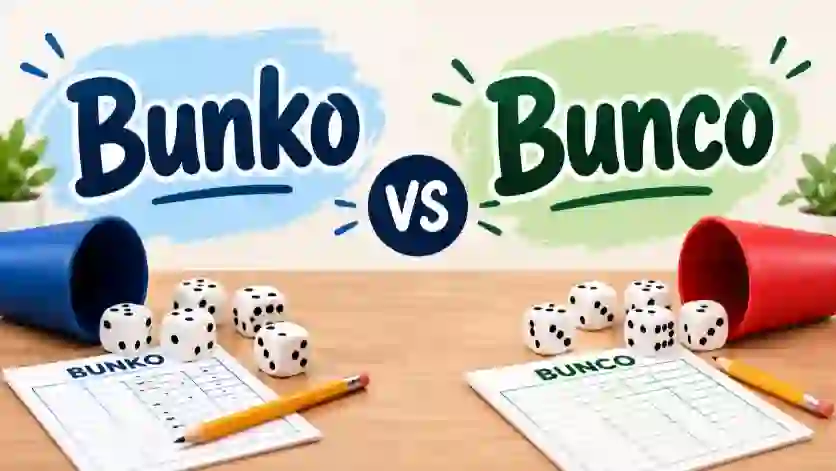
The correct spelling depends on what you mean, but bunco is the standard spelling for the social dice game and a term for a confidence trick or fraud. Bunko is also a recognized spelling variant, especially in references to the game. If you are writing about a bunco party, a dice game, or a scam, the context matters.
People often search for bunko or bunco because both spellings appear online, in game-night invitations, and in discussions of fraud. It can be hard to tell if one spelling is wrong or if the words have different meanings.
The good news is that you can choose the right form by looking at your sentence and your audience. In this guide, you will learn what bunco and bunko mean, where the spellings come from, how people use them in American and British English, and which version is best for everyday writing. You will also find clear examples, common mistakes, and answers to frequently asked questions.
Bunko or Bunco:
Bunco is the standard spelling for a social dice game and can also mean a scam or confidence trick. Bunko is an accepted spelling variant, particularly in references to the game and in some uses related to fraud. Both spellings exist, but bunco is a practical default for general American English writing. Always follow the spelling used by your chosen dictionary or publication.
Bunko or Bunco: Quick Answer
Both bunco and bunko are accepted spellings. Neither is automatically wrong.
- Bunco: A common spelling for a dice game and a word meaning a scam or confidence trick.
- Bunko: An alternative spelling that dictionaries also recognize, especially in American English.
- Best choice: Use bunco for general writing unless your source, audience, or publication prefers bunko.
Examples:
- We are hosting a bunco night on Friday.
- The detective investigated a bunco scheme.
- Our neighbourhood bunko group meets once a month.
The key is consistency. If you are writing about a game, check how the group or game organizer spells its name. If you mean a scam, either spelling may be understood, but bunco is a clear default
What Does Bunko or Bunco Mean?
The words bunco and bunko have closely related meanings. They can refer to a dice game or to dishonest activity designed to trick someone.
The exact meaning depends on the sentence.
1. Bunco as a Dice Game
Bunco is a social dice game played in groups. Players roll dice, score points, and compete through rounds. Many people enjoy it at parties, community gatherings, and game nights.
For example:
- We invited our neighbours to play bunco.
- Sarah is organizing a bunco party.
- The community centre hosts a monthly bunco night.
In these examples, bunco refers to a game, not a crime.
The alternative spelling bunko also appears in references to the game. If a club already uses one spelling in its name, keep that spelling in invitations and promotional materials.
2. Bunco as a Scam
The word bunco can also mean a swindle, fraud, or confidence trick. A confidence trick happens when someone gains another person’s trust to deceive them.
For example:
- The victim lost money in a bunco scheme.
- Police investigated a suspected bunco operation.
- The salesman was accused of trying to bunco customers.
Here, the word describes deception rather than entertainment.
3. Bunko as an Alternative Spelling
Bunko is not simply a spelling error. Major dictionary references recognize it as a variant of bunco. It can also be used as a noun or verb in informal American English
For example:
- The offer sounded like bunko.
- The fraudster tried to bunko an unsuspecting buyer.
The verb forms may also appear as buncoed and bunkoed. Choose the form that matches your intended spelling and follow it consistently.
The Origin of Bunko and Bunco
The history of these spellings helps explain why both exist.
Dictionary sources trace bunco and bunko to nineteenth-century English, when the terms were associated with gambling tricks and swindles. Their precise origins are not completely certain.
One commonly cited explanation connects the word to Spanish banca, a card game, and Italian banca, meaning a bank or gambling table. Another dictionary reference links bunko to bunkum. Because dictionaries present slightly different explanations, it is best not to treat one theory as settled fact.
How Did the Spellings Develop?
The words became associated with dishonest gambling schemes. Over time, bunco developed into a general term for a swindle or confidence trick.
The spelling bunko continued alongside it. This is an example of spelling variation in English: two forms can develop and remain in use without one becoming completely invalid.
The modern dice game also uses the name bunco, with bunko appearing as an alternative. Today, the spelling you encounter may depend on the dictionary, publication, or local group.
Why Do People Still Confuse Them?

There are three main reasons:
- Both forms are recognized. Readers may see either spelling in dictionaries or online.
- The words have the same pronunciation in many varieties of English. The final letters do not usually change the sound.
- The word has more than one meaning. A sentence about a game differs from a sentence about fraud.
The result is simple: you need to understand the context and select a consistent spelling.
British English vs American English
The difference between bunco and bunko is not a simple rule that one belongs to Britain and the other to the United States.
Both forms are documented in American English. British dictionary entries also recognize bunko as a variant of bunco. In British usage, the term is often associated with a swindle or confidence trick.
| British English | American English | Example |
| Bunco is recognized, often in the sense of a swindle. | Bunco is used for a scam and a social dice game. | The police investigated a bunco scheme. |
| Bunko is recognized as a variant spelling. | Bunko is also an accepted variant. | We are hosting a bunko party. |
| Context helps determine the intended meaning. | Context helps determine the intended meaning. | Our group plays bunco every month. |
Regional Differences
In the United States, you may encounter both spellings in game-night invitations, community groups, and descriptions of scams.
In the United Kingdom, bunco and bunko may be less familiar to readers than everyday words such as scam, fraud, or con.Formal British writing, those alternatives may communicate your meaning more clearly.
Canada and Australia also use English with their own publishing conventions. There is no universal rule requiring all writers in these countries to choose one spelling of bunco or bunko.
What Do Style Guides Recommend?
General spelling guides may not discuss this particular word in detail. When a style guide does not settle the question, use a reputable dictionary and follow your publication’s house style.
For a professional article, define the term if readers might not know it. For a casual game invitation, use the spelling familiar to the players.
Which Version Should You Use?
The best spelling depends on your audience, the meaning you intend, and the type of writing you are producing.
United States
Use bunco as a practical default for general American English. It works when discussing the dice game or a swindle.
If your local group calls its event a bunko party, keep that spelling in the event title. There is no need to change an established name simply to match a general preference.
United Kingdom
Both spellings are recognized, but bunco may be less familiar than scam or fraud when you are discussing dishonest activity.
For example:
- Less familiar: The company was involved in a bunco scheme.
- More direct: The company was involved in a fraud scheme.
Choose the word that best serves your readers rather than forcing an unfamiliar term into the sentence.
Canada
Canadian writers should follow the dictionary and house style used by their publication. Both bunco and bunko are recognized variants, so consistency matters more than trying to apply a spelling rule that does not exist.
Australia
The same principle applies in Australian English. If your readers may not know the term, use a familiar alternative such as scam when discussing fraud. For a game, explain the name if necessary.
International Writing
For an international audience, choose words that readers can understand without extra explanation.
- Use bunco when naming the game or referring to the traditional term for a swindle.
- Use bunko when preserving an established name or matching a source.
- Use scam, fraud, or confidence trick when clarity matters more than the original term.
Academic Writing
Academic writing requires clear definitions and reliable sources. If bunco or bunko is important to your argument, define the word and cite an appropriate dictionary or historical source.
Do not assume that readers will recognize the term. If you are analysing a historical text, preserve the spelling used in the original quotation.
Business Writing
In business reports, emails, and customer communications, scam or fraud is usually clearer than bunco.
For example:
- Less clear: We suspect a bunco operation.
- Clearer: We suspect a fraudulent operation.
However, if you are discussing a named historical case or a specific game, retain the appropriate term.
Common Mistakes When Using Bunko or Bunco
The most common mistake is assuming that bunko is always incorrect. Another is confusing the dice game with the word’s meaning related to fraud.
| Incorrect assumption or usage | Better choice | Explanation |
| Bunko is always a misspelling. | Bunko is an accepted variant. | Dictionaries recognize both forms. |
| Bunco only means fraud. | Bunco can also name a dice game. | Context determines the meaning. |
| Bunco and bunko must have different meanings. | Their meanings overlap. | They are spelling variants in relevant dictionary entries. |
| Bunco is always the best word in a formal report. | Scam or fraud may be clearer. | Familiar language helps readers understand the message. |
| Both spellings should be mixed throughout an article. | Choose one spelling and stay consistent. | Consistency improves readability. |
Mistake 1: Calling Bunko Wrong
Incorrect claim: “Bunko is never a correct spelling.”
Correct explanation: Bunko is a recognized alternative to bunco. You may prefer one form, but that does not make the other universally wrong.
Mistake 2: Ignoring the Meaning of the Sentence
Consider these examples:
- “We played bunco after dinner.” This describes a game.
- “The offer was a bunco.” This describes a suspected swindle.
The surrounding words make the meaning clear.
Mistake 3: Changing Spelling Without a Reason
Suppose your article begins with bunco but uses bunko later for the same meaning. Readers may wonder if you mean two different things.
Choose one form at the start. Change it only when quoting a source, using an established name, or following a specific editorial requirement.
An Easy Memory Tip
Remember this: Bunco is a good default, but bunko is not automatically wrong.
This rule is simple enough for everyday writing and accurate enough to avoid the most common spelling mistake.
Everyday Examples of Bunco and Bunko
The examples below show how the two spellings work in different settings. They are illustrative sentences, not quotations from published sources.
1. Emails
Using bunco:
“Hi everyone, our next bunco night will take place on Friday at 7 p.m.”
Using bunko:
“Please confirm if the invitation should say bunko or bunco.”
Both examples are suitable for casual communication. Follow the spelling used by the event organizer.
2. Business Writing
Example:
“The investigation found evidence of a suspected bunco scheme.”
For a broader business audience, you could write:
“The investigation found evidence of a suspected fraud scheme.”
The second version is more direct and widely understood.
3. News Headlines
Example using bunco:
“Authorities Investigate Suspected Bunco Scheme”
Clearer alternative:
“Authorities Investigate Suspected Fraud Scheme”
The best headline depends on the audience and the facts of the story. Do not use bunco merely to make a headline sound dramatic.
4. Blog Articles
Example:
“Bunco is a popular choice for a relaxed group game night.”
Example about spelling:
“Bunko is an alternative spelling of bunco, so both forms may appear in references to the game.”
A grammar article should explain the variant instead of labelling it a spelling error.
5. Social Media
Example:
“Who is ready for bunco night? Bring your friends and get ready to roll!”
For a community group, the familiar spelling used by its members is often the best choice.
6. Academic Writing
Example:
“The author uses the term bunco to describe a confidence trick.”
If the spelling is relevant to a historical analysis, retain the original form and explain its meaning.
7. Daily Conversation
Example about the game:
“Are you coming to our bunco party tonight?”
Example about fraud:
“That deal sounds like a scam.”
In everyday conversation, the second example may sound more natural when you want to warn someone about possible fraud.
Google Trends and Modern Usage
People search for bunko or bunco because they see both spellings and want to know if one is incorrect. The question can also come from someone planning a dice-game event or reading about a fraud case.
Regional Popularity
Both spellings are documented in English dictionaries, but dictionary recognition does not tell us which spelling receives more searches today.
Without a current, verified Google Trends comparison, it would be misleading to claim that one spelling has a particular search volume or is growing faster than the other.
The spelling you encounter may also depend on the subject. A game-night invitation may use a different form from a news article about a scam.
Modern Usage
Both forms remain understandable, but their suitability depends on context.
- For the dice game: Either spelling may be used.
- For fraud or deception: Both forms are recognized, although scam and fraud are often clearer.
- For SEO articles: Include both spellings naturally when relevant, then explain that they are variants.
- For formal writing: Follow a trusted dictionary and the publication’s preferred style.
Why Do People Search for Bunko or Bunco?
There are three likely reasons:
- They want to spell the name of a dice game correctly.
- They have encountered the word in a story about fraud.
- They want to know if bunko is a typo or an accepted spelling.
The most useful answer addresses all three possibilities rather than treating the query as a simple right-versus-wrong spelling question.
Bunko vs. Bunco: Quick Comparison Table
| Version | Meaning | Correct? | Region | Example |
| Bunco | Dice game or swindle | Yes | American and British English | We played bunco last night. |
| Bunko | Variant spelling of bunco | Yes | American and British English | The group held a bunko party. |
| Scam | Dishonest scheme | Yes | General English | The offer turned out to be a scam. |
| Fraud | Deception for unlawful or improper gain | Yes | General English | The company reported suspected fraud. |
The first two entries are spelling variants. The last two are alternatives that may express the meaning more clearly in everyday or professional writing. Their precise meanings are not identical in every context.
Key Takeaways
- Bunco and bunko are both recognized spellings.
- Neither spelling is automatically incorrect.
- Both forms can refer to a social dice game.
- Both forms can also refer to a swindle or confidence trick.
- Bunco is a practical default for general writing.
- Follow an established game name or publication style when applicable.
- Use scam or fraud if your readers may not understand bunco.
- Keep your spelling consistent throughout an article.
Frequently Asked Questions
1. Is bunko or bunco the correct spelling?
Both are correct spellings. Bunco is a practical default for general writing, while bunko is a recognized variant. Your choice can depend on the dictionary, publication, or game group you are referring to. If there is no established preference, choose one spelling and use it consistently.
2. Is bunko a real word?
Yes. Major dictionary references recognize bunko as a variant of bunco. It can refer to a dice game or a swindle, depending on the context. It is not simply a typo, although some readers may be more familiar with the spelling bunco.
3. What does bunco mean?
Bunco has two main uses. It can refer to a social dice game, or it can mean a swindle or confidence trick. The sentence usually makes the intended meaning clear. For example, a bunco party involves a game, while a bunco scheme involves deception.
4. Is bunco an American word?
Bunco is strongly associated with American English, especially in references to scams and the social dice game. However, the word is also recorded in British English dictionaries. It is not exclusive to the United States, though its familiarity and frequency may vary among audiences.
5. Is bunko British or American English?
Bunko appears in both American and British dictionary references. Some British entries identify it as a variant of bunco, while American entries also recognize it as an alternative spelling. Therefore, it is not accurate to say that bunko belongs exclusively to either variety of English.
6. What is a bunco game?
Bunco is a social dice game in which players roll dice and score points across rounds. It is often played in groups at parties or community gatherings. The alternative spelling bunko is also used. If you are attending an event, follow the spelling used by the host.
7. Does bunco mean scam?
Yes. Bunco can mean a swindle or confidence trick. It describes a dishonest scheme intended to deceive someone. However, the word also names a dice game, so context matters. If you want to communicate clearly to a general audience, scam or fraud may be more familiar.
8. How do you spell bunco in the plural?
The plural of bunco is commonly buncos. The corresponding plural of bunko is bunkos. These forms follow the spelling chosen for the singular noun. When writing about multiple game nights or several schemes, use the plural form that matches your chosen spelling.
9. Can bunco be used as a verb?
Yes. Bunco can be used informally as a verb meaning to swindle or cheat someone. For example, “The fraudster tried to bunco the buyer.” The variant bunko can also be used as a verb. In formal writing, deceive, defraud, or swindle may be clearer.
10. Should I use bunko or bunco in an SEO article?
Use bunco as your main spelling unless your subject or editorial style suggests otherwise. If the search topic is bunko or bunco, explain both forms naturally in the article. This answers the reader’s question without keyword stuffing. Include related terms such as dice game, scam, and confidence trick when relevant.
Conclusion: Bunko or Bunco?
When choosing between bunko or bunco, remember that both are accepted spellings. Bunco is a useful default for general writing, but bunko is not automatically wrong. Both can refer to a social dice game or a swindle, depending on the context.
For American readers, bunco is a sensible choice for a general article about the game or the word’s connection to fraud. For British and international audiences, consider if readers will understand the term. Words such as scam, fraud, and confidence trick may communicate the meaning more clearly.
If you are writing for a website, use one spelling consistently, explain the alternative, and rely on reputable dictionaries when checking definitions and word history. If you are promoting a local game night, use the spelling your group already recognizes.
You do not need to treat every spelling difference as a contest between right and wrong. Sometimes, understanding the context is the real answer.
Memorable takeaway: Bunco is a reliable default, but bunko is also correct. Choose the spelling that best serves your readers, and explore more word-choice guides on Wordsblog.
Read more about!
- CT or MRI: What’s the Difference?
- Yoto or Tonies: Which Audio Player Is Better?
- Realizes or Realises: Which Spelling Is Correct?

I’m Olivia Parker, a grammar and English writing enthusiast passionate about making English simple and easy to understand. Through Wordsblog, I share clear explanations, useful grammar tips, and practical writing guidance to help readers write with confidence. My goal is to make learning English easier, one word at a time.