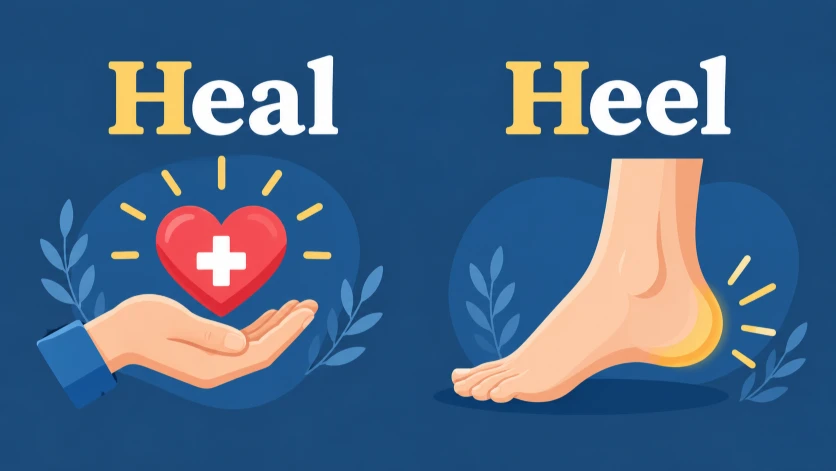
Heal or heel? These words sound the same, but they have very different meanings. Heal means to recover from an injury or to make something healthy again, while heel refers to the back part of your foot or the part of a shoe that supports it.
Many people confuse heal and heel because they are homophones. This means they have the same pronunciation but different spellings and meanings. If you are writing about an injury, a broken heart, or a pair of shoes, choosing the right word matters.
For example, you might say, “My ankle will heal soon,” but “My shoe has a broken heel.” Both sentences are correct because each word has a different purpose.
In this guide, you will learn the meaning of heal and heel, their origins, and how to use them in everyday writing. You will also find clear examples, common mistakes, regional usage notes, and simple memory tips to help you remember the difference.
Heal or Heel:
Heal and heel are different words with different meanings. A verb that means to recover from an injury or become healthy again. Heel is a noun that refers to the back part of your foot or the raised part of a shoe. For example, a wound can heal, but a shoe can have a broken heel.
Heal or Heel: Quick Answer
The main difference between heal and heel is their meaning and grammatical use.
- Heal: A verb that means to recover, repair, or become healthy.
- Heel: A noun that means the back part of your foot or the raised part of a shoe. It can also refer to a person who behaves badly.
Here are three simple examples:
- My cut will heal in a few days.
- The heel of my shoe is damaged.
- He hurt his heel while running, and it took weeks to heal.
Notice that the third sentence uses both words correctly. The heel is the body part, while heal describes the process of recovery.
Easy rule: If you mean recovery, use heal. If you mean a body part, footwear, or a person who behaves badly, use heel.
What Does Heal Mean?
Heal is a verb that means to recover from an injury, illness, or emotional pain. It can also mean to help someone or something become healthy again.
The word applies to both physical and emotional recovery.
1. Heal as physical recovery
Use heal when a wound, injury, or illness improves.
Examples:
- The small cut should heal quickly.
- Her broken arm took several weeks to heal.
- Rest can help your body heal.
In these sentences, heal describes the process of recovery.
2. Heal as emotional recovery
The word can also describe recovery from sadness, grief, or emotional pain.
Examples:
- Time helped him heal after the loss.
- She needed space to heal from a painful breakup.
- Their friendship began to heal after the argument.
Here, heal does not refer to a visible injury. It describes emotional recovery.
3. Heal as repairing a relationship
Heal can also mean to restore a damaged relationship or reduce conflict.
Examples:
- An honest conversation helped heal their friendship.
- The community worked together to heal old divisions.
- They hoped to heal the tension between their families.
Grammar tip: Heal is the base form of a verb. Its other forms include heals, healed, and healing.
For example:
- Present: The wound heals slowly.
- Past: The wound healed last week.
- Continuous: The wound is healing well.
What Does Heel Mean?
Heel is most often a noun. It has several meanings, depending on the context.
1. Heel as a part of the body
Your heel is the back part of your foot, below your ankle.
Examples:
- My right heel hurts after a long walk.
- She landed on her heel.
- The athlete felt pain in his heel.
In each sentence, heel refers to a part of the foot.
2. Heel as part of a shoe
A heel is also the raised part at the back of a shoe.
Examples:
- The heel of my boot came loose.
- She wore shoes with low heels.
- The cobbler repaired the broken heel.
You may also see the word in phrases such as high heels, heel height, and heel support.
3. Heel as an unpleasant person
In informal English, a heel can mean a person who acts selfishly, dishonestly, or cruelly.
For example:
- He acted like a heel when he broke his promise.
- Everyone thought the dishonest salesman was a heel.
This meaning is less common in everyday conversation than the body-part or footwear meanings.
4. Heel as a verb
Although heel is usually a noun, it can also be a verb in certain contexts.
For example, a dog may be trained to heel, meaning to walk close beside its handler. In sailing, a boat can heel when it tilts to one side.
These uses are less likely to cause confusion when you understand the context.
The Origin of Heal and Heel
Although heal and heel sound alike today, they developed from different Old English words.
The origin of heal
Heal comes from the Old English verb hǣlan, which meant to make whole, restore health, or cure. It is related to the Old English word hāl, meaning whole or healthy.
This connection helps explain the modern meaning of heal. When something heals, it moves toward a healthier or more complete state.
The word has long been associated with recovery from physical harm. Its use later also became common in descriptions of emotional recovery and the repair of relationships.
The origin of heel
Heel, referring to the back part of the foot, comes from the Old English word hēla. The word has Germanic roots and is related to similar words in other Germanic languages.
The footwear meaning developed from the same general idea of the heel as the back part of the foot or shoe. The word also gained figurative meanings over time, including its use for an unpleasant person.
Why are the spellings different?
The words have separate histories and meanings, even though their pronunciations are identical in modern English.
Their different spellings help readers distinguish between two unrelated concepts:
- Heal: Recovery or restoration.
- Heel: A body part, footwear feature, or figurative description of a person.
You do not need to memorize their full histories to use them correctly. Remembering their meanings is usually enough.
British English vs American English
Heal and heel are spelled the same way in British English and American English. Neither word has a standard regional spelling variation.
| Context | British English | American English | Example |
| Recover from an injury | Heal | Heal | The wound will heal. |
| Back of the foot | Heel | Heel | My heel hurts. |
| Part of a shoe | Heel | Heel | The shoe has a high heel. |
| Emotional recovery | Heal | Heal | She needs time to heal. |
| An unpleasant person | Heel | Heel | He behaved like a heel. |
Are there any regional differences?
The spelling does not change between the United Kingdom and the United States. The meaning also stays the same.
Differences may arise from local expressions, tone, or context. For example, calling someone a heel sounds old-fashioned or informal in many situations, while talking about a sore heel is ordinary everyday English.
British and American dictionaries recognize both words. Standard spelling guides do not recommend changing heal to heel or the other way around.
What about Canada and Australia?
Canadian and Australian English also use heal and heel with the same spellings and meanings.
The main challenge is not regional spelling. It is choosing the word that fits the intended meaning.
Which Version Should You Use?
There is no need to choose between British and American spelling for these words. The correct choice depends on what you want to say.
United States
Use heal for recovery and heel for the foot, shoes, or the figurative meaning.
Example: “The cut should heal soon, but the heel of my shoe needs repair.”
United Kingdom
Follow the same rule in British English.
Example: “My heel hurts, so I hope it will heal soon.”
Canada
Use the standard spellings heal and heel. Both are correct in Canadian writing.
Australia
Australian English follows the same spelling distinction.
Example: “Give the blister time to heal before wearing those shoes again.”
International writing
Use the word that matches the meaning. Readers across English-speaking regions understand this distinction.
If your audience includes English learners, provide a short explanation or example when the words appear together.
Academic writing
Use heal when discussing recovery, healing processes, or emotional well-being. Use heel when referring to anatomy, footwear, or a specific figurative meaning.
For medical writing, be precise about what is healing, such as a wound, fracture, or tissue.
Business writing
Choose the word based on context.
- Customer service: “We will help resolve the issue and heal the relationship with the customer.”
- Product description: “The boot features a reinforced heel.”
In formal business writing, avoid calling a person a heel because it may sound insulting or dated.
Common Mistakes
The most common mistake is using heel when you mean recovery or using heal when you mean the back of the foot or a shoe.
| Incorrect example | Correct example | Explanation |
| My cut will heel soon. | My cut will heal soon. | Heal means to recover. |
| My heal hurts after running. | My heel hurts after running. | Heel is a part of the foot. |
| The shoe needs a new heal. | The shoe needs a new heel. | A shoe has a heel. |
| I hope my injury will heel. | I hope my injury will heal. | Heal describes recovery. |
| She wore high heals. | She wore high heels. | Heels are the raised parts of shoes. |
| His wound is starting to heel. | His wound is starting to heal. | Heal is the correct verb. |
Why do people confuse heal and heel?
There are three main reasons:
- They sound the same. Both words are pronounced alike in standard English.
- Their meanings are different. One describes recovery, while the other usually names a physical object or body part.
- Spell-check may not catch the error. Both are valid English words, so a writing tool may accept the wrong choice.
A simple memory tip

Think of the word health when you see heal. Both are connected to being healthy.
Think of your heel when you put on a shoe. The heel is the back part of your foot or shoe.
Remember:
- HEAL = HEALTH and RECOVERY
- HEEL = FOOT and SHOE
This simple connection can help you choose the right spelling quickly.
Everyday Examples of Heal and Heel
The best way to understand these words is to see how they work in different types of writing.
1. Emails
Heal:
“Please give yourself time to heal before returning to work.”
Heel:
“I need to replace the heel on my formal shoes before the event.”
2. Business writing
Heal:
“We hope this discussion will help heal the working relationship between the two teams.”
Heel:
“The new shoe design includes a wider heel for added stability.”
3. News headlines
Heal:
“Local Community Works to Heal After the Storm”
Heel:
“Designer Shoes With a Lower Heel Gain Attention”
These examples show how each word can appear in a headline without changing its spelling.
4. Blogs
Heal:
“Five Ways to Support Your Body as It Heals”
Heel:
“How to Choose Shoes That Reduce Heel Discomfort”
A blog about health or recovery may use heal, while a footwear guide may use heel.
5. Social media
Heal:
“Taking a break and giving myself time to heal.”
Heel:
“My favourite shoes finally need a new heel!”
Both examples are natural in casual online writing.
6. Academic writing
Heal:
“The damaged tissue began to heal during the recovery period.”
Heel:
“The study examined pressure distribution beneath the heel during walking.”
In academic writing, the surrounding subject usually makes the intended meaning clear.
7. Daily conversation
Heal:
“Don’t worry. Your scrape should heal soon.”
Heel:
“I can’t wear these shoes because the heel is broken.”
These are simple, natural sentences that demonstrate the difference.
8. Using both words together
A sentence containing both words can make the distinction especially clear.
- “The pain in my heel took weeks to heal.”
- “The cut near her heel began to heal.”
- “He hurt his heel, but it healed after he rested.”
In every case, heel names the body part and heal describes recovery.
Google Trends and Modern Usage
Heal and heel are both established English words. Their spellings remain stable in British, American, Canadian, and Australian English.
Without a current, verified Google Trends comparison, it would be misleading to claim that one word is more popular than the other across all regions. Search interest also depends on context because the words serve different purposes.
Why do people search for “heal or heel”?
People often search for the comparison because:
- The words sound identical.
- They are unsure which spelling fits a sentence.
- They are learning English or improving their writing.
- They want to describe an injury, recovery, or shoe correctly.
- Spell-check does not always identify a wrong word when the spelling itself is valid.
Which word appears in which context?
Heal is useful in content about physical recovery, emotional well-being, wounds, and relationships.
Heel is common in content about anatomy, footwear, fashion, walking, and foot discomfort. It can also appear in informal descriptions of someone’s behavior.
These differences explain why search results for each word may cover very different subjects.
How can you check regional search interest?
You can compare the terms in Google Trends at Google Trends.
Choose a country, a time period, and a search category. Compare the terms separately or use the comparison feature, keeping in mind that Google Trends reports relative search interest rather than total search counts.
For practical writing, however, you do not need search data to decide which spelling is correct. The intended meaning is what matters.
Quick Comparison Table
| Version | Meaning | Correct? | Region | Example |
| Heal | Recover from an injury | Yes | All English varieties | The cut will heal. |
| Heel | Back part of the foot | Yes | All English varieties | My heel hurts. |
| Heel | Raised part of a shoe | Yes | All English varieties | The heel is broken. |
| Heel | An unpleasant person | Yes, in informal use | All English varieties | He acted like a heel. |
| Heals | Present-tense form of heal | Yes | All English varieties | The wound heals slowly. |
| Heeled | Past-tense form of heel as a verb, or a shoe description | Yes, in the right context | All English varieties | She wore heeled boots. |
The important point is that heal and heel are both correct words. You must select the one that matches your sentence.
Key Takeaways
- Heal is a verb that means to recover or become healthy again.
- Heel usually refers to the back of the foot or the raised part of a shoe.
- Heel can also describe an unpleasant person in informal English.
- Heal and heel sound the same but have different meanings.
- Both words use the same spellings in British and American English.
- Spell-check may miss errors because both words are valid.
- Remember heal = health and heel = foot or shoe.
- When both words appear in a sentence, use heel for the body part and heal for the recovery process.
FAQs About Heal or Heel
1. Is it heal or heel?
Both spellings are correct, but they have different meanings. Heal means to recover from an injury, illness, or emotional pain. Heel usually means the back part of your foot or the raised part of a shoe. Choose the word that fits your sentence rather than relying on how it sounds.
2. What is the difference between heal and heel?
Heal is a verb that describes recovery or restoration. Heel is usually a noun that names a body part or part of a shoe. For example, “My wound will heal” is correct, and “My heel hurts” is also correct. The words sound the same but are not interchangeable.
3. Is it heal your heel or heel your heal?
The usual expression is “heal your heel” when you mean helping an injured heel recover. Here, the first word is the verb heal, and the second is the noun heel. “Heel your heal” does not express that meaning because heal is not the name of the body part.
4. How do you spell heel on a shoe?
The correct spelling is heel. It refers to the raised part at the back of a shoe, as in “high heels” or “a broken heel.” For example, “The heel of my boot needs repairing” is correct. Remember that heal relates to recovery, not footwear.
5. Is heal a noun or a verb?
Heal is primarily a verb. It describes the process of recovering or helping something recover. Examples include “The wound will heal” and “Time can help heal emotional pain.” Related forms include heals, healed, and healing. Do not confuse it with health, which is a noun.
6. Can heel be used as a verb?
Yes. Although heel is most often a noun, it can also function as a verb. For example, a dog may be trained to heel, meaning to walk close beside its handler. In sailing, a boat can heel when it tilts to one side. The context determines the meaning.
7. Are heal and heel homophones?
Yes. Heal and heel are homophones because they have the same pronunciation but different spellings and meanings. This is why people sometimes mix them up in writing. Other common homophone pairs include there and their, and brake and break. Context helps you choose the correct word.
8. Is heal or heel correct in British English?
Both words are correct in British English, but their meanings differ. Use heal for recovery and heel for the back part of the foot or a shoe. British English does not use a different regional spelling for either word, so the same rule applies in the United States, Canada, and Australia.
9. How can I remember the difference between heal and heel?
Connect heal with health. Both relate to being healthy or getting better. Connect heel with your foot or the back of a shoe. For example, “My heel hurts, but it will heal.” Practising this short sentence can help you remember which spelling to use in everyday writing.
10. Can heal and heel appear in the same sentence?
Yes. For example, “The injury to my heel took several weeks to heal.” In this sentence, heel identifies the body part, while heal describes recovery. Using both words together is a useful way to remember their different meanings and avoid spelling mistakes.
Conclusion
The difference between heal or heel is simple once you understand what each word means. Heal is a verb that describes recovery from an injury, illness, or emotional pain. Heel usually refers to the back part of your foot or the raised part of a shoe. It can also describe an unpleasant person in informal English.
Both words sound the same, which is why they are easy to confuse. However, they have different spellings, meanings, and uses. Neither spelling is specifically British or American, so you can follow the same rule wherever you write in English.
When you are unsure, read your sentence and ask yourself what you want to describe. If you mean getting better, choose heal. If you mean a foot, a shoe, or the figurative description of a person, choose heel.
Remember: Your heel is part of your foot, and a wound can heal.
Keep this simple rule in mind, and you will find it much easier to use both words correctly. If this guide helped you, explore more word comparisons to improve your spelling and everyday English.
Read more about!
- CT or MRI: What’s the Difference?
- Yoto or Tonies: Which Audio Player Is Better?
- Realizes or Realises: Which Spelling Is Correct?

I’m Olivia Parker, a grammar and English writing enthusiast passionate about making English simple and easy to understand. Through Wordsblog, I share clear explanations, useful grammar tips, and practical writing guidance to help readers write with confidence. My goal is to make learning English easier, one word at a time.








1 thought on “Heal or Heel: What’s the Difference?”