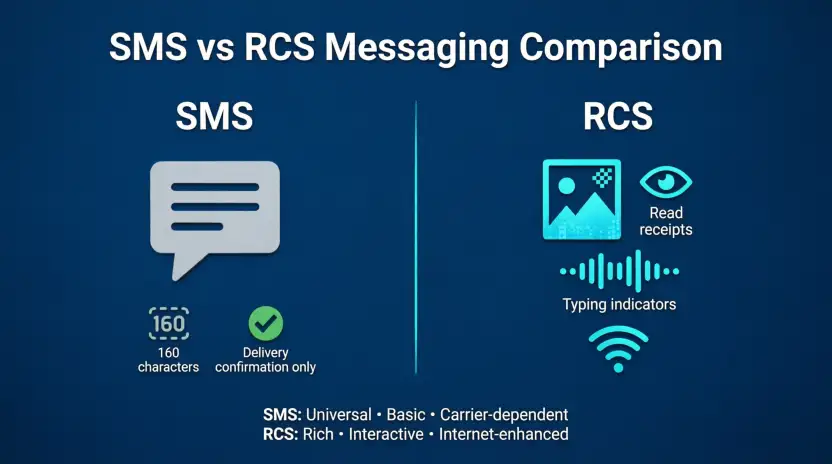
SMS and RCS both let people send messages by phone, but they offer very different experiences. SMS is the older, basic texting standard, while RCS is a newer messaging standard with features such as high-quality media, typing indicators, read receipts, and richer conversations.
People often search for SMS or RCS because both appear as messaging options on modern smartphones. The choice can be confusing because RCS looks and feels more like a modern chat app, while SMS remains widely supported and works on almost any mobile phone.
The key difference is simple: SMS is built for basic text messages, while RCS is designed for richer, internet-based messaging. RCS can support larger photos and videos, group chats, read receipts, typing indicators, and other interactive features when supported by the phone, carrier, and messaging app.
In this guide, you will learn what SMS and RCS mean, how they differ, when to use each one, and what changes when a message falls back from RCS to SMS.
SMS or RCS: Quick Answer
SMS is a basic mobile text messaging service, while RCS is a newer messaging standard that adds richer chat features.
For example:
- SMS: Best for simple text messages and broad compatibility.
- RCS: Better for modern chats with photos, videos, read receipts, typing indicators, and group messaging.
- SMS: Uses the cellular messaging system.
- RCS: Generally uses mobile data or Wi-Fi.
- RCS: Requires compatible devices, apps, networks, and settings.
If both options are available, RCS is usually the better choice for feature-rich conversations, while SMS is the dependable fallback when RCS is unavailable.
What Does SMS or RCS Mean?
What Is SMS?
SMS stands for Short Message Service. It is the traditional system used to send short text messages between mobile phones.
SMS was designed for simple communication. A typical SMS might say:
“I’ll be there at 7 PM.”
SMS does not normally provide modern chat features such as typing indicators or high-resolution photo sharing.
What Is RCS?
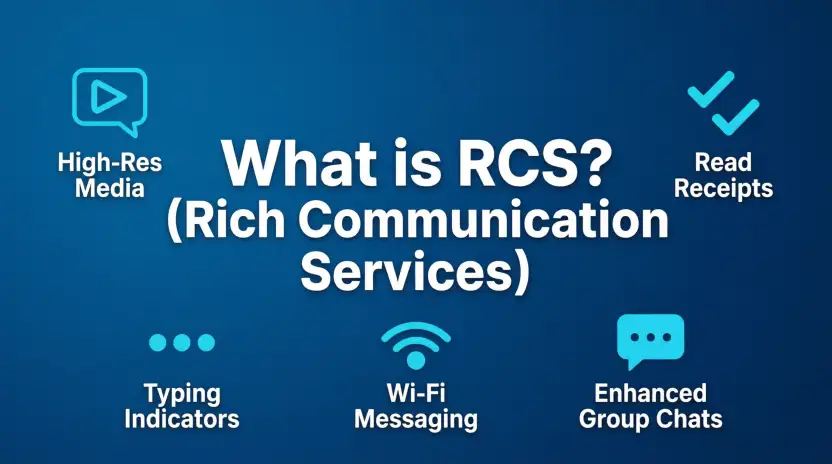
RCS stands for Rich Communication Services. It is a messaging standard designed to provide a richer experience than traditional SMS.
Depending on the platform and implementation, RCS can support:
- Read receipts
- Typing indicators
- High-quality photos and videos
- Larger messages
- Group chats
- Reactions
- Rich media
- Business messaging features
In simple terms, RCS brings many features people expect from internet messaging apps into the phone’s standard messaging experience.
The Origin of SMS or RCS
SMS developed long before modern smartphone messaging. It became a widely used way to send short text messages through mobile networks.
As smartphones and mobile internet became common, people began expecting more from messaging. They wanted to share photos and videos, see when someone was typing, receive read receipts, and have better group conversations.
That created a need for a more capable messaging standard.
RCS was developed to provide a richer alternative to traditional SMS and MMS. It has evolved over time through industry efforts involving mobile operators, device makers, and technology companies.
The important point is that RCS did not simply replace SMS overnight. Instead, modern messaging systems can use RCS when it is supported and fall back to older messaging methods when it is not.
British English vs American English
SMS and RCS are technical abbreviations, so there is no major British-versus-American spelling difference in the terms themselves.
| Term | British English | American English | Example |
| SMS | SMS | SMS | “Send me an SMS.” |
| RCS | RCS | RCS | “The phone supports RCS.” |
| Text message | Text message | Text message | “I sent a text message.” |
| Mobile phone | Common | Less common | “My mobile phone received it.” |
| Cell phone | Less common | Common | “My cell phone received it.” |
The main regional difference is not the technology name. It is the vocabulary used to describe mobile devices.
British English commonly uses mobile phone, while American English commonly uses cell phone.
Which Version Should You Use?
The answer depends more on compatibility and purpose than on geography.
United States
Use RCS when it is available and supported by the recipient’s device and messaging service. It provides a richer messaging experience.
SMS remains useful when RCS is unavailable.
United Kingdom
The same basic rule applies. RCS can provide richer communication when supported, while SMS remains useful for compatibility.
Canada
RCS can be useful for modern messaging, especially when both people have compatible services. SMS remains the more universal option.
Australia
RCS is useful when supported by the devices and networks involved. SMS is still practical when compatibility is uncertain.
International Writing
If you are explaining the technologies to an international audience, avoid assuming that every phone or messaging app supports RCS in the same way.
Academic Writing
Use the full terms on first mention:
Short Message Service (SMS)
and
Rich Communication Services (RCS)
Then use the abbreviations throughout the rest of the document.
Business Writing
For business messaging, RCS can offer richer features, but companies should consider device, carrier, platform, and regional support before relying on it.
Common Mistakes
| Incorrect Example | Correct Example | Explanation | Memory Tip |
| “RCS is just another name for SMS.” | “RCS is a richer messaging standard than SMS.” | They are different technologies. | RCS = richer communication |
| “SMS always needs Wi-Fi.” | “SMS can work through a mobile network without Wi-Fi.” | SMS does not depend on Wi-Fi in the same way internet messaging does. | SMS = traditional mobile messaging |
| “RCS works on every phone.” | “RCS requires compatible support.” | Availability depends on the devices, apps, networks, and settings involved. | Check compatibility |
| “If RCS fails, the message cannot be sent.” | “Messaging may fall back to SMS when supported.” | Modern messaging systems can use SMS as a fallback. | RCS can fall back |
| “SMS supports all modern chat features.” | “RCS supports more advanced messaging features.” | SMS is designed for basic messaging. | SMS = simple |
One of the biggest mistakes is treating SMS and RCS as two different names for the same thing. They are related messaging technologies, but their capabilities are different.
Everyday Examples
Emails
In an email about mobile communication, you might write:
“Our customer notifications can use RCS where supported and SMS as a fallback.”
This is clearer than simply saying “text messages.”
Business Writing
A company might use RCS to send a richer customer message with media or interactive elements.
For example:
“Your order is ready. Tap the message to view your delivery details.”
SMS may still be used for a simple notification:
“Your order has shipped.”
News Headlines
A technology article might use headlines such as:
RCS Messaging Explained: How It Differs From SMS
This clearly tells readers that the article compares two messaging technologies.
Blogs
A blog might explain:
“SMS remains useful because of its broad compatibility, while RCS offers a more modern chat experience.”
Social Media
A social media post might say:
“SMS or RCS? SMS keeps things simple. RCS adds richer chat features.”
Academic Writing
An academic paper could introduce the terms as:
“Short Message Service (SMS) and Rich Communication Services (RCS) represent different generations of mobile messaging technology.”
Daily Conversation
A person might simply say:
“Did you get my text?”
The underlying message could be delivered using SMS or RCS depending on the messaging system being used.
Google Trends & Modern Usage
People search for SMS or RCS because modern phones can make the difference between these messaging systems less obvious.
A user may see a message being sent and wonder why one conversation has read receipts and typing indicators while another does not. The answer can involve if the conversation is using RCS, SMS, or another messaging system.
Modern messaging also makes the distinction important for businesses. Companies may want to understand if they should use SMS, RCS, or another messaging platform for customer communication.
Exact popularity can vary by country, carrier, operating system, messaging app, and time. Therefore, it is better not to assume that one system is equally available everywhere.
The broader trend is clear: messaging has moved from simple text delivery toward richer, internet-connected conversations, while SMS continues to serve as a widely compatible foundation.
Quick Comparison Table
| Version | Meaning | Correct? | Region | Example |
| SMS | Short Message Service | Yes | Worldwide | “I sent you an SMS.” |
| RCS | Rich Communication Services | Yes | Availability varies | “Our chat supports RCS.” |
| Text message | General term for a mobile text | Yes | Worldwide | “Send me a text.” |
| RCS message | A message sent using RCS | Yes | Where supported | “The RCS message shows a read receipt.” |
The terms are not competing spellings. SMS and RCS are both correct terms, but they describe different messaging standards.
Key Takeaways
- SMS means Short Message Service.
- RCS means Rich Communication Services.
- SMS is designed for basic text messaging.
- RCS provides a richer messaging experience when supported.
- RCS can include features such as typing indicators and read receipts.
- SMS has broad compatibility and can serve as a fallback.
- RCS availability depends on the devices, apps, networks, and settings involved.
- For modern, feature-rich messaging, RCS is usually preferable when available.
FAQs
1. What is the main difference between SMS and RCS?
The main difference is the messaging experience. SMS is designed for basic text messages, while RCS supports richer communication features such as read receipts, typing indicators, multimedia, and enhanced group conversations when supported. In simple terms, SMS focuses on basic mobile texting, while RCS is designed to provide a more modern chat experience.
2. Is RCS better than SMS?
For feature-rich conversations, RCS is generally more capable than SMS. It can support features that traditional SMS does not provide. However, SMS has an important advantage: broad compatibility. If RCS is not available or supported, SMS can still provide a simple way to send a text message.
3. Does RCS use Wi-Fi?
RCS can use an internet connection, including mobile data or Wi-Fi, depending on the messaging service and device. SMS works differently and is traditionally delivered through a mobile network. This difference is one reason RCS can provide richer communication features than traditional SMS.
4. Can RCS messages turn into SMS?
Yes, depending on the messaging system and its settings, a message may fall back to SMS when RCS is unavailable. This can happen when the recipient does not support RCS or when the required service is not available. The exact behavior depends on the device, app, carrier, and configuration.
5. Do all phones support RCS?
No. RCS support depends on the phone, operating system, messaging application, carrier or service provider, and configuration. Modern devices may support RCS, but users should not assume that every phone or messaging service provides exactly the same RCS features.
6. Is SMS still used today?
Yes. SMS remains an important mobile messaging method. Its broad compatibility makes it useful for personal messages, notifications, verification codes, alerts, and other communications. Even as richer messaging systems become more common, SMS continues to have a practical role.
7. Does RCS have read receipts?
RCS can support read receipts when the feature is available and enabled. It can also support typing indicators and other modern chat features. However, the exact features a user sees can depend on the messaging application, device, service provider, and settings.
8. Is RCS the same as iMessage?
No. RCS and iMessage are different messaging technologies. RCS is an industry messaging standard designed to provide richer communication across supported services and devices. iMessage is Apple’s messaging service. They can offer some similar features, but they are not the same system.
9. Should businesses use SMS or RCS?
Businesses should choose based on their audience, goals, technical setup, and available support. RCS can be useful for richer customer interactions, while SMS offers broad reach and simple messaging. Many businesses may use both, depending on if the recipient can receive an RCS message.
10. What does SMS or RCS mean on a phone?
When a phone or messaging app mentions SMS or RCS, it is usually indicating how a message is being sent. SMS refers to traditional text messaging, while RCS refers to richer messaging. The available option can depend on the recipient, device, network, messaging app, and service settings.
Conclusion
SMS and RCS are both messaging technologies, but they are designed for different levels of communication. SMS provides simple and widely compatible text messaging, while RCS adds features that make conversations feel more like modern internet-based chats.
If you only need to send a basic text, SMS is often enough. If RCS is supported, it can provide a better experience with features such as read receipts, typing indicators, richer media, and enhanced group conversations.
For businesses, the decision depends on the audience and communication goal. RCS can make customer messaging more interactive, while SMS remains valuable because of its broad reach and simplicity.
The most important thing to remember is that RCS does not simply mean “new SMS.” It is a different, richer messaging standard that can work alongside SMS.
Simple takeaway: SMS keeps messaging basic and compatible, while RCS makes it richer and more interactive.
Read more about!
- Triple or Tripple: Which Spelling Is Correct?
- Trailor or Trailer: Which Spelling Is Correct?
- Mucinex or Robitussin: Which Is Better?

I’m Olivia Parker, a grammar and English writing enthusiast passionate about making English simple and easy to understand. Through Wordsblog, I share clear explanations, useful grammar tips, and practical writing guidance to help readers write with confidence. My goal is to make learning English easier, one word at a time.