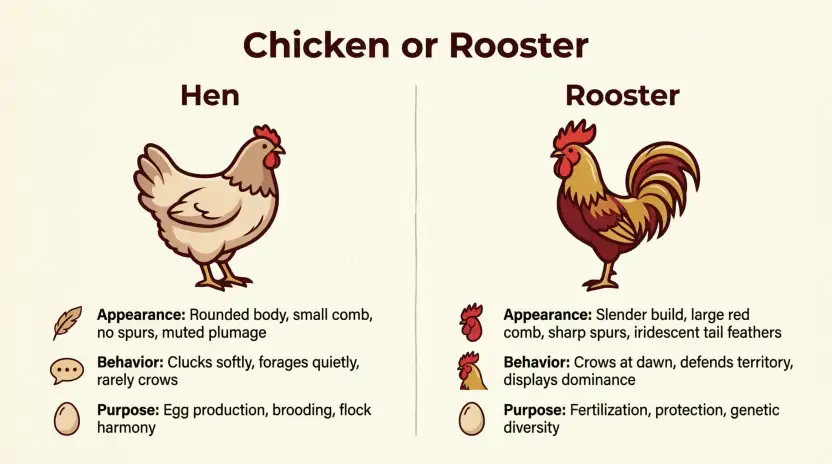
A chicken is a general term for the bird, while a rooster specifically means an adult male chicken. So, every rooster is a chicken, but not every chicken is a rooster.
People often search chicken or rooster because these words are related but do not have the same meaning. “Chicken” can refer to the species or to a bird when its sex is not being specified. “Rooster,” on the other hand, tells you that the bird is male and fully grown.
Knowing the difference is useful when talking about farms, poultry, food, animal behavior, or everyday English. It also helps avoid a common mistake: treating “chicken” and “rooster” as two different types of birds. In reality, they describe the bird at different levels. This guide explains what each word means, where the terms came from, how they are used in different English-speaking regions, and which word you should choose in everyday, academic, and professional writing.
Chicken or Rooster: Quick Answer
The simplest way to remember the difference is:
- Chicken = the general bird or species.
- Rooster = an adult male chicken.
- Hen = an adult female chicken.
- Chick = a young chicken.
Examples
- “There are six chickens in the yard.”
This does not tell us how many are male or female. - “The rooster crowed at sunrise.”
This specifically identifies an adult male chicken. - “The farmer keeps hens and one rooster.”
Here, the words identify the sex of the adult birds.
So, if you are unsure if a chicken is male or female, chicken is the safer general term. If you know the bird is an adult male, rooster is more precise.
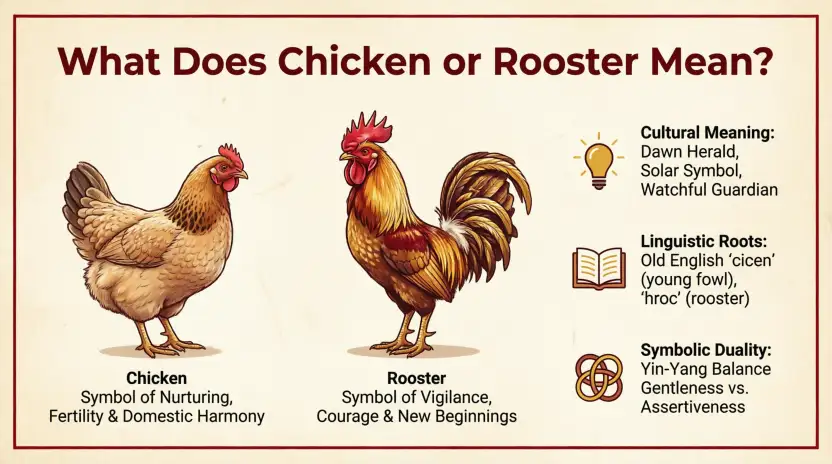
What Does Chicken or Rooster Mean?
What Does “Chicken” Mean?
Chicken is the common English name for the domestic bird Gallus gallus domesticus. In everyday language, it can refer to the bird generally without identifying its sex.
For example:
“The chickens are eating in the garden.”
The sentence does not tell us if the birds are male or female.
The word chicken is also commonly used for the bird as food:
“We had chicken for dinner.”
In this context, the word refers to meat rather than a living bird.
What Does “Rooster” Mean?
A rooster is an adult male chicken.
For example:
“The rooster began crowing early in the morning.”
The word specifically identifies the bird as male.
Cock is another traditional term for an adult male chicken. It is still used in British English and in farming or poultry contexts, although rooster is very common in everyday American English.
Chicken vs. Rooster at a Glance
| Term | Meaning |
| Chicken | General term for the domestic bird |
| Rooster | Adult male chicken |
| Hen | Adult female chicken |
| Chick | Young chicken |
| Cock | Traditional term for an adult male chicken |
The key point is simple: rooster is a more specific term than chicken.
The Origin of Chicken or Rooster
The words chicken and rooster have different histories.
Chicken comes from Old English cicen, which referred to a young domestic fowl. Over time, the word developed into the modern English chicken and became a general term for the bird.
Rooster is a later English term. It comes from roost, referring to the place where birds settle to sleep, combined with the suffix -er. The term became established as a name for a male chicken.
The older word cock has a much longer history in English and was traditionally used for a male bird. In modern everyday English, however, rooster is especially common in American English.
These changes show how English develops through everyday speech. Words can gain new meanings, become more common in certain regions, or replace older terms in ordinary conversation.
British English vs American English
The basic meaning of chicken, rooster, and hen is understood in both British and American English. The main difference is that British English commonly uses cock for an adult male chicken, while American English strongly favors rooster in everyday speech.
| British English | American English | Example |
| Chicken | Chicken | “The chickens are in the yard.” |
| Cock | Rooster | “The cock/rooster is crowing.” |
| Hen | Hen | “The hen is sitting on her eggs.” |
| Chick | Chick | “The chick is very young.” |
Is “Rooster” Correct in British English?
Yes. British speakers understand rooster, but cock is also a traditional and widely recognized term for an adult male chicken.
Is “Cock” Correct in American English?
Yes, but context matters. American English speakers may understand cock as an animal term, but rooster is often preferred in ordinary conversation because it avoids possible ambiguity with another meaning of the word.
For general international writing, rooster is often a clear choice when you specifically mean an adult male chicken.
Which Version Should You Use?
United States
Use rooster when you mean an adult male chicken.
“The rooster woke everyone up.”
Chicken remains the general term.
United Kingdom
Both rooster and cock are understood. Cock is a traditional British term for a male chicken.
“The cock crowed at dawn.”
For broad international audiences, rooster may be clearer.
Canada
Canadian English generally follows the same distinction as American English in everyday use:
- Chicken = general bird
- Rooster = adult male
- Hen = adult female
Australia
Australian English also recognizes rooster and cock. The best choice depends on audience and context.
International Writing
For international readers, use chicken when sex does not matter and rooster when you need to identify an adult male.
This makes the meaning immediately clear.
Academic Writing
Use the most precise biological or zoological term required by the context.
For example:
“The study examined the behavior of adult male chickens.”
If the audience is general, rooster may be easier to understand.
Business Writing
For poultry farming, food production, agriculture, or animal-related business writing, choose the term that accurately describes the subject.
Avoid switching between chicken and rooster as though they mean exactly the same thing.
Common Mistakes
| Incorrect Example | Correct Example | Explanation | Memory Tip |
| “Every chicken is a hen.” | “A hen is a female chicken.” | Chicken is a general term. | Chicken covers the group. |
| “A rooster is a different species.” | “A rooster is a male chicken.” | Rooster identifies sex and age. | Rooster = male chicken. |
| “The rooster laid eggs.” | “The hen laid eggs.” | Hens lay eggs. | Hen = female. |
| “We saw a rooster, but we don’t know if it was male.” | “We saw a chicken, but we don’t know its sex.” | Rooster already indicates male. | Use chicken when unsure. |
| “Chicken and rooster are unrelated birds.” | “A rooster is a type of chicken.” | They are not separate species. | Rooster belongs to chicken. |
Easy Memory Trick
Think of chicken as the big category:
Chicken → Rooster (male) / Hen (female)
This makes the relationship much easier to remember.
Everyday Examples
Emails
“The farm has several chickens and two roosters.”
This is useful when the writer needs to distinguish the male birds from the rest.
Business Writing
“The farm supplies eggs from hens and raises roosters for breeding.”
The terms provide specific information about the birds.
News Headlines
“Rooster Escapes From Local Farm”
The word rooster immediately tells readers that the escaped bird is male.
Blogs
“How can you tell a young chicken from a rooster?”
This wording is natural when discussing poultry identification.
Social Media
“Our new rooster has started crowing every morning!”
Here, rooster gives readers a clear picture of the animal.
Academic Writing
“The researchers observed adult male chickens during the experiment.”
This can be more formal and precise than simply saying “roosters,” depending on the scientific context.
Daily Conversation
“I heard a rooster this morning.”
This is a natural everyday sentence.
“There are chickens all over the farm.”
Here, the speaker is referring to the birds generally.
Google Trends & Modern Usage
People search for chicken or rooster because the words are closely connected but describe different things.
The most common confusion comes from the fact that chicken can describe the bird generally, while rooster identifies a specific type of chicken. People may also encounter hen, cock, and chick, which adds to the confusion.
Modern English generally keeps these distinctions clear:
- Chicken remains the broad everyday term.
- Rooster is widely used for an adult male chicken.
- Hen identifies an adult female chicken.
- Cock remains common in traditional British and agricultural contexts.
Usage also depends on region and audience. American readers are especially familiar with rooster, while British readers may encounter cock more often.
Because exact search-volume data can change over time, it is better to focus on the stable language distinction rather than assume that one term is universally more popular.
Quick Comparison Table
| Version | Meaning | Correct? | Region | Example |
| Chicken | General domestic bird | Yes | Worldwide | “The chicken is in the yard.” |
| Rooster | Adult male chicken | Yes | Especially common in US English | “The rooster is crowing.” |
| Hen | Adult female chicken | Yes | Worldwide | “The hen laid an egg.” |
| Cock | Adult male chicken | Yes | Traditional, especially British English | “The cock crowed at dawn.” |
| Chick | Young chicken | Yes | Worldwide | “The chick is very small.” |
The most important distinction is between the general category and the specific sex. A rooster is a chicken, but the word rooster gives you extra information.
Key Takeaways
- Chicken is the general term for the domestic bird.
- A rooster is an adult male chicken.
- A hen is an adult female chicken.
- A chick is a young chicken.
- Cock is another term for an adult male chicken.
- Rooster is especially common in American English.
- British English also commonly uses cock.
- Use chicken when the bird’s sex is unknown or irrelevant.
- Use rooster when you specifically mean an adult male.
- A rooster is not a separate species from a chicken.
FAQs
1. Is a rooster a chicken?
Yes. A rooster is an adult male chicken. The word chicken is the broader term, while rooster gives more specific information about the bird’s sex and maturity. So, it is accurate to say that a rooster is a chicken, just as a hen is a chicken.
2. What is the difference between a chicken and a rooster?
Chicken is a general term for the domestic bird, while rooster specifically means an adult male chicken. If you do not know or do not need to mention the bird’s sex, use chicken. If you know it is an adult male, rooster is more precise.
3. Is a male chicken called a rooster?
Yes. An adult male chicken is commonly called a rooster. Another traditional term is cock, especially in British English and agricultural contexts. The term rooster is particularly common in American English and is easy for international readers to understand.
4. Is a rooster male or female?
A rooster is male. The corresponding term for an adult female chicken is hen. If the bird is young, it may be called a chick rather than a rooster or hen. The word rooster therefore tells you both the bird type and that it is an adult male.
5. Can you call a rooster a chicken?
Yes. Calling a rooster a chicken is completely correct because rooster is a specific type of chicken. However, saying “rooster” provides more information. For example, “I saw a chicken” does not tell the listener if the bird was male or female.
6. Is “cock” the same as “rooster”?
Yes. In the context of poultry, cock and rooster can both refer to an adult male chicken. “Cock” is a traditional term and is especially familiar in British English. “Rooster” is widely used in American English and can be clearer in general international writing.
7. What is a female rooster called?
There is no female form of rooster because rooster specifically means a male chicken. An adult female chicken is called a hen. Therefore, the basic terms are rooster for an adult male and hen for an adult female.
8. Which word should I use, chicken or rooster?
Use chicken when referring to the bird generally. Use rooster when you specifically mean an adult male chicken. For example, “There are chickens on the farm” is general, while “The rooster is crowing” identifies the bird as male.
9. Do British people say rooster?
Yes. British speakers understand and use rooster, although cock is a traditional term for an adult male chicken. If you are writing for a broad international audience, rooster is a simple and widely understood choice.
10. Is a rooster a different species from a chicken?
No. A rooster is not a separate species. It is an adult male domestic chicken. The words describe the same type of domestic bird at different levels of specificity. Chicken is the general term, while rooster identifies an adult male.
Conclusion
The difference between chicken and rooster is simple once you understand that one word is general and the other is specific. Chicken is the broad term for the domestic bird, while rooster means an adult male chicken. A female adult is a hen, and a young chicken is commonly called a chick.
Regional usage can add a little confusion. In American English, rooster is very common. In British English, cock is also a traditional term for an adult male chicken. Both can be correct when used in the right context.
For everyday writing, choose chicken when the bird’s sex does not matter. Choose rooster when you specifically want to tell the reader that the bird is male. This small distinction makes your writing clearer and more precise.
Remember: every rooster is a chicken, but not every chicken is a rooster.
Read more about!
- Triple or Tripple: Which Spelling Is Correct?
- Trailor or Trailer: Which Spelling Is Correct?
- Mucinex or Robitussin: Which Is Better?

I’m Olivia Parker, a grammar and English writing enthusiast passionate about making English simple and easy to understand. Through Wordsblog, I share clear explanations, useful grammar tips, and practical writing guidance to help readers write with confidence. My goal is to make learning English easier, one word at a time.