
Have you ever wondered if to write follow or fallow? These two words look similar, but they have very different meanings. Follow means to go after someone, obey instructions, or understand something. Fallow describes farmland left unplanted for a time so the soil can rest.
People often confuse these words because their spelling is almost identical. However, using the wrong one can change the meaning of a sentence. For example, you might follow a teacher’s advice, but a farmer might leave a field fallow.
Knowing the difference is useful for students, writers, English learners, and anyone who wants to improve their spelling. Both words are correct English words, but they cannot replace each other in most situations.
In this guide, you will learn what follow and fallow mean, where they came from, how to use them, and which spelling belongs in different sentences. You will also find practical examples, common mistakes, and answers to frequently asked questions.
Follow or Fallow: Quick Answer
Follow and fallow are two different English words with different meanings.
- Follow is mainly a verb. It means to go after someone, obey instructions, or understand something.
- Fallow is mainly an adjective or noun. It describes farmland that is left unplanted for a period so the soil can recover.
Examples:
- Please follow the instructions carefully.
- The farmer left the field fallow for a year.
- I always follow my teacher’s advice.
Remember: Use follow when talking about going after, obeying, or understanding something. Use fallow when talking about unused farmland or an inactive period.
What Does Follow Mean?
The word follow is a common English verb. It describes the action of going after someone or something, doing what someone tells you, or paying attention to something.
It can also mean understanding information or coming after something in time.
Definition of Follow
According to the Cambridge Dictionary, follow has several meanings, including:
- To move behind someone or something.
- To obey instructions or advice.
- To happen after something else.
- To understand what someone is saying.
- To watch or take an interest in someone or something.
Examples of Follow
Here are some simple examples:
- Going after someone: The children followed their mother into the garden.
- Obeying instructions: Please follow the rules during the examination.
- Understanding: I could not follow his explanation.
- Coming next: A short break will follow the meeting.
- Showing interest: She follows several cooking channels online.
Follow in Everyday English
Follow appears in many everyday situations.
For example, you can follow a road to reach a destination. You can follow a recipe when cooking dinner. You can also follow a person’s advice when making an important decision.
On social media, follow has another common meaning. It means choosing to receive updates from a person, brand, or account.
Example:
- Follow our page for daily English tips.
In short, follow is a flexible word that works in many different contexts.
What Does Fallow Mean?
Fallow is a word mainly used in farming and agriculture. It describes land that is not planted with crops for a period.
Farmers may leave a field fallow to help manage soil quality, moisture, weeds, and farming conditions.
Definition of Fallow
Fallow can be used as both an adjective and a noun.
As an adjective:
It describes land that is left without crops for a period.
Example:
- The farmer left the field fallow during the growing season.
As a noun:
It refers to farmland that has been left unplanted or the practice of leaving land unseeded.
Example:
- The farmer decided to use fallow to prepare the land for future crops.
Fallow Beyond Farming
Fallow can also describe a period when something is inactive or produces little activity.
For example:
- The writer returned to work after a long fallow period.
- The business experienced a fallow period before sales improved.
- Her creative work remained fallow for several months.
These examples show that fallow is not limited to farming. It can describe a quiet or unproductive period in other areas of life.
Fallow in Everyday English
You are more likely to see fallow in:
- Farming and agriculture.
- Gardening and soil management.
- Environmental discussions.
- Literature and creative writing.
- Discussions about inactive periods.
Unlike follow, fallow is not a common word in everyday conversation.
The Origin of Follow and Fallow
Although follow and fallow look similar, they have different historical origins.
Understanding their history can make their meanings easier to remember.
Origin of Follow
The word follow comes from Old English folgian, which meant to accompany someone, move in the same direction, or go after someone.
It developed through Middle English, where it appeared in forms such as folwen.
Over time, its meaning expanded. It came to describe obeying rules, accepting someone’s guidance, and coming after something in a sequence.
Today, follow has many uses in everyday English, business, education, and online communication.
Origin of Fallow
The word fallow comes from Old English fealh, which referred to land left for cultivation or resting.
It developed from an older agricultural term connected with farmland and plowing.
Over time, fallow became associated with land that is not planted with crops for a period.
Its meaning later expanded to describe inactive or unproductive periods.
Why Are Follow and Fallow Different?
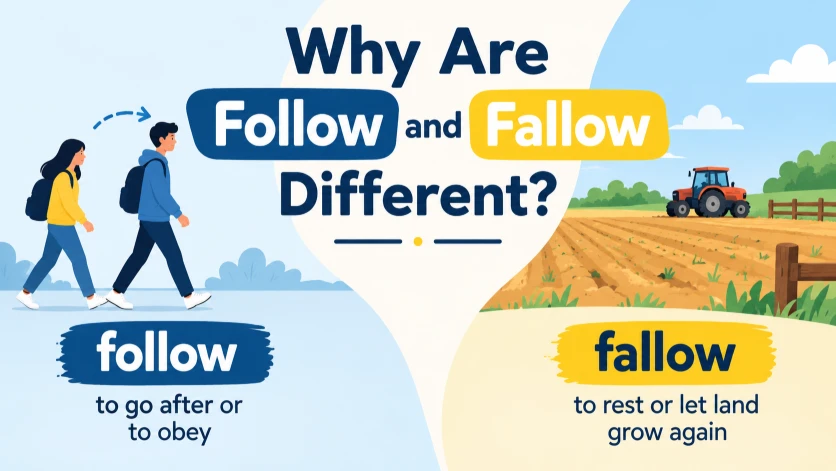
The words developed from different historical roots. Their similar appearance does not mean they share the same meaning.
This is why you should learn them as separate vocabulary words rather than treating one as an alternative spelling of the other.
British English vs American English
There is no spelling difference between follow and fallow in British and American English.
Both regions use the same spellings and meanings. The main differences are in pronunciation and some regional vocabulary.
| Word | British English | American English | Example |
| Follow | Follow | Follow | Follow the road. |
| Fallow | Fallow | Fallow | The field is fallow. |
Regional Pronunciation
The pronunciation of these words can vary slightly between British and American speakers.
- Follow: British pronunciation is commonly /ˈfɒləʊ/, while American pronunciation is /ˈfɑːloʊ/.
- Fallow: British pronunciation is commonly /ˈfæləʊ/, while American pronunciation is /ˈfæloʊ/.
Notice that the first vowel sound is different.
Publishing Preferences
Writers do not need to choose a different spelling based on their audience.
If you write for readers in the United States, United Kingdom, Canada, or Australia, the correct spellings remain:
- Follow
- Fallow
Always focus on the meaning of the sentence rather than the country where your readers live.
Which Version Should You Use?
The choice between follow and fallow does not depend on your location. It depends on what you want to say.
Here is how to use both words in different types of writing.
United States
Use follow when describing an action, instruction, or sequence.
Example:
- Follow the directions to reach the office.
Use fallow when describing farmland or an inactive period.
Example:
- The farmer left the field fallow.
United Kingdom
British English uses both words in the same way as American English.
Examples:
- Follow the safety instructions.
- The land remained fallow for several months.
Canada
Canadian English also uses the standard spellings.
Examples:
- Follow the teacher’s instructions.
- The farmer left the field fallow.
Australia
Australian English follows the same spelling and meaning rules.
Examples:
- Follow the signs to the station.
- The land was left fallow during the season.
International Writing
For international readers, use the word that matches your intended meaning.
Avoid replacing one word with the other simply because their spellings look similar.
Academic Writing
In academic writing, follow is useful when discussing methods, instructions, arguments, or research findings.
Example:
- Researchers followed the same procedure in both experiments.
Fallow is useful in agricultural and environmental studies.
Example:
- The study examined the effects of fallow periods on soil conditions.
Business Writing
Follow is much more common in business communication.
Example:
- Please follow the updated company policy.
Fallow can describe a quiet business period.
Example:
- The company experienced a fallow period before its expansion.
Common Mistakes
Many writers confuse follow and fallow because the words contain similar letters.
However, their meanings are not interchangeable.
Here are some common mistakes and their corrections.
| Incorrect Example | Correct Example | Explanation |
| Please fallow the instructions. | Please follow the instructions. | Instructions are followed, not left unplanted. |
| The farmer followed the field for a year. | The farmer left the field fallow for a year. | Fallow describes unused farmland. |
| I will fallow your advice. | I will follow your advice. | You follow someone’s advice. |
| The land was follow last year. | The land was fallow last year. | Fallow describes land without crops. |
| She asked me to fallow her. | She asked me to follow her. | Follow means to go after someone. |
Why Do People Confuse These Words?
There are several reasons:
- Similar spelling: Both words contain six letters and look almost identical.
- Similar appearance: Their first and last letters are the same.
- Unfamiliar vocabulary: Many people do not use fallow in everyday conversations.
- Typing mistakes: People may choose the wrong word when typing quickly.
An Easy Memory Tip
Use this simple trick:
- Follow = Go after.
- Fallow = Farmland resting.
Think of the word follow as following a person or a path.
Think of fallow as a field that is resting without crops.
This simple connection can help you remember the correct word.
Everyday Examples of Follow and Fallow
The best way to understand the difference is to see both words in real sentences.
Here are examples from different types of communication.
1. Emails
Follow is common in professional emails.
- Please follow the steps listed in the attached document.
- I will follow up with you tomorrow.
- Kindly follow the updated instructions.
Fallow is less common in emails but may appear in agricultural discussions.
- The farm’s northern field will remain fallow this season.
2. Business Writing
Follow is useful when discussing procedures, policies, and plans.
- All employees must follow company guidelines.
- We should follow the agreed marketing strategy.
- The team followed the project schedule.
Fallow can describe a period of limited business activity.
- The company entered a fallow period after losing several major clients.
3. News Headlines
Both words can appear in news stories, but they are used in different contexts.
Examples:
- Local Residents Asked to Follow New Safety Rules
- Farmers Leave Fields Fallow During Dry Season
- New Research Examines the Benefits of Fallow Land
4. Blogs
Follow is common in educational and lifestyle blogs.
- Follow these simple steps to improve your writing.
- Follow our guide to learn basic grammar rules.
Fallow may appear in gardening and farming articles.
- Why Farmers Sometimes Leave Their Fields Fallow
5. Social Media
Follow is especially common on social media.
Examples:
- Follow us for more English grammar tips.
- Follow your favorite creators for daily updates.
- Follow this account for useful writing advice.
Fallow is less common but may appear in educational posts about agriculture.
Example:
- Learn why farmers leave some land fallow.
6. Academic Writing
Both words can be used in academic work, depending on the subject.
Examples using follow:
- Students followed the research instructions.
- The researchers followed a standard testing method.
Examples using fallow:
- The research examined the effects of fallow land.
- Fallow periods may influence soil management practices.
7. Daily Conversation
Follow appears frequently in normal conversations.
Examples:
- Follow me, please.
- I don’t follow what you mean.
- You should follow your dreams.
- Follow the road until you reach the bridge.
Fallow is less common in casual speech.
Example:
- My grandfather used to leave one field fallow each year.
Google Trends and Modern Usage
Follow and fallow serve different purposes in modern English.
Follow is widely used in everyday communication, education, business, entertainment, and social media.
Fallow is more closely connected to farming, gardening, agriculture, and descriptions of inactive periods.
Which Word Is More Common?
Follow is generally much more common in modern everyday English.
There are several reasons:
- People frequently follow instructions.
- Social media users follow accounts and creators.
- Students follow lessons and explanations.
- People follow roads, directions, and advice.
- Businesses follow policies and procedures.
Fallow has a narrower range of common uses, especially in agricultural writing.
Why Do People Search for Follow or Fallow?
People often search for this comparison because:
- The words have similar spellings.
- They may be unsure which word belongs in a sentence.
- English learners may not know the meaning of fallow.
- Spell-check tools may not identify a correctly spelled but incorrectly used word.
- Writers want to avoid mistakes in professional or academic work.
Google Trends and Search Popularity
There is no specific search-volume figure included here to establish an exact popularity difference between these terms.
Based on their general meanings and everyday usage, follow has a much broader range of applications than fallow.
However, both words are useful. The right choice always depends on the context.
Quick Comparison Table
Use this table whenever you need a quick reminder of the difference.
| Version | Meaning | Correct? | Usage | Example |
| Follow | To go after or obey | Yes | Everyday English | Follow the instructions. |
| Fallow | Land left unplanted | Yes | Agriculture | The field is fallow. |
| Follow | To understand something | Yes | Conversation | I don’t follow your point. |
| Fallow | An inactive period | Yes | General writing | It was a fallow period. |
| Fallow the instructions | Incorrect word choice | No | Incorrect usage | Follow the instructions. |
| Follow the field | Incorrect in the intended farming sense | No | Incorrect usage | Leave the field fallow. |
The key difference is simple: follow describes an action, while fallow usually describes land or a period of inactivity.
Key Takeaways
- Follow and fallow are both correct English words.
- Follow is mainly a verb.
- Follow means to go after, obey, understand, or come after something.
- Fallow is mainly an adjective or noun.
- Fallow describes farmland left unplanted for a period.
- Fallow can also describe an inactive or unproductive period.
- British and American English use the same spellings.
- Remember: follow means go after, while fallow means farmland resting.
Frequently Asked Questions
1. What is the difference between follow and fallow?
Follow means to go after someone, obey instructions, or understand something. Fallow describes land that is left without crops for a period. It can also describe an inactive period. Both words are correct, but they have different meanings and cannot normally replace each other.
2. Is follow or fallow the correct spelling?
Both are correct spellings. The right choice depends on your sentence. Use follow when talking about an action, such as following instructions or following someone. Use fallow when describing farmland that is left unplanted or a period of inactivity.
3. What does fallow mean in simple words?
Fallow means land that is not being used to grow crops for a period. Farmers may leave land fallow as part of their soil management practices. The word can also describe a quiet or inactive period when little work or progress takes place.
4. Is follow a verb or a noun?
Follow is mainly used as a verb. It describes actions such as going after someone, obeying instructions, or understanding information. For example, in the sentence “Please follow the rules,” follow is the verb. Its related noun form is following.
5. Can fallow be used as a verb?
Fallow is mainly used as an adjective or noun in modern English. In agricultural contexts, it can also be used as a verb meaning to leave land unplanted for a period. However, this verb use is much less common than the adjective and noun forms.
6. What does leave a field fallow mean?
Leaving a field fallow means not planting crops on that land for a period. Farmers may use this practice as part of soil management. The exact benefits depend on soil type, climate, and farming methods, so leaving land unplanted does not always guarantee improved soil quality.
7. Are follow and fallow pronounced the same?
No. They have different first vowel sounds in standard British and American pronunciations. Follow begins with a sound similar to the vowel in “hot” in many British accents, while fallow begins with the vowel sound in “cat.” Regional accents can affect pronunciation.
8. Is follow the same in British and American English?
Yes. Follow has the same spelling and basic meanings in British and American English. Both varieties also use fallow with the same spelling and meaning. The main differences are in pronunciation and accent, not the spelling of these words.
9. What is a fallow period?
A fallow period is a time when an activity, project, or process is inactive or produces little output. The expression comes from the agricultural use of fallow, which describes land left unplanted. For example, a writer may describe a period without publishing new work as a fallow period.
10. How can I remember follow vs fallow?
Remember this simple rule: follow means to go after someone or something, while fallow describes resting farmland. You follow a person, a road, or instructions. A farmer leaves a field fallow. Linking each word to its main meaning will help you choose correctly.
Conclusion
Understanding follow or fallow is easier when you remember that these words have different meanings.
Follow is a common verb that means to go after someone, obey instructions, understand information, or come after something. Fallow usually describes farmland that is left unplanted for a period. It can also describe an inactive or unproductive time.
Neither word is incorrect. The mistake happens when you use one in place of the other. If you are writing an email, completing schoolwork, preparing a business document, or creating a blog post, always check the meaning of your sentence.
You do not need to change these spellings for British or American readers. Both regions use follow and fallow in the same way.
The easiest way to remember the difference is this: You follow a person, but you leave a field fallow.
Keep this simple rule in mind, and you will find it much easier to use both words correctly. If you found this guide helpful, explore more word comparisons to improve your English.
Read more about!
- VT vs. VOO: Which ETF Is Better for You?
- Extention or Extension: Which Spelling Is Correct?
- Heal or Heel: What’s the Difference?

I’m Olivia Parker, a grammar and English writing enthusiast passionate about making English simple and easy to understand. Through Wordsblog, I share clear explanations, useful grammar tips, and practical writing guidance to help readers write with confidence. My goal is to make learning English easier, one word at a time.