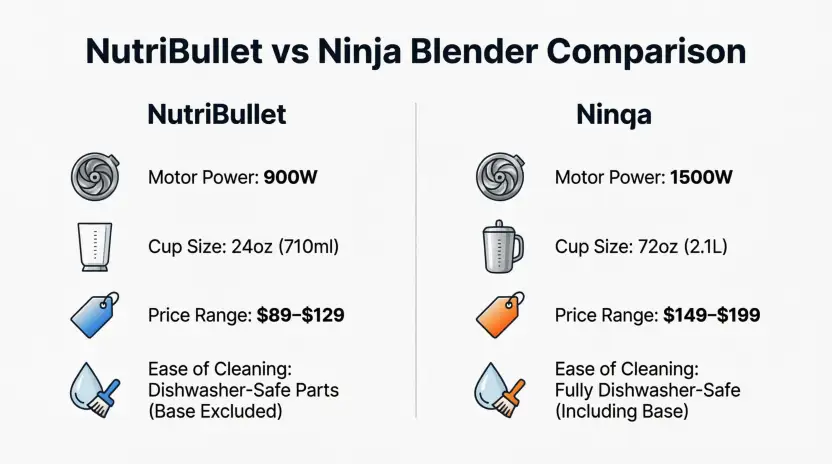
Choosing between NutriBullet or Ninja can be difficult because both brands offer blenders for smoothies, shakes, and everyday kitchen tasks. However, the best choice depends on what you want to make, how often you use a blender, and how much you want to spend.
NutriBullet is well known for its personal blenders, which are popular for quick smoothies and single servings. Ninja offers a wide range of personal and countertop blenders, including models designed for crushing ice, making frozen drinks, and handling larger batches.
So, is NutriBullet better than Ninja, or is Ninja the smarter choice for your kitchen? The answer depends on the specific models you compare. Features, blending performance, cleaning, capacity, and price can vary across both brands.
In this guide, you will learn the main differences between NutriBullet and Ninja, compare their strengths and weaknesses, and discover which brand may suit your needs best. By the end, you will have a clearer idea of what to look for before buying your next blender.
NutriBullet vs Ninja: Quick Answer
Ninja is the better choice for many people who want an all-purpose blender, while NutriBullet is a strong choice for quick, single-serving smoothies. Ninja models often offer more control, ice-crushing ability, and useful attachments. NutriBullet models focus on simple operation, compact designs, and everyday drinks. The best option depends on the exact model, your budget, and how you plan to use it.
NutriBullet or Ninja: Quick Answer
If you are deciding between NutriBullet and Ninja, start by thinking about what you make most often.
Both brands sell personal blenders and larger countertop models. However, their features and performance vary by model.
- Choose NutriBullet for quick smoothies, protein shakes, and simple daily blending.
- Choose Ninja for crushing ice, making frozen drinks, and preparing a wider range of recipes with a suitable model.
- Compare individual models if you want a large pitcher, food-processing attachments, or automatic blending programs.
For example, a NutriBullet personal blender may suit someone who makes one smoothie before work. A Ninja model with a large pitcher may be more useful for a family that prepares frozen drinks and several servings at once.
Neither brand wins every comparison. A powerful personal blender from one brand may perform better than an entry-level model from the other.
The smartest choice is the blender that fits your kitchen, daily routine, and budget.
What Does NutriBullet or Ninja Mean?
NutriBullet and Ninja are two brands that make kitchen appliances, including blenders.
Although people often compare them as if they were single products, each brand offers several models with different features.
What Is NutriBullet?
NutriBullet is known for personal blenders designed to make smoothies, shakes, and other blended drinks.
Many models use a compact motor base and a blending cup. You add your ingredients, attach the blade assembly, and blend directly in the cup.
Some NutriBullet models also offer larger pitchers, automatic blending cycles, and additional functions. For example, the brand’s current US range includes personal blenders, full-size blenders, and combination systems.
Common uses include:
- Fruit and vegetable smoothies
- Protein shakes
- Breakfast drinks
- Salad dressings
- Small batches of sauces and dips
NutriBullet is especially appealing if you want a straightforward way to prepare individual drinks.
What Is Ninja?
Ninja is a kitchen appliance brand with a broad range of blenders and food-preparation systems.
Depending on the model, a Ninja blender may include a large pitcher, personal blending cups, preset programs, or extra attachments.
Some models are designed to crush ice and frozen ingredients. Others combine blending with food processing or offer specialised functions.
Common uses include:
- Smoothies and protein shakes
- Frozen drinks
- Crushed ice
- Sauces and dips
- Nut butter and other thick mixtures, when the model supports them
- Food preparation with compatible attachments
Ninja can be a good fit if you want one appliance to handle several kitchen tasks.
However, not every Ninja blender includes all these functions. Check the product specifications before buying.
The Origin of NutriBullet and Ninja
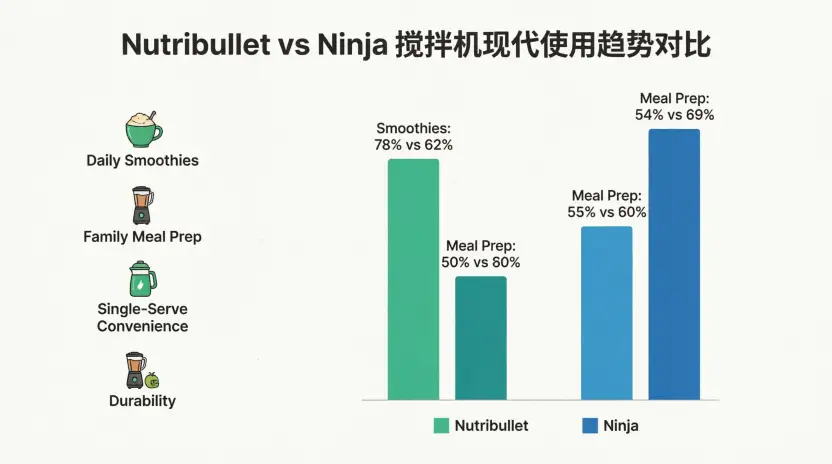
NutriBullet and Ninja are brand names, not alternative spellings of the same word. Their names do not have different meanings in British and American English.
NutriBullet is associated with personal blending and nutrient-focused drinks. Its product range has expanded to include larger countertop blenders and combination systems.
Ninja has developed a broader range of kitchen appliances, including personal blenders, full-size blenders, and food-processing products.
This difference in product focus helps explain why shoppers often associate NutriBullet with smoothies and Ninja with versatility.
There is no spelling rule that makes one name more correct than the other. Both names are correct when referring to the relevant brand.
When writing an article, product review, or buying guide, use the official brand spelling NutriBullet or nutribullet, as styled by the relevant market, and Ninja.
Avoid changing the names to forms such as “Nutri Bullet” or “Ninja Blender” when the exact brand name matters. “Ninja blender” is a normal product description, but Ninja alone is the brand name.
British English vs American English
NutriBullet and Ninja are brand names, so the main difference is not British versus American spelling. The important differences are product availability, model names, electrical specifications, prices, and warranty terms.
| British English context | American English context | Example |
| NutriBullet personal blender | NutriBullet personal blender | A blender for one serving |
| Ninja blender | Ninja blender | A countertop blender for family use |
| Price in pounds (£) | Price in dollars ($) | Compare local prices |
| UK plug and voltage specifications | US plug and voltage specifications | Check compatibility before buying |
| UK warranty and returns terms | US warranty and returns terms | Read the local policy |
| Product capacity may be listed in ml or litres | Product capacity may be listed in fl oz or cups | Compare equivalent capacities |
Regional differences
United Kingdom: Check the model sold for the UK market. Confirm that it has the correct plug, electrical rating, and warranty.
United States: Compare the available models, included accessories, and current prices in dollars. Do not assume that a US model has the same specifications as its UK counterpart.
Canada and Australia: Check local availability, electrical requirements, accessories, and warranty coverage.
International writing: Use the official brand names and explain technical differences in standard terms.
A model with a similar name may have different accessories or specifications in another country. Compare the exact product number rather than relying on the brand name alone.
Which Version Should You Use?
The best choice depends on where you live and what you need from a blender.
United States
Both brands offer options for different budgets and blending needs.
Choose NutriBullet if you mainly make individual smoothies and want a simple appliance. Consider Ninja if you need ice crushing, a larger pitcher, or additional food-preparation functions.
Compare current prices and included accessories rather than assuming one brand is always cheaper.
United Kingdom
UK shoppers should compare models available from the official UK stores and trusted local retailers.
NutriBullet personal blenders are worth considering for single-serving drinks. Ninja may be more suitable if you want a larger blender or a system with extra attachments.
Check the capacity in millilitres or litres, the product dimensions, and the warranty offered in the UK.
Canada
Look for models sold specifically for the Canadian market. Check the voltage rating, plug type, local warranty, and replacement-part availability.
Your choice should depend on the recipes you prepare and the features included in the exact model.
Australia
Choose a locally supported model with the correct electrical specifications and warranty.
If you prepare smoothies for one person, a personal blender may be enough. For frozen drinks, family portions, or several kitchen tasks, compare suitable Ninja and NutriBullet countertop systems.
International writing
When recommending either brand to an international audience, avoid suggesting that every model is available worldwide.
Use the exact product name and explain any market-specific limitations. Include measurements in familiar units when practical.
Academic writing
For a school assignment, research project, or formal product comparison, use the official product pages for specifications.
Separate measurable facts, such as motor power and capacity, from opinions about convenience or value. Cite independent testing when discussing comparative performance.
Do not claim that one brand is scientifically superior at preserving nutrients unless you have reliable evidence supporting that specific claim.
Business writing
For buying guides, retail content, and professional product reviews, keep the comparison clear and evidence-based.
Discuss the intended use, capacity, cleaning requirements, accessories, warranty, and price. If you recommend a particular model, explain why it fits the reader’s needs.
Avoid statements such as “Ninja is always better” or “NutriBullet is the healthiest blender.” Neither claim applies to every model.
NutriBullet vs Ninja: Main Differences
The biggest differences usually involve convenience, ice crushing, capacity, controls, cleaning, and versatility.
Independent testing by RTINGS has found strengths for both brands. Its comparison generally favours Ninja for ice crushing and dishwasher-safe blade assemblies on tested personal models, while NutriBullet can appeal to users who prefer simpler hand-cleaning and quieter operation. Results vary by model.\
1. Blending performance
NutriBullet personal blenders are designed around everyday drinks. They can be a good choice for fruit smoothies, protein shakes, and blends containing vegetables.
Ninja also makes personal blenders, but some models offer extra control or programs that make them useful for a broader range of tasks.
The result depends on the motor, blade design, container shape, ingredient quantity, and recipe.
2. Ice crushing
If you often make slushies, frozen cocktails, or drinks with crushed ice, a suitable Ninja model may be the better option.
Many NutriBullet personal blenders can handle ice as part of a smoothie recipe when used according to the manual. However, some are not designed to crush ice on its own.
Always check the instructions for your specific model. Adding enough liquid and following the recommended loading order can also make a difference.
3. Ease of use
NutriBullet often appeals to people who want a simple blending process.
Many personal models use a cup-and-blade setup with straightforward controls. Some newer models also include automatic blending cycles.
Ninja offers simple models too, along with machines that have buttons, presets, and more advanced functions.
Choose the controls that suit your routine. More features are useful only if you actually need them.
4. Cleaning
Cleaning can be an important part of everyday use.
Some NutriBullet designs have blade assemblies that are relatively straightforward to clean by hand. Certain Ninja models have removable blade assemblies or dishwasher-safe components, but the details vary.
Never handle sharp blades carelessly. Follow the manufacturer’s cleaning instructions and unplug the machine before cleaning the motor base.
Check whether the cups, lids, and blades are dishwasher-safe before buying.
5. Capacity and versatility
A personal blender is ideal for one drink at a time. A full-size pitcher is more practical for family servings, sauces, and larger recipes.
Ninja offers systems with various attachments for blending and food preparation. NutriBullet also offers full-size and combination models.
Do not compare a personal NutriBullet directly with a large Ninja system without considering their different purposes.
6. Noise
Both brands make motorised appliances, so neither should be assumed to operate silently.
Noise varies with the model, ingredients, speed, and amount being blended. Independent tests have found some NutriBullet models quieter than some Ninja models, but this is not a universal rule.If noise matters, look for a test of the exact model you intend to buy.
7. Price and value
The cheapest model is not always the best value.
A personal blender may cost less because it includes fewer accessories and has a smaller capacity. A larger system may cost more because it includes a pitcher, extra cups, or food-processing attachments.
Compare the complete package, including replacement parts and warranty coverage. Current prices can change with sales and location.
Common Mistakes
Shoppers often make avoidable mistakes when comparing NutriBullet and Ninja. Use these examples to make a better decision.
| Incorrect assumption | Correct understanding | Why it matters |
| Every Ninja is better than every NutriBullet. | Performance varies by model. | Compare the exact products. |
| Every NutriBullet is only for smoothies. | Some models support more tasks. | Check the functions offered. |
| Any blender can crush ice without liquid. | Ice-crushing ability depends on the model. | Follow the manual to avoid damage. |
| A higher wattage always means a better blender. | Power is only one part of performance. | Blade design and container shape also matter. |
| All accessories are dishwasher-safe. | Cleaning instructions vary by product. | Check the user manual. |
| The same model has identical features worldwide. | Regional versions can differ. | Check the local product listing. |
| More attachments always mean better value. | Extra parts help only if you use them. | Match the package to your needs. |
Memory tip
Remember this simple rule: choose by task, not by brand name alone.
If you mainly make one smoothie each morning, start with personal blenders. If you often crush ice, make large batches, or prepare several kinds of food, compare full-size systems and their attachments.
Everyday Examples
The following examples show how to apply the comparison to real buying decisions.
1. Making a morning smoothie
You blend banana, berries, yoghurt, and milk before work.
A NutriBullet personal blender may suit you because it is designed for quick, single-serving drinks. A Ninja personal blender can also do the job.
Practical choice: Compare cup size, cleaning, and ease of use.
2. Preparing protein shakes
You mix protein powder, milk, and fruit after a workout.
Either brand may be suitable. You probably do not need a large pitcher or several attachments for this task.
Practical choice: Focus on serving size, portability, and how easily the cup can be cleaned.
3. Crushing ice for frozen drinks
You regularly make drinks with crushed ice or frozen ingredients.
A Ninja model specifically designed for ice crushing may be more suitable than a NutriBullet model that does not support this task.
Practical choice: Check the instructions for crushing ice, not just the motor wattage.
4. Cooking for a family
You make smoothies for several people or prepare larger batches of sauces.
A full-size blender may save time because you can blend several servings at once. Both brands offer models with larger containers.
Practical choice: Compare usable capacity, not just the size of the machine.
5. Preparing dips and sauces
You make salsa, dressings, or small batches of dips.
Both brands have models that can handle some of these tasks. The right choice depends on whether you need a personal cup, a pitcher, or a dedicated food-processing attachment.
Practical choice: Check the supported recipes and recommended ingredient quantities.
6. Writing a product review
You are comparing the brands for a website or buying guide.
Avoid saying that one brand is best for everyone. Describe the model tested, the recipe used, and the result.
Practical choice: Separate product specifications from your personal opinion.
7. Buying a blender as a gift
You are shopping for someone who lives alone and makes daily smoothies.
A compact personal blender may be more useful than a large kitchen system. However, if the person cooks often, a larger model may offer better value.
Practical choice: Consider the recipient’s kitchen space and usual recipes.
Google Trends and Modern Usage
People search for “NutriBullet or Ninja” because they want to compare two familiar blender brands before spending money.
The search usually reflects a buying decision rather than a spelling or grammar question. Readers want to know which brand makes better smoothies, which blender handles ice, which is easier to clean, and which offers better value.
Regional popularity
Search interest can vary by country and over time. Product availability, advertising, seasonal shopping, and local retail offers can all affect what people search for.
However, without a verified comparison of Google Trends data for a defined period and region, it would be misleading to claim that either brand receives more searches.
You can compare both terms using Google Trends. Select the same country, time range, and search category to make the comparison more useful. Google also notes that Trends provides relative search-interest data, not a direct count of total searches.
Trends Help
Why do people search for NutriBullet or Ninja?
Common reasons include:
- Deciding which blender to buy for smoothies.
- Comparing personal blenders with countertop models.
- Checking which brand handles ice and frozen fruit.
- Looking for easier cleaning and better everyday convenience.
- Comparing prices, warranties, and included accessories.
- Reading reviews before choosing a particular model.
What does modern usage tell us?
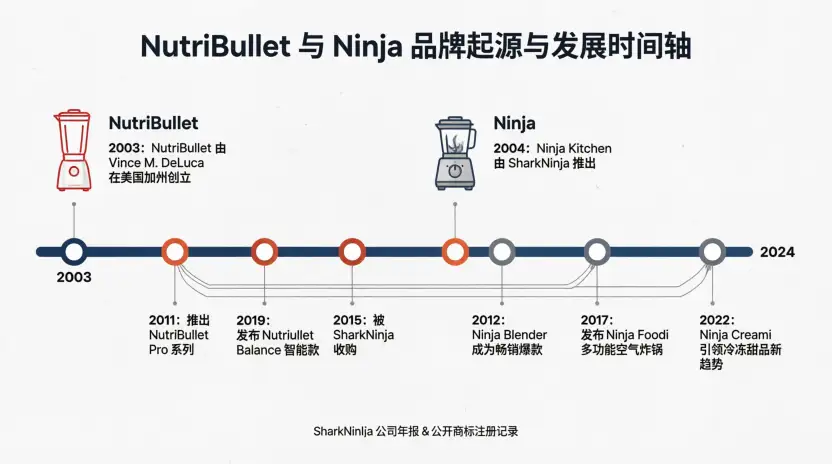
The comparison is useful because neither brand serves only one type of customer.
NutriBullet offers personal and full-size blenders, while Ninja sells personal blenders, larger pitcher models, and multi-function systems. Both brands therefore compete across several types of kitchen use.
For a reliable buying guide, compare individual models and use recent testing where possible. Avoid relying on search popularity as proof of product quality.
Quick Comparison Table: NutriBullet vs Ninja
| Feature | NutriBullet | Ninja |
| Main appeal | Simple everyday blending | Versatile blending options |
| Personal smoothies | Very suitable | Very suitable |
| Protein shakes | Suitable | Suitable |
| Ice crushing | Depends on the model; some have restrictions | Many models are designed for ice crushing |
| Large batches | Available on selected models | Available on selected models |
| Automatic programs | Available on selected models | Available on selected models |
| Food-processing attachments | Available on selected systems | Available on selected systems |
| Cleaning | Varies by model and component | Varies by model and component |
| Noise | Varies by model | Varies by model |
| Best buying approach | Start with your daily blending needs | Start with your desired features and recipes |
The table describes general product ranges, not every model. Always check the manufacturer’s instructions and specifications before making a purchase.
Key Takeaways
- NutriBullet and Ninja are both established blender brands.
- NutriBullet is a strong option for simple, everyday smoothies and single servings.
- Ninja is worth considering if you need ice crushing, larger batches, or additional attachments.
- Neither brand is automatically better for every recipe or household.
- Motor power alone does not determine blending performance.
- Cleaning, noise, capacity, and ease of use can matter as much as power.
- Compare the exact model, accessories, warranty, and local price before buying.
FAQs: NutriBullet or Ninja?
1. Is NutriBullet better than Ninja?
NutriBullet may be better for people who mainly make individual smoothies and want a simple appliance. Ninja may be better for those who want ice-crushing features, larger pitchers, or extra attachments. Neither brand is best for everyone. Compare the specific models, because their performance, cleaning requirements, and included features can differ.
2. Is Ninja more powerful than NutriBullet?
Not always. Both brands sell models with different motor ratings and designs. A higher wattage does not automatically guarantee a smoother blend or better results with every ingredient. Check the motor rating alongside independent performance tests, blade design, container capacity, and the recipes the blender is intended to handle.
3. Which is better for smoothies, NutriBullet or Ninja?
Both brands make blenders that work well for smoothies. NutriBullet personal blenders are convenient for single servings, while Ninja offers personal and countertop models with different features. Your choice depends on the ingredients, serving size, and texture you prefer. If possible, compare test results for the exact models you are considering.
4. Can NutriBullet crush ice?
Some NutriBullet models can handle ice as part of a smoothie when used according to their instructions, but not every model is designed to crush ice on its own. Check the user manual before adding ice. If you frequently make crushed-ice drinks, consider a model specifically designed for that purpose.
5. Is Ninja better for crushing ice?
Many Ninja blenders are designed to crush ice and prepare frozen drinks. However, capabilities vary by model, so check the manufacturer’s instructions before buying. Consider whether you need crushed ice, frozen fruit smoothies, or both. These tasks can place different demands on a blender.
6. Which blender is easier to clean?
The answer depends on the model and its components. Some NutriBullet designs are convenient to wash by hand, while selected Ninja models have dishwasher-safe blade assemblies. Always check the product manual. Never handle sharp blades carelessly, and keep the motor base away from water.
7. Which brand is quieter, NutriBullet or Ninja?
Some tested NutriBullet models are quieter than some Ninja models, but there is no universal winner. Noise depends on the motor, blade design, ingredients, and blending speed. If a quiet kitchen is important to you, look for independent noise tests of the exact model rather than relying on brand reputation.
8. Is NutriBullet cheaper than Ninja?
It depends on the models and current offers. A basic personal blender may cost less than a multi-function countertop system, but the comparison is not always between similar products. Compare the total price, included cups and attachments, replacement parts, warranty, and expected use before deciding which offers better value.
9. Which blender lasts longer, NutriBullet or Ninja?
Neither brand can be guaranteed to last longer in every case. Product lifespan depends on the model, frequency of use, care, and how closely you follow the instructions. Check the warranty, replacement-part availability, and credible long-term reviews. Avoid treating a single customer’s experience as proof that an entire brand is more durable.
10. Should I buy NutriBullet or Ninja for everyday use?
Choose NutriBullet if you mainly want quick, single-serving smoothies and simple blending. Consider Ninja if you need features such as ice crushing, a large pitcher, or food-processing attachments. Before buying, list your three most common recipes and choose a model that handles all three safely and conveniently.
Conclusion: NutriBullet or Ninja?
Choosing between NutriBullet and Ninja comes down to how you use a blender. Both brands make models that can prepare smoothies, shakes, and other blended recipes, but their features and strengths vary.
NutriBullet is a sensible starting point if you want a compact appliance for everyday smoothies, protein shakes, and individual servings. Ninja is worth a closer look if you want more versatility, regular ice crushing, larger batches, or a system with extra kitchen attachments.
Still, the brand name alone should not make the decision for you. A well-suited personal blender can be more useful than a larger, more powerful machine that takes up space and offers features you never use.
Before buying, compare the exact model’s capacity, motor rating, cleaning instructions, warranty, and current price. Read independent reviews that test the tasks you actually plan to perform.
The final recommendation: Choose NutriBullet for straightforward daily blending or Ninja for a model that offers the specific extra features you need. If you compare the products fairly, you are more likely to find the right blender for your kitchen.
If this guide helped you, explore more practical product comparisons on Wordsblog.
Read more about!
- SMS or RCS: What’s the Difference?
- Titled or Entitled: Which Word Should You Use?
- Bike or Bar: Meaning, Difference & Correct Use

I’m Olivia Parker, a grammar and English writing enthusiast passionate about making English simple and easy to understand. Through Wordsblog, I share clear explanations, useful grammar tips, and practical writing guidance to help readers write with confidence. My goal is to make learning English easier, one word at a time.





1 thought on “NutriBullet or Ninja: Which Blender Is Better?”