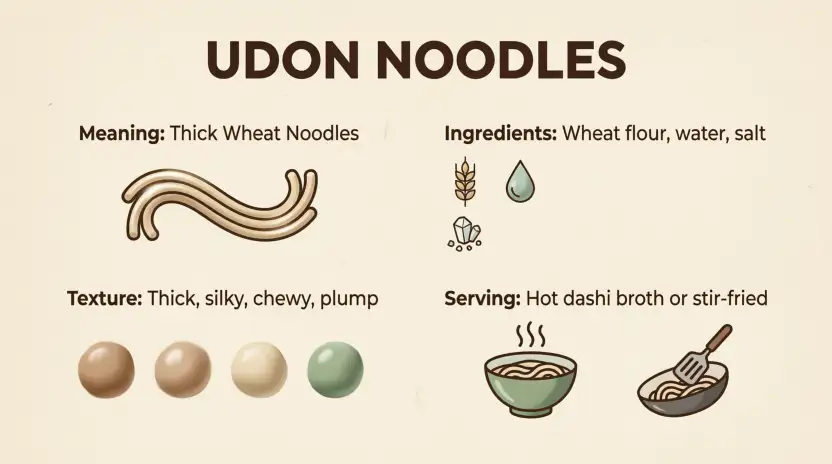
When choosing between soba or udon, the main difference is simple: soba noodles are thin, usually made with buckwheat, while udon noodles are thick, soft, and made mainly from wheat flour. Both are traditional Japanese noodles, but they differ in texture, flavor, ingredients, and the dishes they are used in.
People often search for soba or udon because both noodles appear on Japanese menus and can be served in similar ways, especially in hot broths or with dipping sauces. The names can be confusing if you have never tried them before.
Soba has a firmer, slightly earthy taste because of buckwheat. Udon is mild, chewy, and pleasantly soft. Your choice depends on the texture and flavor you prefer, as well as the dish you are ordering.
This guide explains the difference between soba and udon, where each noodle comes from, how they are used, and which one may be better for different meals.
Soba or Udon: Quick Answer
If you need the answer quickly, use this simple comparison:
- Soba: Thin Japanese noodles traditionally made with buckwheat flour.
- Udon: Thick Japanese noodles made mainly from wheat flour.
- Soba texture: Firm, delicate, and slightly springy.
- Udon texture: Thick, soft, and chewy.
- Soba flavor: Earthy and slightly nutty.
- Udon flavor: Mild and neutral.
- Both: Can be served hot, cold, in broth, or with dipping sauces.
Which should you choose?
Choose soba if you like a thinner noodle with a more distinct, earthy flavor.
Choose udon if you prefer thick, soft, chewy noodles that absorb the flavor of a broth or sauce.
There is no universally better option. The best choice depends on your taste and the dish you want.
What Does Soba or Udon Mean?
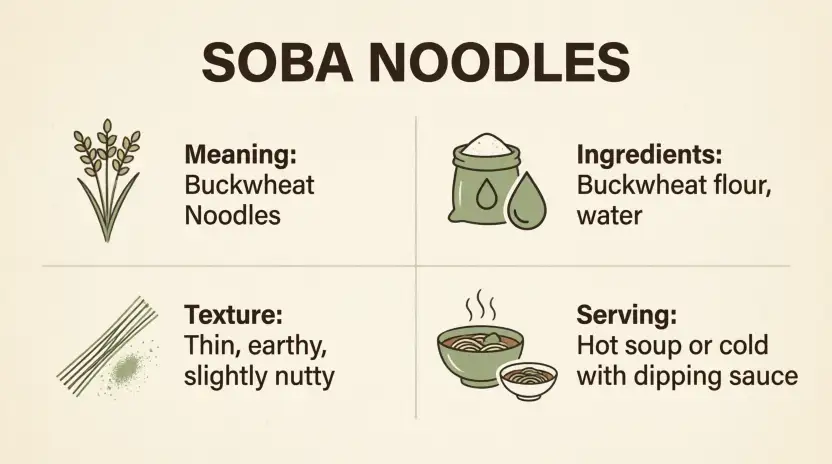
Soba and udon are names for two different types of Japanese noodles.
What is soba?
Soba is a traditional Japanese noodle made with buckwheat flour. Depending on the variety, wheat flour may also be used.
Soba noodles are usually thin and have a firm texture. They are commonly served either chilled with a dipping sauce or in a hot broth.
Their buckwheat content gives them a distinctive flavor that is more noticeable than the mild taste of udon.
What is udon?
Udon is a thick Japanese noodle made mainly from wheat flour, water, and salt.
The noodles are usually white or off-white and have a thick, chewy texture. Udon is often served in a flavorful broth, but it can also be served cold with a dipping sauce or in stir-fried dishes.
Soba vs. udon in simple terms
Think of the difference this way:
Soba = thin, firm, earthy
Udon = thick, soft, chewy
That simple distinction can help you remember which noodle is which.zzzzzz
Soba and udon both have long histories in Japanese food culture, but their ingredients and culinary traditions developed differently.
Soba
The word soba is associated with buckwheat and buckwheat noodles in Japanese cuisine. Buckwheat has been cultivated and eaten in Japan for centuries.
Soba became an important food partly because buckwheat can grow in conditions where some other crops are less suitable. Over time, noodle-making techniques developed, creating the soba dishes commonly enjoyed today.
Soba is now strongly associated with Japanese cuisine and is served in many forms, including hot noodle soups and chilled noodles with dipping sauce.
Udon
Udon is another traditional Japanese noodle with a long culinary history. It is made mainly from wheat flour and is known for its thick, chewy form.
The exact historical development of udon is complex, and claims about its earliest origins vary. It is safer to describe udon as a long-established part of Japanese noodle culture rather than assign its invention to one specific person or event.
Today, different regions of Japan have their own udon traditions and preparations.
British English vs American English
Unlike spelling questions such as colour vs. color, soba and udon are food names rather than British and American spelling variants.
Therefore, the terms do not change between British and American English.
| Variety | Term Used | Example |
| British English | Soba / Udon | I ordered soba noodles. |
| American English | Soba / Udon | I ordered udon noodles. |
| Canadian English | Soba / Udon | We had udon for lunch. |
| Australian English | Soba / Udon | She prefers cold soba. |
| International English | Soba / Udon | Soba is often served chilled. |
The important distinction is not regional spelling. It is the type of noodle being described.
Which Version Should You Use?
Because soba and udon are different foods, you should choose the word that matches the noodle you mean.
United States
Use soba for thin buckwheat noodles and udon for thick wheat noodles.
Both terms are familiar in Japanese restaurants and food writing.
United Kingdom
The same distinction applies in British English. Use soba and udon according to the type of noodle.
Canada
Canadian English follows the same general usage. Both terms can be used without changing their spelling.
Australia
Australian English also uses soba and udon for these Japanese noodles.
International writing
For an international audience, briefly explain the difference if your readers may not know Japanese food terminology.
For example:
Soba are thin buckwheat noodles, while udon are thick wheat noodles.
That makes the meaning clear without assuming specialist knowledge.
Academic writing
If you are writing about Japanese food, culture, or history, use the established terms soba and udon. Define them the first time they appear if your audience may not know them.
Business writing
Menus, restaurant descriptions, food websites, and product descriptions should use the correct noodle name.
Calling udon “soba” can mislead customers because the noodles have different ingredients and textures.
Common Mistakes
People who are unfamiliar with Japanese noodles often confuse soba and udon. Here are some common mistakes.
| Incorrect Example | Correct Example | Explanation | Memory Tip |
| Udon is the thin noodle. | Soba is usually the thin noodle. | Udon is thick. | Udon = thick |
| Soba is always made entirely from wheat. | Soba is traditionally associated with buckwheat. | Soba gets its name from its buckwheat tradition. | Soba = buckwheat |
| Soba and udon are the same noodle. | Soba and udon are different noodles. | Their ingredients and textures differ. | Different names, different noodles |
| Udon always comes with soup. | Udon can be served in different ways. | It can be hot, cold, or prepared in other dishes. | Udon is versatile |
| Soba is always served hot. | Soba can be hot or cold. | Chilled soba is a common preparation. | Soba works both ways |
Easy memory trick
Remember:
Soba = slender
Udon = unusually thick
The first letters are different, but the visual contrast is even easier to remember: thin soba, thick udon.
Everyday Examples
The words soba and udon appear in many everyday food situations.
In emails
The restaurant offers both soba and udon noodles.
In business writing
Our menu includes chilled soba and several traditional udon dishes.
In news headlines
Japanese Soba and Udon Gain Popularity Worldwide
In blogs
If you enjoy light, firm noodles, soba may be worth trying.
On social media
Cold soba on a hot day is hard to beat!
In academic writing
Soba and udon represent two distinct noodle traditions within Japanese cuisine.
In daily conversation
A: Should I get soba or udon?
B: Try udon if you want something thick and chewy.
On a restaurant menu
You might see descriptions such as:
- Cold soba with dipping sauce
- Tempura soba
- Kitsune udon
- Curry udon
- Cold udon
- Stir-fried udon
The preparation can vary, so the noodle name alone does not tell you everything about the finished dish.
Google Trends & Modern Usage
Searches for soba or udon usually reflect food-related curiosity rather than a spelling problem. People may encounter both terms on restaurant menus, cooking websites, travel guides, or social media.
The terms are also increasingly familiar to international audiences because Japanese cuisine is widely available outside Japan.
Search interest can be driven by questions such as:
- What is the difference between soba and udon?
- Is soba healthier than udon?
- Which tastes better, soba or udon?
- What is soba made from?
- What is udon made from?
- Is soba served hot or cold?
- What should I order at a Japanese restaurant?
Exact popularity can vary by country and time. Without a specific Google Trends dataset and date range, it would be misleading to claim that one term is searched more often than the other.
The key modern usage point is simple: both “soba” and “udon” are established food terms, and neither is an alternative spelling of the other.
Quick Comparison Table
| Version | Meaning | Correct? | Region | Example |
| Soba | Japanese noodle traditionally associated with buckwheat | Yes | Worldwide | I ordered cold soba. |
| Udon | Thick Japanese wheat noodle | Yes | Worldwide | She ordered udon soup. |
| Soba for a thick wheat noodle | Incorrect usage | No | All regions | ❌ This udon is soba. |
| Udon for a thin buckwheat noodle | Incorrect usage | No | All regions | ❌ This soba is udon. |
A second useful comparison:
| Feature | Soba | Udon |
| Main traditional ingredient | Buckwheat | Wheat flour |
| Shape | Thin | Thick |
| Texture | Firm and delicate | Soft and chewy |
| Flavor | Earthy, slightly nutty | Mild and neutral |
| Served hot | Yes | Yes |
| Served cold | Yes | Yes |
| Common with dipping sauce | Yes | Yes |
| Common in soup | Yes | Yes |
Key Takeaways
- Soba and udon are different Japanese noodles.
- Soba is usually thin and traditionally made with buckwheat.
- Udon is thick and made mainly from wheat flour.
- Soba has a more distinctive, earthy flavor.
- Udon has a mild flavor and chewy texture.
- Both can be served hot or cold.
- The terms do not change between British and American English.
- Choose soba for a thinner, firmer noodle and udon for a thicker, chewier noodle.
FAQs
1. What is the main difference between soba and udon?
The main difference is the noodle itself. Soba is thin and traditionally associated with buckwheat, while udon is thick and made mainly from wheat flour. Soba usually has a firmer texture and more noticeable earthy flavor. Udon is softer, chewier, and milder in taste.
2. Is soba healthier than udon?
Neither noodle is automatically healthier in every situation. Soba can contain buckwheat, while udon is mainly made from wheat flour. The nutritional value also depends on the specific noodles, portion size, broth, toppings, and other ingredients in the meal. Check the specific dish if nutrition is important to you.
3. Which tastes better, soba or udon?
Taste is personal. Soba is a good choice if you enjoy a more distinct, earthy flavor and a firmer noodle. Udon is better suited to people who prefer thick, chewy noodles with a mild flavor that works well with flavorful broths and sauces.
4. Is soba always made from buckwheat?
Soba is traditionally associated with buckwheat, but not every soba product has the same buckwheat-to-wheat ratio. Some varieties contain wheat flour along with buckwheat flour. If you need to avoid wheat or gluten, check the specific product or restaurant preparation rather than assuming all soba is wheat-free.
5. Is udon thicker than soba?
Yes. Udon is characteristically thick, while soba is generally much thinner. This difference is one of the easiest ways to identify them. If you see long, thick, white noodles, they are likely udon. Thin noodles with a darker, more earthy appearance are more likely to be soba.
6. Can you eat soba cold?
Yes. Cold soba is a well-known way to serve these noodles. Chilled soba may be served with a separate dipping sauce, allowing you to dip the noodles before eating them. This preparation can be especially appealing in warm weather.
7. Can udon be eaten cold?
Yes. Udon is not limited to hot noodle soup. It can also be served chilled or cold, depending on the dish. Cold udon may be paired with a dipping sauce or other ingredients. The thick, chewy texture remains one of its defining characteristics.
8. Which is better for soup, soba or udon?
Both work well in soup, so the choice depends on what you like. Udon is ideal if you want a thick, chewy noodle that makes the dish feel substantial. Soba offers a thinner noodle with a more noticeable buckwheat flavor and a lighter texture.
9. Are soba and udon the same thing?
No. Soba and udon are separate types of Japanese noodles. They differ in their traditional ingredients, thickness, texture, and flavor. They can both appear in soups, cold dishes, and meals with dipping sauces, which is one reason people sometimes confuse them.
10. Should I order soba or udon at a Japanese restaurant?
Choose soba if you want thin, firm noodles with a more distinctive flavor. Choose udon if you prefer thick, soft, chewy noodles with a mild taste. If you are unsure, ask the restaurant about the preparation because toppings, sauces, and broths can change the overall dish.
Conclusion
When comparing soba or udon, the easiest thing to remember is that they are two different Japanese noodle types. Soba is generally thin and traditionally associated with buckwheat, while udon is thick and made mainly from wheat flour.
Their textures are also different. Soba tends to be firmer with a more noticeable earthy flavor, while udon is soft, chewy, and mild. Both can be served hot or cold, and both work with soups, sauces, and a range of toppings.
There is no single winner between soba and udon. If you enjoy thin noodles and a distinctive flavor, soba is a strong choice. If you prefer thick, chewy noodles with a neutral taste, udon may be better for you.
For writers and food websites, the most important rule is simple: do not use “soba” and “udon” as interchangeable terms. They describe different noodles.
Remember: soba is thin and buckwheat-based, while udon is thick and chewy.
Read more about!
- Triple or Tripple: Which Spelling Is Correct?
- Trailor or Trailer: Which Spelling Is Correct?
- Mucinex or Robitussin: Which Is Better?

I’m Olivia Parker, a grammar and English writing enthusiast passionate about making English simple and easy to understand. Through Wordsblog, I share clear explanations, useful grammar tips, and practical writing guidance to help readers write with confidence. My goal is to make learning English easier, one word at a time.