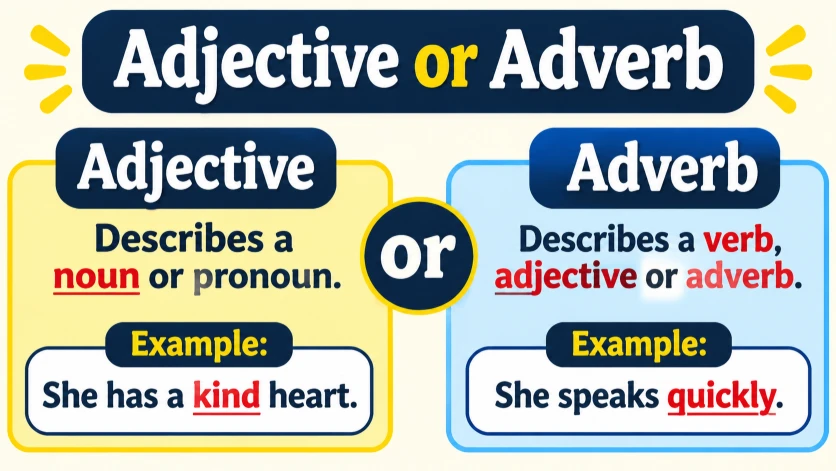
Adjectives and adverbs both describe other words, but they do different jobs in a sentence. An adjective describes a noun or pronoun, while an adverb describes a verb, adjective, or another adverb.
For example, in “She is a careful driver,” the word “careful” is an adjective because it describes the noun “driver.” In “She drives carefully,” the word “carefully” is an adverb because it explains how she drives.
People often confuse adjectives and adverbs because some words look similar, and many adverbs are formed by adding -ly to adjectives. However, not every word ending in -ly is an adverb, and not every adverb ends in -ly.
Understanding the difference helps you write clearer sentences, avoid common grammar mistakes, and choose the correct word in everyday English. This guide explains their meanings, uses, examples, and differences in simple language.
Quick Answer: Adjective vs. Adverb
- Adjective: Describes a noun or pronoun.
- Adverb: Describes a verb, adjective, or another adverb.
- Example: She is a quick learner. She learns quickly.
The easiest way to remember the difference is that adjectives describe people, places, things, or ideas, while adverbs explain how, when, where, or how often something happens.
What Is an Adjective?
An adjective is a word that describes or gives more information about a noun or pronoun. It helps readers understand what someone or something looks, feels, sounds, or seems like.
Adjectives can describe qualities such as size, color, shape, age, appearance, and condition.
Examples of adjectives:
- Beautiful
- Tall
- Small
- Happy
- Cold
- Intelligent
- Difficult
- Bright
Example sentences:
- She lives in a beautiful house.
- The tall man is my teacher.
- I bought a new phone.
- The soup is hot.
- He is a friendly person.
In these examples, the adjectives describe nouns or pronouns.
Types of Adjectives
Adjectives can serve different purposes in a sentence.
| Type | Example | Sentence |
| Descriptive | Beautiful | She has a beautiful garden. |
| Quantitative | Some | I need some water. |
| Demonstrative | This | This book is interesting. |
| Possessive | My | My brother is helpful. |
| Interrogative | Which | Which color do you prefer? |
| Proper | American | She enjoys American literature. |
What Is an Adverb?
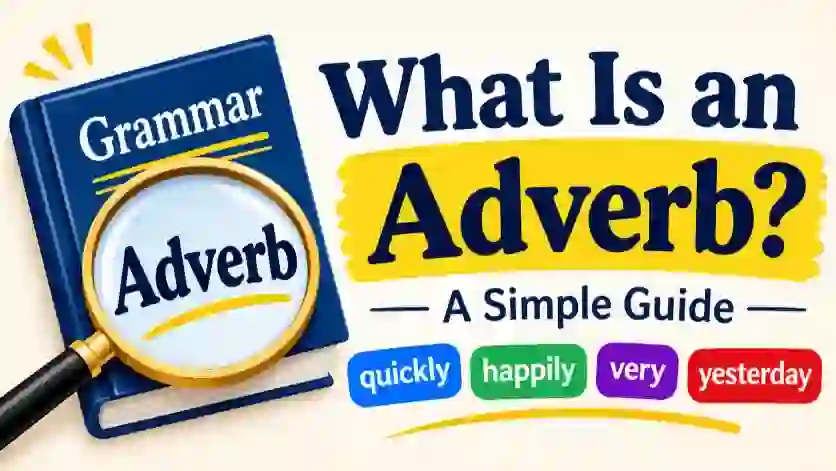
An adverb is a word that modifies a verb, an adjective, or another adverb. It provides extra information about an action or description.
Adverbs commonly answer these questions:
- How? She speaks clearly.
- When? He arrived yesterday.
- Where? Please sit here.
- How often? I exercise regularly.
- To what extent? The water is extremely cold.
Examples of adverbs:
- Quickly
- Slowly
- Carefully
- Happily
- Often
- Yesterday
- Here
- Very
- Almost
Example sentences:
- She sings beautifully.
- He drives carefully.
- They arrived early.
- I always drink water.
- The movie was extremely interesting.
In these sentences, the adverbs add information about actions or descriptions.
Types of Adverbs
| Type | What It Describes | Example |
| Manner | How something happens | She works carefully. |
| Time | When something happens | He arrived yesterday. |
| Place | Where something happens | Come inside. |
| Frequency | How often something happens | I rarely travel. |
| Degree | How much or to what extent | It is very cold. |
Adjective vs. Adverb: Key Differences
Although adjectives and adverbs both add information, they modify different parts of a sentence.
| Feature | Adjective | Adverb |
| Main purpose | Describes a noun or pronoun | Modifies a verb, adjective, or adverb |
| Common question | What kind? Which one? | How? When? Where? How often? |
| Example | Quick | Quickly |
| Sentence | He is a quick runner. | He runs quickly. |
| Common ending | No fixed ending | Often ends in -ly |
| Modifies | Nouns and pronouns | Verbs, adjectives, and adverbs |
Remember: An adjective describes a person or thing, while an adverb often describes how an action happens.
How to Form Adverbs from Adjectives
Many adverbs are formed by adding -ly to an adjective. However, spelling changes can happen.
| Adjective | Adverb |
| Quick | Quickly |
| Slow | Slowly |
| Careful | Carefully |
| Happy | Happily |
| Easy | Easily |
| Gentle | Gently |
| Beautiful | Beautifully |
| Quiet | Quietly |
Common Spelling Rules
1. Add -ly
For many adjectives, simply add -ly.
- Careful → Carefully
- Beautiful → Beautifully
- Slow → Slowly
2. Change -y to -ily
When an adjective ends in a consonant followed by y, change the y to i before adding -ly.
- Happy → Happily
- Easy → Easily
- Angry → Angrily
3. Some words do not change
Some words have the same form as adjectives and adverbs.
- Fast → Fast
- Hard → Hard
- Early → Early
- Late → Late
For example:
- She is a fast runner. (Adjective)
- She runs fast. (Adverb)
Common Mistakes When Using Adjectives and Adverbs
Writers sometimes use adjectives where adverbs are needed, or the other way around.
| Incorrect | Correct | Explanation |
| She sings beautiful. | She sings beautifully. | The adverb describes how she sings. |
| He drives careful. | He drives carefully. | The adverb modifies the verb drives. |
| I feel badly. | I feel bad. | Bad describes how someone feels. |
| She is a happily girl. | She is a happy girl. | Happy describes the noun girl. |
| He runs quick. | He runs quickly. | Quickly describes how he runs. |
Important Exceptions: Good vs. Well
Good is usually an adjective, while well is commonly an adverb.
- She is a good singer.
- She sings well.
However, well can also be an adjective when it means healthy.
– I am feeling well today.
Important Exceptions: Bad vs. Badly
Bad is an adjective, while badly is an adverb.
- That was a bad decision.
- He played badly.
But when describing how someone feels, use bad:
– I feel bad about the mistake.
How to Identify an Adjective or Adverb in a Sentence
You can identify the correct word by checking what it describes.
Step 1: Find the word being described.
Look for the noun, pronoun, verb, adjective, or adverb.
Step 2: Ask what the word modifies.
- If it describes a noun or pronoun, it is an adjective.
- If it modifies a verb, adjective, or another adverb, it is an adverb.
Step 3: Read the complete sentence.
Do not rely only on the word’s ending. Context determines its grammatical role.
Examples:
– The little boy smiled happily.
- Little = adjective because it describes boy.
- Happily = adverb because it describes smiled.
– The extremely tall building looks impressive.
- Extremely = adverb because it modifies tall.
- Tall = adjective because it describes building.
- Impressive = adjective because it describes building.
Everyday Examples of Adjectives and Adverbs
Here are some simple examples to help you understand how these words work in everyday English.
| Adjective Example | Adverb Example |
| She is a careful writer. | She writes carefully. |
| He is a slow driver. | He drives slowly. |
| They are happy children. | They played happily. |
| It is a quiet room. | Please speak quietly. |
| She is a beautiful singer. | She sings beautifully. |
| He is a good student. | He studies well. |
| It was an easy test. | She completed it easily. |
| He is a hard worker. | He works hard. |
Adjectives vs. Adverbs: Quick Comparison
Use this table as a simple reference when deciding which type of word belongs in a sentence.
| Question | Use an Adjective | Use an Adverb |
| Describing a person? | A kind teacher | Speaks kindly |
| Describing an action? | A slow car | Drives slowly |
| Describing a noun? | A beautiful flower | Not applicable |
| Describing an adjective? | Not applicable | Very beautiful |
| Describing another adverb? | Not applicable | Runs extremely quickly |
Key Takeaways
- Adjectives describe nouns and pronouns.
- Adverbs modify verbs, adjectives, and other adverbs.
- Many adverbs end in -ly, but not all of them do.
- Some words, such as fast, hard, and early, can work as both adjectives and adverbs.
- Good is generally an adjective, while well is commonly an adverb.
- Always check what a word describes before choosing its grammatical form.
Frequently Asked Questions
1. What is the main difference between an adjective and an adverb?
An adjective describes a noun or pronoun, while an adverb modifies a verb, adjective, or another adverb.
2. How can I identify an adjective?
Look for a word that describes a noun or pronoun. For example, in “a beautiful garden,” beautiful is the adjective.
3. How can I identify an adverb?
Look for a word that adds information about a verb, adjective, or another adverb. For example, in “she speaks softly,” softly is the adverb.
4. Do all adverbs end in -ly?
No. Many adverbs end in -ly, but words such as fast, hard, well, and often are also adverbs.
5. Can a word be both an adjective and an adverb?
Yes. Words such as fast, hard, early, and late can function as either, depending on the sentence.
6. Is good an adjective or an adverb?
Good is generally an adjective. For example, “She is a good singer.” The adverb form is usually well, as in “She sings well.”
7. Is well an adjective or an adverb?
Well is usually an adverb, as in “He writes well.” It can also be an adjective meaning healthy, as in “I feel well.”
8. Can an adverb describe an adjective?
Yes. An adverb can modify an adjective to show its degree. For example, “The movie was very interesting.” Very modifies interesting.
9. Can an adjective describe a verb?
No. Adjectives generally describe nouns and pronouns. Adverbs usually modify verbs.
10. Why are adjectives and adverbs important in English?
They make sentences more specific and meaningful. Adjectives describe people and things, while adverbs explain how, when, where, or how often actions happen.
Conclusion
Understanding the difference between an adjective and an adverb makes English grammar easier. An adjective describes a noun or pronoun, while an adverb adds information about a verb, adjective, or another adverb.
Remember the simple example: “She is a careful driver” uses an adjective, while “She drives carefully” uses an adverb.
Once you learn to identify what a word modifies, choosing the correct form becomes much easier. Practice with everyday sentences, and you will become more confident using adjectives and adverbs in your writing and speaking.
Read more about!
- Paper or Plastic: Which Is Better for Shopping Bags?
- Cesium or Caesium: Which Spelling Is Correct?
- Lowe’s Roseburg, OR: Store Location, Phone Number, and Services

I’m Olivia Parker, a grammar and English writing enthusiast passionate about making English simple and easy to understand. Through Wordsblog, I share clear explanations, useful grammar tips, and practical writing guidance to help readers write with confidence. My goal is to make learning English easier, one word at a time.



2 thoughts on “Adjective or Adverb: What’s the Difference?”