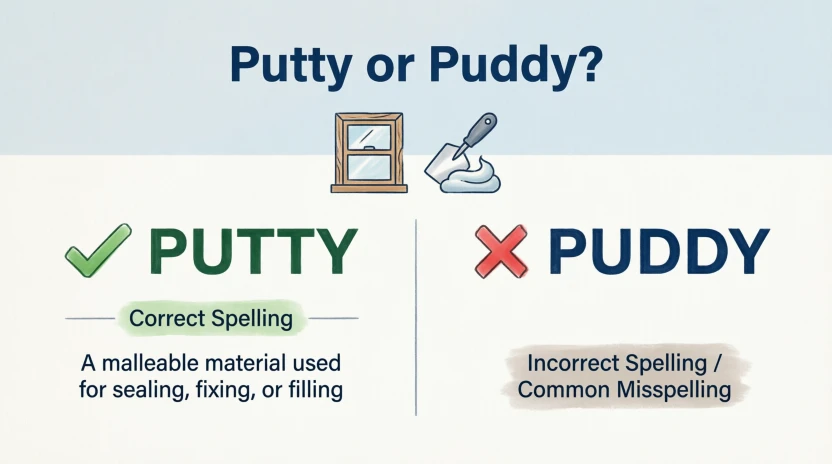
If you are unsure if to write putty or puddy, use putty when referring to the soft material used to fill holes, seal gaps, or secure glass in window frames. It is the standard spelling in both American and British English. Although puddy has a few rare uses, it is not an alternative spelling of this repair material.
This spelling confusion often happens because the two words look and sound similar. Someone might hear a builder mention putty, then write puddy because they are unsure which letters belong in the word. Others may encounter puddy in informal writing or as a name and wonder if it is correct English.
Knowing the difference can help you avoid spelling mistakes in emails, schoolwork, home improvement guides, and professional documents. It can also help you understand the word when you see it in a sentence.
In this guide, you will learn the meaning of putty, the rare meaning of puddy, their origins, and how to use the correct word in everyday writing.
Putty or Puddy: Quick Answer
Putty is the correct spelling when you mean a soft material used for filling, sealing, glazing, or repairing surfaces. Puddy is not a standard spelling of that material, although it can appear as a rare adjective or in names and other special contexts.
Examples:
- Correct: The carpenter used putty to fill the holes in the wood.
- Incorrect for the intended meaning: The carpenter used puddy to fill the holes in the wood.
- Correct: The worker applied putty around the window frame.
Remember that putty is the word you need for ordinary repair work.
What Does Putty or Puddy Mean?
The two spellings are not interchangeable. Understanding their meanings makes it easier to choose the right one.
What Does Putty Mean?
Putty is a soft, workable substance used to fill small holes, seal gaps, or hold glass in window frames. Some types are designed for woodwork, glazing, plumbing, or other repair tasks.
According to the putty is a material similar to clay that is used especially for securing glass in window frames and filling small holes in wood. Its exact composition and purpose depend on the product.
Common examples include:
- Wood putty: Used to fill small defects in wooden surfaces.
- Glazing putty: Used in certain window-glazing applications.
- Plumber’s putty: Used for specific sealing jobs in plumbing.
- Epoxy putty: A moldable repair material that hardens as it cures.
Example sentences:
- I bought putty to repair the damaged wooden door.
- The old window needs fresh glazing putty.
- Let the putty dry before sanding or painting, if the product instructions allow it.
Putty can also have a figurative meaning. In the expression putty in someone’s hands, it describes a person who is easily influenced or controlled.
For example:
He is putty in his daughter’s hands.
This means he is easily persuaded by his daughter.
What Does Puddy Mean?
Puddy is a much less common word. It is not the standard spelling for the repair material.
However, it would be inaccurate to claim that puddy can never be a real word. Some dictionaries record it as a rare adjective meaning pudgy or short and podgy. It may also appear as a name or nickname.
For example:
- The writer used Puddy as a character’s name.
- A dictionary entry may use puddy as a rare descriptive adjective.
These special uses do not make puddy correct when referring to window putty, wood putty, or another repair compound.
The key distinction: Use putty for the material. Use puddy only when a specific name or documented meaning calls for that spelling.
The Origin of Putty and Puddy
The history of putty helps explain why its spelling is established in modern English.
Where Does the Word Putty Come From?
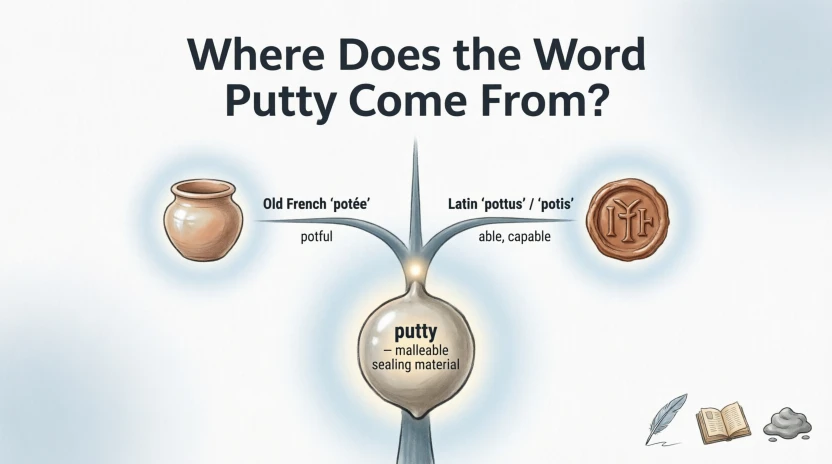
The word putty has a historical connection to the French word potée. The English word is recorded from the seventeenth century. Its early history is linked to a soft mixture used for practical purposes.
Over time, putty became an established term for materials used in glazing and filling. Today, it also appears in names for different repair products.
The word has developed several related uses:
- A substance used to fill holes or gaps.
- A material used in certain window-glazing jobs.
- A general term for similar moldable repair compounds.
- A figurative expression for someone who is easily influenced.
These meanings share the idea of something soft or easily shaped.
Why Is Puddy Sometimes Used Instead?
Puddy may appear because someone has guessed the spelling from pronunciation, made a typing mistake, or encountered the word in a separate context.
English spelling does not always match pronunciation in a simple way. This can cause confusion when people learn words by hearing them rather than reading them.
There is no standard American-versus-British spelling change from putty to puddy. The established spelling for the repair material remains putty in both varieties of English.
British English vs American English
British and American English use the same spelling for the material: putty. The main differences may involve pronunciation, product terminology, or the way a particular repair task is described.
| British English | American English | Example |
| Putty | Putty | Apply putty to the frame. |
| Wood filler | Wood filler or wood putty | Fill the small holes before painting. |
| Glazing putty | Glazing putty | The window needs new glazing putty. |
| Puddy, in rare contexts | Puddy, in rare contexts | The meaning depends on the specific context. |
Are There Regional Spelling Differences?
No standard regional spelling difference makes puddy the correct form of the repair material.
British and American speakers may pronounce the word slightly differently. However, the spelling remains putty.
Product names can vary between countries and manufacturers. For example, a product sold as wood filler may have a different name or formula from a product sold as wood putty. Always check the label and intended use.
What Do Style Guides Recommend?
For ordinary writing, use a reliable dictionary and follow the spelling used by your chosen style guide. Both British and American readers will recognize putty as the standard word for the material.
If you are writing technical instructions, use the precise product name. If you are writing about the rare adjective puddy, provide enough context for readers to understand it.
Which Version Should You Use?
The best choice depends on your meaning and audience. For the repair material, use putty in every major English-speaking region.
United States
Use putty in American English.
Example: The contractor used wood putty to fill the small holes.
United Kingdom
Use putty in British English.
Example: The decorator applied putty before finishing the woodwork.
Canada
Use putty in Canadian English. Follow the product label when discussing a particular repair material.
Example: We need putty to repair the window frame.
Australia
Use putty in Australian English as well.
Example: He bought putty for the home repair project.
International Writing
Choose putty when writing for a global audience. It is widely understood and avoids unnecessary confusion.
Academic Writing
Use putty when referring to the material, and consult a recognized dictionary if you are discussing puddy as a rare word. Do not label puddy a universal spelling variant.
Business Writing
Use putty in quotations, purchase requests, invoices, technical documents, and repair instructions when that is the intended material.
Example: Please order two containers of wood putty for the maintenance team.
The rule is simple: Your location does not change the standard spelling of putty.
Common Mistakes With Putty and Puddy
The most common mistake is writing puddy when the intended word is putty. Other errors happen when writers assume that every similar-looking word has the same meaning.
| Incorrect or Confusing Example | Correct Form | Explanation |
| I need puddy for the window. | I need putty for the window. | Putty is the repair material. |
| The carpenter applied puddy. | The carpenter applied putty. | Puddy is not the standard spelling here. |
| We ordered wall puddy. | We ordered wall putty. | Use the established product term. |
| Putty is spelled differently in Britain. | Putty is used in both regions. | There is no standard regional spelling change. |
| Puddy is never a word. | Puddy has rare, separate uses. | Its meaning depends on context. |
How Can You Remember the Correct Spelling?
Use this simple memory tip:
Putty has two T’s, just like the word it belongs in: putty.
When you mean the material used to fill, seal, or repair something, write putty.
You can also check the sentence by replacing the word with repair compound. If the sentence still makes sense, putty is probably the word you need.
For example:
The worker applied putty to the frame.
The sentence makes sense because putty is a material used for certain repair jobs.
Everyday Examples of Putty and Puddy
These examples show how the correct spelling works in different situations.
1. Emails
Correct: Please order more putty for the window repair.
Incorrect for the intended meaning: Please order more puddy for the window repair.
2. Business Writing
Correct: The maintenance team used putty to fill the small holes in the wooden panels.
In professional writing, use the established spelling and identify the product clearly.
3. News Headlines
Correct: Local Contractor Uses Putty to Repair Historic Windows
A headline should use the standard spelling when discussing the material.
4. Blogs
Correct: How to Choose the Right Wood Putty for Small Repairs
This title clearly identifies the subject and uses the correct term.
5. Social Media
Correct: I finally found the right putty to fix the small cracks in my wooden table.
Casual writing still benefits from correct spelling.
6. Academic Writing
Correct: The study examined the properties of a putty-like material used in repair applications.
The word putty-like describes a material with properties similar to putty.
7. Daily Conversation
Correct: Do we have any putty left in the garage?
This is a natural way to ask about the repair material.
8. Figurative Language
Correct: He is putty in her hands.
Here, putty is used figuratively to describe someone who is easily influenced.
9. A Name or Nickname
Correct in the right context: Puddy is the name of the character in the story.
A name may use this spelling, but that does not change the spelling of the repair material.
Google Trends and Modern Usage
People search for putty or puddy because the two spellings look similar and can sound alike in conversation. Some users want to check their spelling before publishing a blog post, writing an email, or buying a repair product.
Others may have seen puddy in a message, a character name, or an unfamiliar text and want to know if it is a real word.
Which Spelling Is More Common?
Putty is the established spelling for the repair material in standard English. It appears in dictionaries and in product terms related to glazing, woodwork, and repairs.
Puddy is much less common and has separate, limited uses.
This distinction reflects general dictionary and language usage. It should not be treated as a measured Google Trends ranking. Without verified, date-specific Trends data, it would be misleading to claim exact search volumes or percentages for either spelling.
Why Do People Search for This Keyword?
Common reasons include:
- Checking if putty or puddy is correct.
- Looking for the meaning of putty.
- Learning how to spell the word after hearing it.
- Checking if puddy is a real English word.
- Finding the correct term for a home repair product.
- Understanding the difference between British and American spelling.
What Should Modern Writers Do?
Use putty for the repair material. If you encounter puddy in a sentence, check if it is a name, a rare adjective, or simply a spelling error.
This approach gives readers an accurate answer without incorrectly treating every occurrence of puddy as meaningless.
Quick Comparison Table
| Version | Meaning | Correct? | Region | Example |
| Putty | A soft repair, filling, or sealing material | Yes | British, American, Canadian, Australian | We need putty for the window. |
| Puddy | A rare adjective with a meaning related to pudgy or podgy | In specific contexts | Limited usage | The word appears in a rare descriptive sense. |
| Puddy | An intended spelling of the repair material | No | Not standard in any major English variety | Use putty instead. |
| Putty | A person who is easily influenced, in a figurative expression | Yes | General English | He is putty in her hands. |
Key Takeaways
- Putty is the correct spelling for the soft material used in filling, sealing, and repair work.
- Puddy is not an alternative spelling of that material.
- Puddy can have rare, separate meanings and may also appear as a name.
- British and American English both use putty.
- Putty can be a noun or a verb.
- The expression “putty in someone’s hands” describes someone who is easily influenced.
- Use the exact product name in technical and business writing.
- When in doubt, check a trusted dictionary rather than relying on pronunciation.
FAQs About Putty or Puddy
1. Is it putty or puddy?
Putty is correct when you mean the soft material used for filling holes, sealing gaps, or securing glass in window frames. Puddy is not a standard alternative spelling of that material. However, it can appear as a rare adjective or in names and other special contexts.
2. Is puddy a real English word?
Yes, in limited contexts. Some dictionaries record puddy as a rare adjective related to pudgy or podgy. It may also be used as a name. However, if you mean the repair material used in glazing or woodworking, the correct spelling is putty.
3. Is putty the correct spelling in British English?
Yes. Putty is the standard spelling in British English, just as it is in American English. There is no standard British spelling rule that changes the material’s name to puddy. You should use putty in British emails, schoolwork, professional documents, and repair instructions.
4. Is putty the correct spelling in American English?
Yes. American English uses putty for the soft material used in repairs, filling, and glazing. Although pronunciation can vary, the written spelling stays the same. If you are describing a repair product, use the name printed on the product label when a more specific term is needed.
5. What does putty mean?
Putty is a soft, workable substance used to fill holes, seal certain gaps, or secure glass in window frames. Different products serve different purposes. The word also appears in the figurative phrase “putty in someone’s hands,” which describes a person who is easily influenced or persuaded.
6. What does puddy mean?
Puddy can be a rare adjective meaning pudgy or podgy. It may also appear as a name or nickname. Its meaning depends on context. It should not be used as a replacement for putty when referring to a material used for glazing, filling holes, or repairing surfaces.
7. Why do people confuse putty and puddy?
People may confuse the words because they look similar and can sound alike in speech. Someone who has heard the word but rarely seen it written may guess the spelling. Typing errors can also contribute. Checking the dictionary form is the simplest way to avoid the mistake.
8. Is putty a noun or a verb?
Putty can function as both a noun and a verb. As a noun, it refers to the material: “The putty has dried.” As a verb, it means to apply putty: “The worker puttied the frame.” The intended meaning and sentence structure determine how the word is used.
9. What does “putty in someone’s hands” mean?
The expression means that someone is easily influenced, persuaded, or controlled by another person. For example, “The puppy had him putty in her hands” suggests that he was easily won over by the puppy. This figurative expression uses the standard spelling putty.
10. How can I remember if to use putty or puddy?
Remember that putty, with two T’s, is the standard word for the repair material. Before writing puddy, ask yourself if you mean a name or a rare descriptive word. If you are talking about filling holes, glazing windows, or repairing surfaces, choose putty.
Conclusion: Putty or Puddy?
When deciding between putty or puddy, choose putty if you mean the soft material used for filling, sealing, glazing, or repairing surfaces. It is the standard spelling in British, American, Canadian, and Australian English.
Puddy has limited, separate uses. It may appear as a rare adjective or as a name, but it is not a regional spelling of putty. Understanding this distinction helps you avoid spelling errors without overlooking the fact that unusual words can have legitimate meanings.
For everyday writing, the rule is straightforward. Use putty in emails, blogs, schoolwork, professional documents, and home repair instructions whenever you mean the material. When discussing an unfamiliar use of puddy, check a reliable dictionary and consider the surrounding sentence.
Memorable takeaway: If you mean the repair material, putty is the right word. Check your spelling, share this guide with someone who needs it, and keep your writing clear.
Read more about!
- Delt or Dealt: Which Spelling Is Correct?
- Hybrid vs. Indica: What’s the Difference?
- Believes or Beliefs: Which Word Is Correct?

I’m Olivia Parker, a grammar and English writing enthusiast passionate about making English simple and easy to understand. Through Wordsblog, I share clear explanations, useful grammar tips, and practical writing guidance to help readers write with confidence. My goal is to make learning English easier, one word at a time.